For a home security camera system under $500, my best overall pick is the Rraycom 4-Camera PoE Security System for buyers who want a wired setup and centralized recording. The ELYSOO 2K Solar-Powered Kit stands out for outdoor coverage without running power cables, while the Hiseeu 5MP Wireless System suits shoppers who want a multi-camera kit with local hard-drive storage. The main tradeoff is between the reliability and installation effort of wired systems, the placement flexibility of wireless cameras, and the upkeep solar-powered models may need. I compare all 15 options by their recording setup, coverage, power needs, and ease of use. Continue reading for the full breakdown and guidance on choosing a system that fits your home.

Get privacy and security gear delivered free with Prime
- Fast, free delivery on millions of items
- Prime Video, Amazon Music and more included
- Member-only deals all year
Key Takeaways
Wired recording and easy placement are different priorities: Rraycom’s PoE system suits buyers willing to run cables, while solar and wireless kits reduce installation constraints.
Local storage appears across several kit styles: options such as Hiseeu, ZOSI, and the 500GB solar system can appeal to buyers who want recordings kept on a local recorder rather than relying only on a camera.
Solar convenience depends on camera location: ELYSOO, KCSNYOPRO, and other solar kits avoid routine power wiring, but shaded or high-traffic locations may make charging and upkeep less predictable.
Resolution is only one part of coverage: the 5MP Jennov and Hiseeu kits prioritize image detail, while dual-lens PTZ and pan-tilt models offer a different benefit: adjustable or broader views.
Some kits trade system coverage for simplicity: compact two-camera sets from VIMTAG and Arlo may suit smaller spaces, but they are not direct substitutes for four-camera NVR kits covering several sides of a home.
| Rraycom 4-Camera PoE Security System with 3MP Cameras and 4K NVR |  | Best for Reliable Wired Recording | Camera count: 4 | Camera resolution: 3MP (1440p) | NVR channels: 4 | VIEW ON AMAZON | See Our Full Breakdown |
| Jennov 5MP WiFi Security Camera System with Monitor and 4 Cameras |  | Best for Adding Cameras Later | Included cameras: 4 | Camera resolution: 5MP | NVR channels: 10 | VIEW ON AMAZON | See Our Full Breakdown |
| ELYSOO 2K/4MP Solar-Powered Outdoor Security Camera System, 4-Camera Kit |  | Best for Wire-Free Camera Placement | Camera count: 4 | Video resolution: 2K/4MP | Connectivity: 2.4GHz and 5GHz Wi-Fi | VIEW ON AMAZON | See Our Full Breakdown |
| AIWIXEN 4-Channel Wired Security Camera System with 512GB HDD |  | Best for Straightforward Local Surveillance | Channels: 4 | Camera resolution: 1080p | Storage capacity: 512GB | VIEW ON AMAZON | See Our Full Breakdown |
| Camcamp 4-Camera Wireless Outdoor Security System with Dual-Lens PTZ Cameras |  | Best for Expandable Pan-Tilt Coverage | Camera count: 4 | Camera type: Dual-lens PTZ | NVR channels: 10 | VIEW ON AMAZON | See Our Full Breakdown |
| KCSNYOPRO 4-Camera Solar Outdoor Security Camera System with 500GB Storage |  | Best for Offline Local Recording | Included cameras: 4 | Video resolution: 4MP (2.5K QHD) | Local storage: 500GB HDD | VIEW ON AMAZON | See Our Full Breakdown |
| Solar Wireless Outdoor Security Camera System with 500GB Local Storage, 4MP Video, Color Night Vision, and Two-Way Audio |  | Best for Two-Way Communication | Included cameras: 4 | Video resolution: 4MP | Local storage: 500GB hard drive; supports up to 128GB TF card (not included) | VIEW ON AMAZON | See Our Full Breakdown |
| CAMCAMP Wireless Outdoor Security Camera System with 16-Channel NVR |  | Best for Expandable NVR Capacity | Video resolution: 1080P (2MP) | NVR channels: 16 | Maximum supported cameras: 8 | VIEW ON AMAZON | See Our Full Breakdown |
| 4MP Wireless Solar Outdoor Security Camera System, 4-Camera Kit |  | Best for Encrypted Local Storage | Included cameras: 4 | Video resolution: 4MP | Local storage: 128GB encrypted storage in hub | VIEW ON AMAZON | See Our Full Breakdown |
| VORGUT Wireless Security Camera System with 10-Inch Monitor and Two 3MP Pan-Tilt Cameras |  | Best for a Ready-to-View Monitor Setup | Included cameras: 2 | Camera resolution: 3MP | Monitor: 10 inches | VIEW ON AMAZON | See Our Full Breakdown |
| Hiseeu 5MP Wireless Security Camera System with 500GB HDD |  | Best for Expandable Local Recording | Camera resolution: 5MP (2560 × 1920) | Included cameras: 4 | NVR channels: 10 | VIEW ON AMAZON | See Our Full Breakdown |
| ZOSI 8-Channel Home Security Camera System with Audio, Four 1080p Cameras and 500GB HDD |  | Best for Wired Detection and Night Coverage | Included cameras: 4 | Video resolution: 1080p | DVR channels: 8 | VIEW ON AMAZON | See Our Full Breakdown |
| GMK 4-Pack 2K Wireless Outdoor Security Camera System | 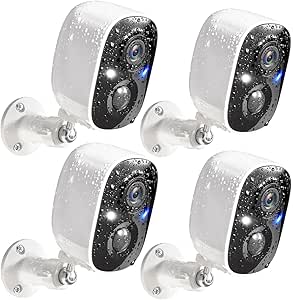 | Best Battery-Powered Four-Camera Kit | Camera quantity: 4 | Video resolution: 2K, 3MP | Power: Rechargeable battery | VIEW ON AMAZON | See Our Full Breakdown |
| VIMTAG 2.5K Indoor/Outdoor Security Cameras, 2-Pack |  | Best Compact Two-Camera System | Pack size: 2 cameras | Resolution: 2.5K QHD; 4MP | Night-vision range: 33 feet | VIEW ON AMAZON | See Our Full Breakdown |
| Arlo Essential Wireless Security Camera 2K (3rd Gen), 2-Camera Set |  | Best for Smart-Home Integration | Included cameras: 2 | Video resolution: 2K | Field of view: 130° | VIEW ON AMAZON | See Our Full Breakdown |
| home security camera system under 500 | Weather resistance | Included cameras | Video resolution |
|---|---|---|---|
| Rraycom 4-Camera PoE Security | — | — | — |
| Jennov 5MP WiFi Security Camer | IP66 | 4 | — |
| ELYSOO 2K/4MP Solar-Powered Ou | IP65 | — | 2K/4MP |
| AIWIXEN 4-Channel Wired Securi | — | — | — |
| Camcamp 4-Camera Wireless Outd | — | — | — |
| KCSNYOPRO 4-Camera Solar Outdo | IP65 | 4 | 4MP (2.5K QHD) |
| Solar Wireless Outdoor Securit | — | 4 | 4MP |
| CAMCAMP Wireless Outdoor Secur | IP66 | — | 1080P (2MP) |
| 4MP Wireless Solar Outdoor Sec | IP66 | 4 | 4MP |
| VORGUT Wireless Security Camer | IP66 | 2 | — |
| Hiseeu 5MP Wireless Security C | IP66 | 4 | — |
| ZOSI 8-Channel Home Security C | IP66 | 4 | 1080p |
| GMK 4-Pack 2K Wireless Outdoor | IP65 | — | 2K, 3MP |
| VIMTAG 2.5K Indoor/Outdoor Sec | IP66 | — | — |
| Arlo Essential Wireless Securi | — | 2 | 2K |
More Details on Our Top Picks
Rraycom 4-Camera PoE Security System with 3MP Cameras and 4K NVR
For buyers who want continuous local recording and can run cables, the Rraycom is a straightforward four-camera setup with a useful mix of deterrence and monitoring features. Its PoE connection carries power and video over wired runs, so it avoids the outlet requirements of Jennov’s Wi-Fi cameras. The four 3MP cameras record to a 500GB drive, with no required monthly storage subscription. Night vision rated up to 100 feet and a 130-degree viewing angle suit broad outdoor coverage, while the spotlight, siren, and two-way audio add ways to respond to activity.
The tradeoff is installation: cable routing can take more effort than setting up ELYSOO’s solar cameras. Storage is also fixed at the included 500GB in the listed specs, and the system is limited to four NVR channels. I’d choose it for dependable wired coverage, not for a quick, wire-free setup or room to add cameras.
Pros:- Four cameras and a 500GB NVR support continuous local recording
- PoE wiring avoids needing a separate power outlet at each camera
- Night vision reaches up to 100 feet, with a 130-degree viewing angle
- Two-way audio, spotlight, siren, and customizable motion zones add response options
Cons:- Wired installation may require routing cables through or around the home
- The listed system includes only 500GB of storage
- The four-channel NVR leaves no listed capacity for additional cameras
Best for: Homeowners who can route PoE cables and want four outdoor views with continuous local recording and no required cloud subscription.
Not ideal for: Renters or buyers who cannot run camera cables, and anyone who wants a system with more than four NVR channels.
- Camera count:4
- Camera resolution:3MP (1440p)
- NVR channels:4
- Included storage:500GB
- Connectivity:Wired PoE
- Night vision range:Up to 100 feet
- Viewing angle:130 degrees
- Recording:24/7
- Audio:Two-way audio; built-in microphone
Our verdict“Choose the Rraycom if you want wired, continuous recording and can handle cable installation; choose ELYSOO instead if avoiding camera wiring matters more.”
Jennov 5MP WiFi Security Camera System with Monitor and 4 Cameras
Jennov’s main advantage over the four-channel Rraycom and AIWIXEN systems is expansion capacity: its NVR has 10 channels, while the kit starts with four 5MP cameras. That leaves space for additional compatible cameras without replacing the recorder. A monitor, 500GB local drive, remote app viewing, and color night vision also make this a more ready-to-use package than a system that depends on a separate display purchase.
Despite wireless video transmission to the NVR, the cameras still need nearby outlet power, so this is not a battery- or solar-powered installation like ELYSOO. The fixed 80-degree lenses also offer narrower framing than Rraycom’s stated 130-degree view, and the listed frame rate is 15 fps. I’d favor Jennov when future camera capacity matters more than flexible placement or wider coverage from each camera.
Pros:- 10-channel NVR provides room beyond the four included cameras
- Includes a monitor and 500GB local storage
- 5MP cameras provide higher stated resolution than the Rraycom and AIWIXEN kits
- Color night vision, motion alerts, and remote app viewing are included
Cons:- Each camera needs access to an electrical outlet
- Fixed 80-degree lenses limit framing flexibility and per-camera coverage
- Listed frame rate is 15 fps
Best for: Homeowners who want a monitor and local recording now, with the option to add compatible cameras to a 10-channel NVR later.
Not ideal for: Buyers who need cameras far from power outlets, want pan-and-tilt coverage, or prefer a wide fixed viewing angle.
- Included cameras:4
- Camera resolution:5MP
- NVR channels:10
- Storage:500GB
- Camera power:Corded electric
- Video connection:Wireless transmission between cameras and NVR
- Night vision range:20 meters
- Viewing angle:80 degrees
- Weather resistance:IP66
Our verdict“Pick Jennov if you want an included monitor and room to expand, but choose ELYSOO for solar-powered placement away from outlets.”
ELYSOO 2K/4MP Solar-Powered Outdoor Security Camera System, 4-Camera Kit
ELYSOO is the clearest choice here for buyers who cannot or do not want to run power cables to outdoor cameras. Its solar-powered rechargeable design pairs with dual-band Wi-Fi, while the included 64GB memory card supports local loop recording without a monthly storage fee. Compared with Jennov, which sends video wirelessly but still needs an outlet at every camera, ELYSOO offers more flexible placement. Its 350-degree pan and 90-degree tilt can also cover a larger area from each mounting point than the fixed lenses on Jennov or AIWIXEN.
That flexibility depends on conditions: the system needs about two hours of sunlight daily for reliable solar operation, and the included storage is smaller than the 500GB drives in Rraycom and Camcamp. Optional cloud storage and AI analysis may add ongoing costs. I’d choose ELYSOO for sunny locations and adaptable views, not for dependable solar charging in shaded areas or a large local archive.
Pros:- Solar power reduces the need to run cables or recharge cameras frequently
- 64GB memory card supports local loop recording without a required monthly fee
- 350-degree pan and 90-degree tilt adjust coverage from each camera
- Dual-band Wi-Fi, color night vision, and PIR human detection are included
Cons:- Reliable solar operation depends on receiving about two hours of sunlight daily
- Included 64GB storage is less than the 500GB drives in Rraycom and Camcamp
- Cloud storage and AI analysis are optional services
Best for: Owners of sunny homes who want four outdoor cameras without running power cables and are comfortable managing local memory-card storage.
Not ideal for: Buyers with shaded mounting locations, a need for a large built-in recording drive, or a preference for a wired NVR system.
- Camera count:4
- Video resolution:2K/4MP
- Connectivity:2.4GHz and 5GHz Wi-Fi
- Included storage:64GB memory card; supports up to 256GB
- Power:Solar-powered rechargeable battery
- Weather resistance:IP65
- Pan and tilt:350-degree pan; 90-degree tilt
- Detection:PIR human detection
- Night vision:Color
Our verdict“Choose ELYSOO for flexible solar-powered placement in sunny areas, but favor Rraycom or Camcamp if you want a larger included recording drive.”
AIWIXEN 4-Channel Wired Security Camera System with 512GB HDD
AIWIXEN keeps the setup focused on wired local recording: four 1080p cameras, a 512GB hard drive, and motion settings that can flag human or vehicle activity. Compared with Rraycom, it offers slightly more included storage but lower camera resolution and a narrower 82-degree viewing angle. Its IP68-rated cameras and stated 100-foot night vision make it a practical fit for outdoor monitoring where weather protection and long-range night coverage matter more than fine image detail.
The system records by event or schedule, rather than listing continuous recording as a mode, so buyers should check that this suits their coverage plan. Remote app access also requires a router connected to the internet; the wired cameras themselves do not remove that dependency. Fixed lenses and a four-channel limit make it less adaptable than Jennov’s 10-channel system. I’d pick AIWIXEN for simple, local-focused coverage, not for expansion or adjustable camera views.
Pros:- 512GB hard drive supports local recording without a required monthly storage subscription
- IP68-rated cameras are designed for outdoor use
- Night vision is specified up to 100 feet
- Customizable motion detection includes human and vehicle alerts
Cons:- 1080p resolution is lower than the 3MP Rraycom and 5MP Jennov cameras
- Fixed lenses and an 82-degree viewing angle limit framing flexibility
- Remote app access requires an internet-connected router
Best for: Homeowners seeking a wired four-camera system with local storage, weather-resistant cameras, and human or vehicle motion alerts.
Not ideal for: Buyers who want higher-resolution video, adjustable camera framing, more than four channels, or app access without an internet-connected router.
- Channels:4
- Camera resolution:1080p
- Storage capacity:512GB
- Connectivity:Wired
- Night vision range:Up to 100 feet
- Viewing angle:82 degrees
- Frame rate:12.5 fps
- Recording modes:Event and schedule
- Camera cable length:60 feet per cable
Our verdict“Choose AIWIXEN for weather-rated wired cameras and local storage, but pick Rraycom for higher resolution and a wider stated viewing angle.”
Camcamp 4-Camera Wireless Outdoor Security System with Dual-Lens PTZ Cameras
Camcamp suits buyers who want more adjustable coverage than a conventional fixed-camera kit. Each of its four cameras combines dual-lens views with pan-and-tilt movement, auto tracking, and a 10-channel NVR. That gives it more room to expand than Rraycom’s four-channel recorder, while its 500GB hard drive supports continuous recording without a required subscription. Three night-vision modes let buyers choose between infrared, color, and automatic switching, and the NVR can expand to 6TB according to the listed specs.
Its cameras transmit over 2.4GHz or 5GHz Wi-Fi, but they still need plug-in power; this is less placement-flexible than solar ELYSOO. Night vision is rated to 65 feet, shorter than the 100 feet listed for Rraycom and AIWIXEN. I’d choose Camcamp for camera movement, tracking, and storage growth, while buyers who value long-range night vision or wire-free power should look elsewhere.
Pros:- Dual-lens PTZ cameras add movable views and auto tracking
- 10-channel NVR leaves capacity beyond the four included cameras
- 500GB hard drive supports continuous recording without a required subscription
- NVR storage is expandable up to 6TB, with microSD recording also supported
Cons:- Cameras require plug-in power despite wireless video transmission
- Night vision range is 65 feet, shorter than the 100 feet listed for Rraycom and AIWIXEN
- Wi-Fi connectivity may be less suitable than PoE for locations with weak wireless coverage
Best for: Homeowners who want pan-tilt tracking, multiple night-vision modes, and a recorder that can grow beyond four cameras.
Not ideal for: Buyers who need battery or solar cameras, longer stated night-vision range, or a simple system without plug-in camera power.
- Camera count:4
- Camera type:Dual-lens PTZ
- NVR channels:10
- Included storage:500GB HDD
- Maximum expandable storage:6TB
- Pan and tilt:355-degree pan; 90-degree tilt
- Night vision:Infrared, full-color, and smart auto-switching
- Night vision range:65 feet
- Connectivity and power:2.4GHz/5GHz Wi-Fi; corded electric
Our verdict“Choose Camcamp if adjustable tracking and expandable recording matter most, but select ELYSOO for solar-powered camera placement without outlet access.”
KCSNYOPRO 4-Camera Solar Outdoor Security Camera System with 500GB Storage
The KCSNYOPRO suits buyers who want a four-camera solar setup that can keep recording locally when internet service drops. Its 500GB base-station drive and offline recording give it an advantage over the 4MP Solar Outdoor Security Camera System, which lists local storage but depends on Wi-Fi for connectivity. Each camera also adds 360° pan-and-tilt coverage, 4MP color night vision, and spotlight-and-siren deterrents, making it a stronger fit for watching larger outdoor areas than a fixed-view camera kit.
The tradeoff is a less self-contained control setup: the base station requires a compatible monitor and wired USB mouse, while alerts are limited to motion-triggered notifications. I’d choose it for local-recording resilience, not for the simplest app-first experience or the most flexible alert settings.
Pros:- Four solar-powered cameras are included with the base station.
- 500GB local recording can continue without internet access.
- 4MP color night vision and 360° pan-and-tilt coverage help monitor broad outdoor areas.
- Motion alerts can activate a spotlight and siren.
Cons:- Base-station control requires a compatible monitor and wired USB mouse.
- Motion-only alerts offer fewer notification options.
- Solar charging performance depends on the cameras receiving adequate sunlight.
Best for: Homeowners seeking four solar-powered cameras and local recording that can continue during internet outages.
Not ideal for: Buyers who want to control every feature from an app without connecting a monitor and wired USB mouse, or who need varied alert types.
- Included cameras:4
- Video resolution:4MP (2.5K QHD)
- Local storage:500GB HDD
- Power:Solar
- Camera coverage:360° pan and tilt
- Wi-Fi:2.4GHz and 5GHz dual-band Wi-Fi 6
- Night vision range:98.4 feet
- Weather resistance:IP65
- Maximum supported cameras:10
Our verdict“Choose the KCSNYOPRO if offline local recording and four solar pan-and-tilt cameras matter more than streamlined, app-only control.”
Solar Wireless Outdoor Security Camera System with 500GB Local Storage, 4MP Video, Color Night Vision, and Two-Way Audio
This four-camera solar system is the communication-focused alternative in this group. Its two-way audio lets owners speak through the cameras, while AI human detection can help distinguish people from less relevant motion. Compared with the KCSNYOPRO system, it gives up offline recording as a stated strength but adds app-based remote viewing and conversation; that makes it a better match for checking on a delivery or addressing someone at the door.
The 500GB hard drive provides local storage, and the system can expand to ten cameras. Its 355° rotation and 90° tilt cover wide areas, though that is not quite the KCSNYOPRO’s stated 360° pan coverage. Color night vision reaches up to 65 feet. Some AI features require a premium plan, and the optional TF card is not included, so buyers should check which detection functions are available without a subscription.
Pros:- Four solar-powered cameras combine 8000mAh batteries with 4W solar panels.
- 500GB hard drive provides local recording.
- Two-way audio supports speaking through the cameras.
- AI human detection, remote viewing, and motion-triggered light and sound alarms are included.
Cons:- Some AI detection features require a premium plan.
- The TF card is not included.
- Its stated color night-vision range is shorter than the KCSNYOPRO system’s.
Best for: Households that want solar-powered outdoor cameras with two-way audio, app viewing, and local recording.
Not ideal for: Buyers who need every AI detection feature without a paid plan or want recording explicitly supported during internet outages.
- Included cameras:4
- Video resolution:4MP
- Local storage:500GB hard drive; supports up to 128GB TF card (not included)
- Camera expansion:Up to 10 cameras
- Pan and tilt:355° horizontal rotation; 90° vertical tilt
- Night vision range:Up to 65 feet
- Detection:AI human detection; adjustable 16–29 ft range
- Audio:Two-way audio
- Power:4W solar panel and 8000mAh battery
Our verdict“Pick this system if two-way audio and app-based access are priorities and you’re comfortable checking which AI features require a plan.”
CAMCAMP Wireless Outdoor Security Camera System with 16-Channel NVR
The CAMCAMP is the expansion-minded choice here: its 16-channel NVR supports up to eight cameras, giving a growing setup more room than the four-camera solar kits in this batch. It includes a 500GB hard drive and H.265+ compression for local recording, plus 24/7 recording and AI human tracking. That makes it a more traditional NVR option than the solar-powered systems, which are better suited to wire-free placement.
The main compromise is image detail. This system is listed at 1080P (2MP), below the 4MP KCSNYOPRO and solar system above, so it may reveal less detail when identifying distant activity. Pan-and-tilt movement, color night vision with motion-activated spotlights, and two-way audio help offset that limitation for general monitoring. Choose it for channel capacity and continuous recording rather than resolution leadership.
Pros:- 16-channel NVR provides room to expand beyond the included cameras.
- 500GB hard drive and H.265+ compression support local recording.
- AI human detection and tracking work with pan-and-tilt cameras.
- IP66 weather resistance and a stated operating range of -4°F to 122°F suit outdoor installation.
Cons:- 1080P (2MP) resolution is lower than the 4MP systems in this batch.
- The included hard drive provides 500GB of storage.
- The listed setup does not include solar power.
Best for: Homeowners planning to add cameras over time who want an NVR with continuous local recording and AI tracking.
Not ideal for: Buyers who prioritize higher-resolution footage or need solar-powered cameras for locations without convenient power.
- Video resolution:1080P (2MP)
- NVR channels:16
- Maximum supported cameras:8
- Included storage:500GB hard drive
- Recording:24/7 recording with AI human detection and tracking
- Camera movement:355° pan and 90° tilt
- Weather resistance:IP66
- Wireless bands:2.4GHz and 5GHz
- Smart assistant compatibility:Alexa
Our verdict“Choose the CAMCAMP if expanding an NVR-based system matters more than matching the sharper footage of the 4MP alternatives.”
4MP Wireless Solar Outdoor Security Camera System, 4-Camera Kit
This four-camera kit focuses on a simple promise: solar-powered coverage with encrypted local storage and no required subscription fees for that storage. Its hub has 128GB, a smaller capacity than the 500GB drives in the KCSNYOPRO and two other systems in this batch. In return, the setup pairs solar panels and 8000mAh batteries with four 4MP cameras, making it a compact-storage option for buyers who want wire-free placement rather than a larger hard-drive base.
AI human detection, auto-tracking, color night vision up to 65 feet, and Alexa compatibility round out the feature set. The auto-tracking is off by default and must be enabled in the app, a setup detail that could be missed. It also requires Wi-Fi, unlike the KCSNYOPRO’s stated ability to keep recording locally without internet. I’d favor this model for encrypted hub storage, not outage resilience.
Pros:- Four solar-powered cameras include 8000mAh batteries and 5W panels.
- Hub provides 128GB of encrypted local storage.
- 4MP video, color night vision, and AI human detection support detailed outdoor monitoring.
- Built-in microphone and speaker provide two-way audio.
Cons:- Auto-tracking must be enabled manually in the app.
- 128GB hub storage is less than the 500GB drives included with several alternatives.
- Wi-Fi connectivity is required.
Best for: Buyers who want four solar-powered cameras, encrypted hub storage, and Alexa compatibility without a storage subscription.
Not ideal for: Households with unreliable Wi-Fi or buyers who need more local capacity than the included 128GB hub offers.
- Included cameras:4
- Video resolution:4MP
- Local storage:128GB encrypted storage in hub
- Power:Solar; 5W panel and 8000mAh battery
- Night vision:Full color, up to 65 feet
- Camera coverage:355° pan and tilt
- Detection:AI human detection with auto-tracking
- Connectivity:2.4GHz and 5GHz Wi-Fi
- Weather resistance:IP66
Our verdict“Pick this kit for encrypted local storage and solar-powered cameras if its 128GB capacity and Wi-Fi requirement fit your setup.”
VORGUT Wireless Security Camera System with 10-Inch Monitor and Two 3MP Pan-Tilt Cameras
VORGUT stands apart from the solar four-camera kits by including a 10-inch monitor alongside its NVR, two cameras, and 500GB drive. That bundled screen makes it a practical choice for someone who wants a dedicated viewing station without sourcing a separate display. It also supports 24/7 recording, event and scheduled modes, and human detection alerts that can activate a spotlight and siren.
The tradeoff is coverage per kit: there are only two 3MP cameras, compared with four 4MP cameras in the KCSNYOPRO and other solar options. Its cameras need corded electric power, so placement is less flexible than solar models, even though wireless connectivity avoids a camera data cable. The 10-channel NVR leaves expansion room, but buyers should weigh the included monitor and continuous recording against the smaller starting camera count.
Pros:- Includes a 10-inch monitor for direct system viewing.
- 500GB hard drive supports local recording.
- Offers 24/7, event, and scheduled recording modes.
- Human detection can trigger phone alerts, a spotlight, and a siren.
Cons:- Only two cameras are included, fewer than the four-camera kits in this batch.
- Corded electric power limits camera placement compared with solar models.
- 3MP resolution is lower than the 4MP options listed here.
Best for: Homeowners who want a dedicated screen and local continuous recording for a compact two-camera indoor or outdoor setup.
Not ideal for: Buyers who need four-camera coverage immediately or want solar-powered cameras for locations without nearby power.
- Included cameras:2
- Camera resolution:3MP
- Monitor:10 inches
- NVR channels:10
- Local storage:500GB hard drive
- Recording modes:24/7, event, and scheduled
- Pan and tilt:350° pan and 90° tilt
- Weather resistance:IP66
- Power source:Corded electric
Our verdict“Choose VORGUT if a bundled monitor and continuous local recording matter more than getting four solar-powered cameras in the box.”
Hiseeu 5MP Wireless Security Camera System with 500GB HDD
For a buyer who wants a recorder-based setup under $500, the Hiseeu’s included 500GB drive and support for both continuous and event recording make it a stronger fit than camera kits that rely mainly on cloud storage. Its four 5MP cameras capture more detail than the 1080p ZOSI system, while the 10-channel NVR leaves room to add cameras later. Wireless video connections can simplify placement compared with ZOSI’s BNC cables, but they do not make installation wire-free: each Hiseeu camera still needs corded power. Color night vision, motion alerts, and two-way audio round out a useful property-monitoring setup. The listed 65-foot night-vision range is shorter than ZOSI’s 80 feet, so I’d favor Hiseeu for resolution and expansion rather than the longest stated nighttime reach.
Pros:- Four 5MP cameras provide more image detail than the ZOSI kit’s 1080p cameras.
- Preinstalled 500GB hard drive supports local event and 24/7 recording.
- 10-channel NVR allows expansion beyond the four included cameras.
- Color night vision, motion alerts, and two-way audio add useful monitoring and response options.
Cons:- Cameras need corded power, limiting placement even though their video connection is wireless.
- Listed night-vision range is 65 feet, shorter than the ZOSI system’s 80-foot specification.
- A one-year warranty offers a limited coverage window.
Best for: Homeowners who want four higher-resolution cameras, local recording without relying on a cloud plan, and room to expand their system.
Not ideal for: Renters or anyone who needs truly wire-free camera placement, since the cameras require corded power; skip it if long listed night-vision reach is your main priority.
- Camera resolution:5MP (2560 × 1920)
- Included cameras:4
- NVR channels:10
- Expandable NVR resolution:Up to 8MP
- Storage:500GB hard drive
- Recording modes:Event and 24/7
- Night-vision range:65 feet
- Weather resistance:IP66
- Audio:Two-way audio
Our verdict“Choose Hiseeu if you want 5MP local recording and future camera expansion, and can provide power at each camera location.”
ZOSI 8-Channel Home Security Camera System with Audio, Four 1080p Cameras and 500GB HDD
The ZOSI suits buyers who prefer a fixed wired setup with local recording and detection that can distinguish people and vehicles. Its included 500GB HDD supports continuous recording, and the stated 80-foot night-vision range exceeds the Hiseeu system’s 65 feet. The tradeoff is the BNC connection: cable runs constrain camera placement more than the wireless video link on Hiseeu, and the cameras still need corded power. ZOSI also records audio, but it offers listen-in only, not two-way talk, so it cannot match Hiseeu’s ability to speak through the camera. Four 1080p cameras cover the basics, though buyers seeking more image detail should look at Hiseeu’s 5MP kit. This is the more compelling choice for a planned, cable-friendly installation rather than flexible placement.
Pros:- AI human and vehicle detection can make motion alerts more selective.
- Included 500GB HDD supports local continuous recording without a cloud storage plan.
- 80-foot stated night-vision range is longer than Hiseeu’s 65-foot specification.
- IP66 cameras are specified for indoor or outdoor use.
Cons:- Wired BNC connections restrict camera placement and require cable routing.
- Audio is listen-in only; there is no two-way talk.
- 1080p resolution provides less detail than Hiseeu’s 5MP cameras.
Best for: Homeowners planning a permanent wired installation who want local continuous recording, human and vehicle detection, and extended stated night vision.
Not ideal for: Renters or buyers who cannot run BNC cables, and anyone who wants camera-to-viewer two-way conversation.
- Included cameras:4
- Video resolution:1080p
- DVR channels:8
- Storage:500GB HDD
- Connectivity:Wired BNC
- Night-vision range:80 feet
- Viewing angle:90 degrees
- Weather resistance:IP66
- Recording modes:Manual and scheduled
Our verdict“Pick ZOSI for a cable-ready property where local recording, detection, and longer stated night vision matter more than flexible placement or two-way talk.”
GMK 4-Pack 2K Wireless Outdoor Security Camera System
GMK is the standout here for buyers who want four cameras without running power cables. Its rechargeable design makes placement more flexible than Hiseeu or ZOSI, whose cameras require corded power, and its 2K video, color and infrared night vision, and two-way audio cover the core needs of outdoor monitoring. The package also includes a siren and flashing lights, giving it a more direct deterrent feature than the recording-focused ZOSI. That convenience comes with upkeep: batteries need recharging, which takes a listed six to eight hours, and the advertised standby span varies from one to six months. GMK supports memory-card storage, while optional cloud storage and advanced AI features may require a subscription after the seven-day trial. It also works on 2.4GHz Wi-Fi only, which may rule it out for buyers relying on 5GHz coverage.
Pros:- Four rechargeable cameras avoid the power cabling required by Hiseeu and ZOSI.
- 2K video with color and infrared night vision supports day and night monitoring.
- Two-way talk, a siren, and flashing lights provide ways to respond to activity.
- Local memory-card storage is supported, with optional cloud storage also available.
Cons:- Supports 2.4GHz Wi-Fi only, not 5GHz.
- Battery charging takes six to eight hours, and the stated standby span varies widely.
- Cloud storage and advanced AI features may require a subscription after the seven-day trial.
Best for: Homeowners who need four outdoor camera positions but cannot run power cables, and who are willing to recharge batteries and use 2.4GHz Wi-Fi.
Not ideal for: Buyers who want continuous recorder-based footage, use only 5GHz Wi-Fi, or want advanced AI and cloud storage without a potential subscription.
- Camera quantity:4
- Video resolution:2K, 3MP
- Power:Rechargeable battery
- Battery standby time:1–6 months
- Night vision:Color and infrared
- Motion detection:PIR with AI cloud analysis
- Wi-Fi:2.4GHz only; does not support 5GHz
- Storage:Memory card or optional cloud service
- Weather resistance:IP65
Our verdict“Choose GMK for flexible battery-powered coverage across four outdoor locations if 2.4GHz Wi-Fi and periodic recharging work for your setup.”
VIMTAG 2.5K Indoor/Outdoor Security Cameras, 2-Pack
VIMTAG is the compact pick for buyers who need a pair of cameras rather than a four-camera property kit. Its 2.5K resolution, human, motion, and sound detection, plus two-way audio make it more feature-rich per camera than the ZOSI 1080p system, but it covers fewer locations and lacks an included recorder and drive. The cameras connect over 2.4GHz or 5GHz Wi-Fi, giving them a network flexibility GMK’s 2.4GHz-only cameras do not offer. Local recording is possible with a microSD card, but the card is sold separately; cloud recording requires a subscription. VIMTAG’s corded power also means it cannot match GMK’s battery-powered placement. For a small home, entry points, or a mixed indoor-and-outdoor setup, two compact cameras may be sufficient; buyers seeking broad perimeter coverage should compare it with the four-camera kits.
Pros:- 2.5K video and human, motion, and sound detection provide detailed, varied alerts.
- Dual-band Wi-Fi supports both 2.4GHz and 5GHz networks, unlike GMK’s 2.4GHz-only setup.
- IP66 rating and multiple mounting options suit indoor or outdoor placement.
- Supports local microSD storage as well as cloud recording.
Cons:- Only two cameras are included, fewer than the four-camera Hiseeu, ZOSI, and GMK kits.
- MicroSD card is sold separately, and cloud recording requires a subscription.
- Corded power limits placement compared with GMK’s rechargeable cameras.
Best for: Apartment residents or homeowners who need two compact cameras for a few entry points and want dual-band Wi-Fi with local-storage capability.
Not ideal for: Buyers seeking four-camera coverage, battery-powered installation, or included local storage hardware.
- Pack size:2 cameras
- Resolution:2.5K QHD; 4MP
- Night-vision range:33 feet
- Weather resistance:IP66
- Wi-Fi:2.4GHz and 5GHz
- Detection:Human, motion, and sound
- Storage:Cloud subscription or microSD card, sold separately
- Power:Corded electric, 5 V, 5 W
- Dimensions:2.28 × 1.85 × 2.8 inches
Our verdict“Choose VIMTAG if two dual-band, detection-rich cameras meet your coverage needs and you can provide power and separate storage.”
Arlo Essential Wireless Security Camera 2K (3rd Gen), 2-Camera Set
Arlo makes the most sense for buyers who want battery-powered cameras that fit into a broader smart-home setup. Its 2K video, wide 130° field of view, color night vision, two-way audio, and siren give each camera a useful mix of monitoring and response features. Compared with the two-camera VIMTAG, Arlo lists broader smart-home compatibility, including Apple Home, Alexa, Google Home, Samsung SmartThings, and IFTTT; VIMTAG instead offers IP66 weather resistance and dual-band Wi-Fi. Arlo’s rechargeable batteries allow more flexible placement than either corded system, but they need periodic charging. Buyers should also weigh the plan terms: some advanced features require a paid Arlo Secure plan after the included one-month trial. As a two-camera set, it is less suited to broad perimeter coverage than the four-camera Hiseeu or GMK kits.
Pros:- 130° field of view covers a wider area per camera than the listed 78° Hiseeu viewing angle.
- Rechargeable wireless design allows flexible placement without camera power cables.
- Color night vision, two-way audio, and a built-in siren support monitoring and response.
- Works with Alexa, Apple Home, Google Home, Samsung SmartThings, and IFTTT.
Cons:- Some advanced features require a paid Arlo Secure plan after the one-month trial.
- Two cameras provide less coverage than the four-camera Hiseeu or GMK kits.
- Rechargeable batteries need periodic charging, and functionality may be limited outside the USA.
Best for: Smart-home households that want two rechargeable 2K cameras, wide viewing coverage, and compatibility with several major home platforms.
Not ideal for: Buyers who need four or more camera locations, want advanced features without a subscription, or are outside the USA where functionality may be limited.
- Included cameras:2
- Video resolution:2K
- Field of view:130°
- Connectivity:Dual-band Wi-Fi
- Power:Rechargeable battery
- Night vision:Color
- Audio:Two-way audio
- Smart-home compatibility:Alexa, Apple Home, Google Home, Samsung SmartThings, IFTTT
- Included trial:1 month of Arlo Secure
Our verdict“Pick Arlo if smart-home compatibility and flexible placement matter more than four-camera coverage or subscription-free access to every feature.”

How We Picked
I compared these systems by how well their design matches the needs of a household buying below the $500 ceiling: coverage per kit, recording and storage approach, power requirements, installation demands, and the practical value of features such as pan-tilt movement, a bundled monitor, or solar charging. I also considered whether a system looks suited to a fixed multi-camera installation, a flexible wireless setup, or a smaller two-camera footprint. A higher resolution alone did not put a product ahead if its power or placement requirements could limit where it works.
The ranking favors systems with a clear fit for common home-security needs and a coherent balance of coverage, recording, and setup. Wired PoE and NVR kits rank well for buyers prioritizing continuous, centralized recording, while solar and wireless choices earn their place for locations where cabling is difficult. Monitor bundles, expandable channel counts, and local storage can add useful convenience, but they do not suit every household. I treat each product as a distinct option and call out tradeoffs rather than assuming all 15 are interchangeable or that every feature is included in every configuration.
Factors to Consider When Choosing Home Security Camera System Under 500
Before choosing a system, I would match the kit to the way your home is laid out and how you expect to review footage. Camera count and resolution matter, but recording method, power access, wireless coverage, and installation effort can have a bigger effect on daily usefulness. These checks can prevent a common mismatch: buying a capable kit that cannot be placed where you need coverage.
Choose the Recording Style Before the Camera Count
A four-camera package can sound like broad coverage, but it only helps if the recorder can keep footage for the period you need and the cameras can reach useful angles. NVR systems centralize recordings, while standalone wireless cameras may manage clips differently; check what is actually included rather than assuming every kit has the same recording features. A bundled HDD or local-storage capacity gives you a starting point, not a guaranteed retention period, since resolution, recording schedule, and motion activity all affect how quickly storage fills. If continuous recording matters, verify that the system supports it across the cameras you plan to use. For a small apartment, two well-placed cameras may be more useful than four cameras aimed at overlapping areas. I would map entry points and outdoor approaches before deciding how many units to buy.
Match Power and Wiring to Each Mounting Location
Wired PoE systems use a cable to carry data and power, which can simplify power at the camera while making installation more involved. Wireless cameras avoid data cabling, but they still need a dependable power source, whether that is an outlet, a battery, or solar charging. Solar panels are most practical where they can receive enough direct light and remain accessible for maintenance; a north-facing or heavily shaded wall may undermine the convenience. Battery-powered models also bring a maintenance tradeoff: more frequent motion activity can mean more charging or battery checks. Before buying, identify which locations have outlets, which can support cable runs, and which receive suitable sunlight. This quick survey often narrows the field more effectively than comparing resolution numbers alone.
Plan for Your Home’s Wi-Fi and Signal Obstacles
Wireless does not mean signal-independent: a camera still needs a reliable connection to its recorder or network, depending on the system design. Exterior walls, detached garages, and long distances can weaken a signal, so a setup that works near the router may not work at the far end of a property. Check whether the cameras communicate with a dedicated NVR or connect through your home Wi-Fi, since those arrangements can behave differently. A bundled monitor may simplify live viewing, but it does not remove the need to check where the recorder can sit and how the cameras reach it. If coverage includes a distant outbuilding, prioritize the system’s connection method and test placement before permanently mounting cameras. Avoid buying extra cameras until you know the recorder and network can support their locations.
Set Expectations for Resolution, Night Views, and Camera Movement
Higher resolution can capture more detail, but it cannot compensate for a camera aimed at the wrong area or a view blocked by glare and obstacles. Compare the intended use: a driveway overview may benefit more from a wider or movable view, while a fixed view of a doorway may call for consistent detail at a known distance. Pan-tilt and dual-lens designs can help cover a broader area, though movement and multiple views do not automatically replace carefully placed fixed cameras. Night vision claims also need context: think about ambient lighting, the distance to the subject, and whether you need color at night or simply a usable monochrome image. A practical approach is to prioritize framing and lighting first, then use resolution as a tiebreaker. This can help avoid paying attention to a headline spec that does not solve your actual blind spot.
Check Expandability, App Needs, and Everyday Operation
A system with more NVR channels can leave room to add cameras later, but channel capacity alone does not confirm compatibility with every camera or future model. Check the manufacturer’s supported expansion path before treating a 16-channel recorder as a long-term guarantee. Also consider who will use the system: a bundled screen may work well for someone who prefers a local display, while app-centered systems may suit buyers who mainly check alerts from a phone. Review whether remote viewing, notifications, and recording depend on an internet connection or account features. If several household members need access, investigate user permissions and the setup process before mounting everything. A system that is easy for the household to operate can be more useful than one with extra capacity that nobody configures.
Compare the Full Cost, Not Just the Kit
The under-$500 limit should cover the system you can actually install and use, not only the camera bundle. Add up any needed storage, longer cables, mounting hardware, weather protection, or network equipment before committing. Check whether the kit includes a monitor, recorder, storage drive, solar panels, and power adapters, since bundle contents differ. Also review whether any desired cloud features require an ongoing plan; local recording and cloud access are separate choices, not interchangeable labels. Spending more can make sense when it removes a real limitation, such as giving you a recorder, suitable camera coverage, or a display you would otherwise buy separately. If the extra feature does not address a specific coverage or usability problem, a simpler kit may be the better fit.
Frequently Asked Questions
Is a wired PoE system a better choice than a wireless kit for my house?
It depends on whether you prioritize a fixed installation or easier camera placement. A PoE system such as Rraycom can suit a home where you can route cables and want cameras connected to a central recorder. Wireless kits can reduce data-cable work, but their signal and power arrangements still need to match each mounting location. If you are renting or need to move cameras often, a wireless option may be easier to live with. For a permanent installation, map cable routes and recorder placement before choosing.
Can I rely on solar cameras for a shaded side yard?
Solar cameras are most suitable where the panel can receive adequate sunlight; a shaded side yard may not provide dependable charging conditions. The camera’s placement and the panel’s placement may differ, so check whether the panel can be positioned in a sunnier spot within reach. Frequent motion events can also increase power demand, which makes exposure and usage patterns relevant. If the location gets little sun, compare a powered wireless camera or a wired system instead. Solar is a convenience option, not a substitute for checking the site.
Do I need a hard drive or local storage if a camera system saves clips?
First determine where clips are saved and whether the system supports the recording pattern you want. A system with an included HDD or local storage can reduce reliance on cloud recording, but available capacity and retention vary with camera count, resolution, activity, and continuous versus motion-triggered recording. Some cameras may store clips locally without offering the same centralized review as an NVR. Check how footage is accessed and whether it remains available if your internet connection is down. Choose based on how long you need recordings and how you want to retrieve them.
Should I buy a two-camera set or a four-camera system?
Start by listing the areas you need to monitor, such as entrances, a driveway, or a side gate, then check whether the views overlap. A two-camera set like VIMTAG or Arlo may fit a smaller home or a focused pair of entry points, while a four-camera kit can cover more sides of a property. More cameras also mean more mounting, power, network, and recording demands. A movable camera can change its view, but it may not watch several places at once. Choose the smallest setup that covers your real blind spots, with room to expand only if the recorder and system support it.
What should I prioritize if I want remote alerts but also want footage stored at home?
Look for a system that clearly supports both the local recording method you want and remote access through its app or network connection. Local storage can keep recordings at home, while remote notifications and viewing generally rely on an internet-connected system. Those functions are related but not identical, so confirm what happens to recording if the internet goes offline and what features remain available remotely. Check whether app access or particular alert features require an account or subscription. This balance can suit buyers who want to review footage remotely without making cloud storage their only recording option.
Conclusion
For a fixed multi-camera installation, I would start with the Rraycom PoE system as my best overall pick, especially if cable routing is manageable. For a best-value direction, compare the ZOSI four-camera kit and AIWIXEN wired system against your storage and installation needs rather than paying for features you will not use. The best premium-style choice among these options is the CAMCAMP 16-channel NVR system for buyers who expect to expand, provided its camera compatibility and setup suit the home. Beginners may prefer a kit with a bundled monitor, such as Jennov or VORGUT, because local viewing can make day-to-day use more straightforward. For locations where running power or data cables is difficult, I would choose a solar kit such as ELYSOO only after checking sunlight; for a compact two-camera setup, compare VIMTAG and Arlo. Match the system to your wiring, coverage map, and recording preference, then confirm the included components before buying.