A smart lock with voice assistant support can add hands-free status checks and smart-home routines, but voice compatibility does not always mean you can unlock the door by voice. My best overall pick is the Philips Wi-Fi Smart Door Lock with Fingerprint and Voice Control, which pairs biometric entry with its stated voice-control feature. The Eufy Security Smart Lock C220 stands out for fingerprint entry and Wi-Fi control, while the Kwikset Halo offers a familiar deadbolt format with built-in Wi-Fi and geofencing. The main tradeoffs are whether a model supports your assistant and desired voice commands, how it fits your door, and which access methods you will actually use. Read on for the full comparison, buying guidance, and answers to common setup questions.

Get privacy and security gear delivered free with Prime
- Fast, free delivery on millions of items
- Prime Video, Amazon Music and more included
- Member-only deals all year
Key Takeaways
- Voice support needs a closer check than the product title. The Philips model explicitly names voice control, while several other listings state Alexa and Google Assistant compatibility; buyers should verify which commands each integration permits.
- Fingerprint entry separates the more flexible picks. Philips, Eufy, DESLOC, and the SwitchBot Lock Vision Pro listings include biometric access, which can reduce keypad use but adds setup and reliability considerations.
- Built-in Wi-Fi changes the installation equation. Several Philips models, Eufy, and Kwikset Halo advertise Wi-Fi control without a separate hub, while buyers should check connectivity and power demands before choosing remote access.
- Many Philips entries differ mainly by configuration. Some include handles, some emphasize a keypad, and others add fingerprint access; matching the lock format to the existing door matters more than choosing by brand name alone.
- The most feature-rich access methods are not automatically the best fit. SwitchBot’s listed face, palm-vein, and fingerprint options may suit buyers seeking multiple biometric routes, while a keypad or standard deadbolt may be simpler for households that want fewer setup steps.
| Philips WiFi Fingerprint Door Lock Set with Touchscreen |  | Best Overall for Flexible Entry | Brand: PHILIPS | Model: DDL240X-1HW-L | Unlocking methods: Fingerprint, PIN, key, app, and voice commands | VIEW ON AMAZON | See Our Full Breakdown |
| Philips WiFi Smart Keypad Deadbolt Lock, App Remote Control, No Hub Needed |  | Best for Weather-Exposed Keypad Entry | Brand: PHILIPS | Model: DDL242X-15HW | Connectivity: Wi-Fi; no hub needed | VIEW ON AMAZON | See Our Full Breakdown |
| Smart Lock Keypad Door Lock with Handle, WiFi Keyless Entry, Alexa & Google Assistant Compatible, Voice Control, APP Remote, Fingerprint, PIN Code, Mechanical Key |  | Best for Multiple Access Methods | Unlocking methods: Fingerprint, passcode, app, voice, FOB card, and mechanical key | Wi-Fi: Built in | Voice assistants: Alexa and Google Assistant | VIEW ON AMAZON | See Our Full Breakdown |
| Philips Wi-Fi Front Lock Set with Handles |  | Best for Confirmed Door Fit | Brand: PHILIPS | Model: DDL240X-1HW-H2 | Recommended use: Home | VIEW ON AMAZON | See Our Full Breakdown |
| Philips WiFi Keypad Door Lock with Handle, App Control Smart Deadbolt Lock | 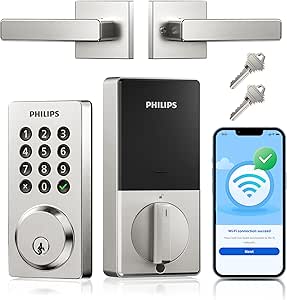 | Best for High-Capacity Passcodes | Brand: PHILIPS | Model: DDL242X-15HW-L | Connectivity: Built-in Wi-Fi | VIEW ON AMAZON | See Our Full Breakdown |
| Philips Wi-Fi Smart Deadbolt Lock with 2 Handles |  | Best for a Complete Handle-and-Lock Upgrade | Brand: PHILIPS | Model: DDL240X-1HW-L | Connectivity: Wi-Fi | VIEW ON AMAZON | See Our Full Breakdown |
| LOCKSTAR Smart Door Lock – Keyless Deadbolt with Multiple Entry Methods |  | Best for Flexible Household Access | Brand: LOCKSTAR | Model: LS-SDL | Material: Zinc | VIEW ON AMAZON | See Our Full Breakdown |
| Eufy Security Smart Lock C220, Keyless Entry with Fingerprint, Wi-Fi Control, and App Integration |  | Best for Straightforward Voice-Enabled Deadbolt Replacement | Unlock methods: Fingerprint, keypad, app, voice, and physical key | Voice assistants: Alexa and Google | Connectivity: Built-in Wi-Fi | VIEW ON AMAZON | See Our Full Breakdown |
| SwitchBot Lock Vision Pro Smart Lock with 3D Face Recognition, Palm Vein, and Fingerprint |  | Best Premium Biometric Choice | Biometric methods: 3D face, palm vein, and fingerprint | Connectivity: Wi-Fi without a hub; Matter support | Voice assistants and platforms: Alexa, Google, and Apple Home | VIEW ON AMAZON | See Our Full Breakdown |
| Philips Wi-Fi Smart Door Lock with Fingerprint and Voice Control |  | Best for High-Capacity Voice-Controlled Access | Brand: PHILIPS | Model: DDL240X-1HW | Connectivity: Wi-Fi | VIEW ON AMAZON | See Our Full Breakdown |
| DESLOC Fingerprint WiFi Smart Lock K120 with Keypad and Up to 16 Months Battery Life |  | Best for Long Battery Life | Battery: 15,000mAh rechargeable Li-ion | Battery life: Up to 16 months | Connectivity: Wi-Fi with app control | VIEW ON AMAZON | See Our Full Breakdown |
| WiFi Smart Door Lock Set with Keyless Entry, Fingerprint, App Control, Alexa & Google Assistant Compatibility |  | Best for Multiple Entry Options | Unlock methods: Fingerprint, passcode, app, voice, mechanical key | Voice assistants: Alexa and Google Assistant | Fingerprint capacity: 50 | VIEW ON AMAZON | See Our Full Breakdown |
| Philips Wi-Fi Smart Deadbolt Lock, Keyless Entry Door Lock |  | Best for Straightforward Voice-Ready Deadbolt Access | Model: DDL242X-1HW | Connectivity: 2.4GHz Wi-Fi | Voice assistants: Alexa and Google Assistant | VIEW ON AMAZON | See Our Full Breakdown |
| Philips WiFi Keypad Door Lock with Handle, App Control Smart Deadbolt Lock |  | Best for Doors Needing a Handle Set | Model: DDL242X-15HW-L | Included hardware: Door lock and 2 lever handles | Voice assistants: Alexa and Google Assistant | VIEW ON AMAZON | See Our Full Breakdown |
| Kwikset Halo Wi-Fi Smart Lock, Keyless Entry Door Deadbolt, Geofence Auto-Unlock, Grade AAA Certified, No Hub Required, Satin Nickel Finish |  | Best for Guest Access and Geofencing | Model: 99390-001 | Connectivity: Wi-Fi; no hub required | Voice assistants: Alexa and Google Home | VIEW ON AMAZON | See Our Full Breakdown |
| smart lock with voice assistant support | Connectivity | Model | Voice assistants |
|---|---|---|---|
| Philips WiFi Fingerprint Door | Wi-Fi | DDL240X-1HW-L | Alexa and Google Assistant |
| Philips WiFi Smart Keypad Dead | Wi-Fi; no hub needed | DDL242X-15HW | — |
| Smart Lock Keypad Door Lock wi | — | — | Alexa and Google Assistant |
| Philips Wi-Fi Front Lock Set w | Wi-Fi | DDL240X-1HW-H2 | — |
| Philips WiFi Keypad Door Lock | Built-in Wi-Fi | DDL242X-15HW-L | Alexa and Google Assistant |
| Philips Wi-Fi Smart Deadbolt L | Wi-Fi | DDL240X-1HW-L | Alexa and Google Assistant |
| LOCKSTAR Smart Door Lock | — | LS-SDL | — |
| Eufy Security Smart Lock C220 | Built-in Wi-Fi | — | Alexa and Google |
| SwitchBot Lock Vision Pro Smar | Wi-Fi without a hub; Matter support | — | — |
| Philips Wi-Fi Smart Door Lock | Wi-Fi | DDL240X-1HW | Alexa and Google Assistant |
| DESLOC Fingerprint WiFi Smart | Wi-Fi with app control | — | — |
| WiFi Smart Door Lock Set with | Wi-Fi | — | Alexa and Google Assistant |
| Philips Wi-Fi Smart Deadbolt L | 2.4GHz Wi-Fi | DDL242X-1HW | Alexa and Google Assistant |
| Philips WiFi Keypad Door Lock | — | DDL242X-15HW-L | Alexa and Google Assistant |
| Kwikset Halo Wi-Fi Smart Lock | Wi-Fi; no hub required | 99390-001 | Alexa and Google Home |
More Details on Our Top Picks
Philips WiFi Fingerprint Door Lock Set with Touchscreen
Fingerprint, touchscreen PIN, app, key, and voice access give this Philips set more ways to get through the door than the keypad-focused Philips WiFi Smart Keypad Deadbolt Lock. That flexibility suits households where different people prefer different entry methods, while Alexa and Google Assistant support adds voice control and remote app management. Auto-lock can reduce the chance of leaving the deadbolt unsecured, and the included handles make this a fuller entry-set replacement than a standalone deadbolt.
The tradeoff is that auto-lock does not detect whether the door has actually closed, so it may lock before the door is properly shut. Installation may call for drilling and careful door-fit checks. I would also factor in the separate Philips WiFi Gateway needed for sharing timed or recurring PINs; buyers who need that access workflow should compare it with the simpler keypad setup of the Philips WiFi Keypad Door Lock with Handle.
Pros:- Fingerprint, touchscreen PIN, key, and app entry accommodate different household preferences.
- Alexa and Google Assistant support pair voice commands with remote app management.
- Included handles make it a more complete set than a deadbolt-only option.
- Auto-lock can help prevent the deadbolt being left unlocked.
Cons:- Auto-lock does not detect whether the door is closed.
- Timed or recurring PIN sharing requires an additional Philips WiFi Gateway.
- Some doors may need drilling or compatibility checks during installation.
Best for: Households that want fingerprint entry, voice control, remote access, and included handles in one front-door upgrade.
Not ideal for: Rental hosts who need timed or recurring PIN sharing without buying a separate Philips WiFi Gateway, or buyers who need door-closed sensing.
- Brand:PHILIPS
- Model:DDL240X-1HW-L
- Unlocking methods:Fingerprint, PIN, key, app, and voice commands
- Voice assistants:Alexa and Google Assistant
- Connectivity:Wi-Fi
- Included components:Two door handles, Wi-Fi smart lock, 8 AA batteries, mounting hardware, and user manual
- Auto-lock:Yes; no door-closure sensor
Our verdict“Choose this Philips set if your household values several entry methods and voice control, but skip it if you need gateway-free scheduled PIN sharing.”
Philips WiFi Smart Keypad Deadbolt Lock, App Remote Control, No Hub Needed
This Philips deadbolt is a good fit for buyers who want voice assistant access without a separate hub and prefer passcodes to fingerprint recognition. Remote control through the Philips Home Access App means access can be managed away from home, while customizable temporary or permanent codes suit changing household needs. Its IP54 rating and stated temperature range make it a more clearly specified choice for exposed entryways than the Philips WiFi Fingerprint Door Lock Set with Touchscreen, whose supplied details do not give comparable weather ratings.
The simpler keypad approach has a tradeoff: there is no fingerprint option, so users must rely on a code, key, app, or supported voice command. It also takes eight AA batteries, which are not included, and setup may be less straightforward for some buyers. Compared with the Philips WiFi Keypad Door Lock with Handle, this model is the deadbolt-only choice, so check whether your existing handles are staying in place.
Pros:- Wi-Fi remote control works through the app without a separate hub.
- Supports keys, passcodes, app access, and voice commands.
- Temporary and permanent passcodes offer flexible access management.
- IP54 rating and a stated operating range suit a range of outdoor conditions.
Cons:- Eight AA batteries are required and are not included.
- No fingerprint entry, unlike the Philips WiFi Fingerprint Door Lock Set with Touchscreen.
- Deadbolt-only package does not include handles.
Best for: Homeowners with an existing handle set who want a Wi-Fi keypad deadbolt, remote code management, and a stated weather-resistance rating.
Not ideal for: Buyers seeking fingerprint entry, included handles, or a lock that arrives with its required AA batteries.
- Brand:PHILIPS
- Model:DDL242X-15HW
- Connectivity:Wi-Fi; no hub needed
- Unlocking methods:Key, passcode, app, and voice commands
- Battery:8 AA batteries, not included
- Battery life:Up to 6 months
- Water resistance:IP54
- Temperature range:-31°F to 150°F (-35°C to 66°C)
- Pressure resistance:2200 N
Our verdict“Pick this deadbolt for hub-free remote keypad access in varied weather, provided you do not need fingerprint entry or replacement handles.”
Smart Lock Keypad Door Lock with Handle, WiFi Keyless Entry, Alexa & Google Assistant Compatible, Voice Control, APP Remote, Fingerprint, PIN Code, Mechanical Key
This model stands out for combining six entry methods—fingerprint, passcode, app, voice, FOB card, and mechanical key—with built-in Wi-Fi and handles. The FOB card gives it an access option not listed for the Philips WiFi Fingerprint Door Lock Set with Touchscreen, which may help households that want to hand out a credential without sharing a code. Alexa and Google Assistant support also keeps voice control in scope, while the stated fingerprint and passcode capacities clarify how many entries can be stored.
Its broad feature set comes with more setup choices and upkeep than a keypad-only deadbolt such as the Philips WiFi Smart Keypad Deadbolt Lock. It uses eight AA batteries, and the listed battery life can vary with usage. ANSI Grade 3 certification is specified, but buyers should still check their door fit and installation requirements; the product details describe it as suitable for residential and commercial use, not as a substitute for checking the hardware against a particular door.
Pros:- Six listed entry methods include FOB card access as well as fingerprint and voice.
- Built-in Wi-Fi supports app-based remote management.
- Stores up to 50 fingerprints and 50 passcodes.
- Auto-lock and ANSI Grade 3 certification are specified.
Cons:- Eight AA batteries require eventual replacement, and battery life varies with use.
- More access methods can make setup and credential management less straightforward than the Philips keypad deadbolt.
- The supplied specifications do not state a weather-resistance rating or door dimensions.
Best for: Households or small workplaces that want several credential types, including FOB cards, alongside app and voice access.
Not ideal for: Buyers who prefer a simpler keypad deadbolt, want detailed weather ratings, or do not want to manage multiple access methods.
- Unlocking methods:Fingerprint, passcode, app, voice, FOB card, and mechanical key
- Wi-Fi:Built in
- Voice assistants:Alexa and Google Assistant
- Fingerprint capacity:50
- Passcode capacity:50
- Auto-lock:Yes
- Battery:8 AA batteries
- Battery life:Up to 8 months
- Certification:ANSI Grade 3
Our verdict“Choose this lock if FOB cards and multiple credential types matter as much as voice control, but favor a simpler Philips keypad model for a more focused setup.”
Philips Wi-Fi Front Lock Set with Handles
Among these Philips options, this front lock set gives buyers the clearest door-thickness specification: 35–50 mm compatibility. That makes it easier to screen for fit before buying than the Philips WiFi Fingerprint Door Lock Set with Touchscreen, whose supplied specs do not list a thickness range. The set combines a handle with fingerprint, PIN, key, app, and voice access, so it covers the everyday entry modes expected from a voice-assistant-compatible smart lock while adding remote management and auto-lock.
The main limitation is the thin detail provided about weather resistance, battery life, and access-code capacity, especially compared with the Philips WiFi Smart Keypad Deadbolt Lock, which states an IP54 rating and a battery-life estimate. Installation also calls for basic tools and may challenge buyers unfamiliar with lock fitting. I would choose this model when the listed door thickness matches and the bundled handle matters, rather than when detailed outdoor-use specifications are the priority.
Pros:- Published 35–50 mm door-thickness compatibility helps buyers check fit.
- Combines handle hardware with fingerprint, PIN, key, app, and voice entry.
- Wi-Fi supports remote management.
- Auto-lock can reduce the chance of leaving the lock unsecured.
Cons:- Installation requires basic tools and may be challenging for some buyers.
- The supplied details do not state a weather-resistance rating or battery-life estimate.
- Door compatibility should be confirmed before purchase.
Best for: Homeowners replacing a front-door lock and handle who can confirm their door is 35–50 mm thick.
Not ideal for: Buyers whose doors fall outside the stated thickness range or who need published weather-resistance and battery-life details before choosing.
- Brand:PHILIPS
- Model:DDL240X-1HW-H2
- Recommended use:Home
- Door thickness compatibility:35–50 mm
- Included components:Door lock, handle set, and 4 batteries
- Connectivity:Wi-Fi
- Unlocking methods:App, fingerprint, PIN, key, and voice commands
- Auto-lock:Yes
Our verdict“Choose this Philips set when your door matches its stated thickness range and you want a handle plus voice-enabled keyless entry.”
Philips WiFi Keypad Door Lock with Handle, App Control Smart Deadbolt Lock
For homes that manage access through codes, this Philips set has a useful stated limit: up to 100 custom passwords. Built-in Wi-Fi connects remote app control with Alexa and Google Assistant voice support, while the included lever handles make it a more complete replacement than the deadbolt-only Philips WiFi Smart Keypad Deadbolt Lock. Auto-lock and low-battery alerts address practical day-to-day concerns; the IP54 rating and wide temperature range also give buyers more outdoor-use detail than the Philips Wi-Fi Front Lock Set with Handles.
This is a keypad-led choice, not the pick for fingerprint entry: unlike the Philips WiFi Fingerprint Door Lock Set with Touchscreen, the supplied description does not list a fingerprint reader. It also needs eight AA batteries, which are not included, and full remote features depend on Wi-Fi. Check the stated bore size and door thickness against your door before buying, even though the product is described as suitable for standard US deadbolts.
Pros:- Supports up to 100 custom passwords for managing access among multiple people.
- Built-in Wi-Fi enables app control and remote access management.
- Alexa and Google Assistant voice commands are supported.
- Includes two lever handles, auto-lock, and low-battery alerts.
Cons:- Eight AA batteries are required and are not included.
- Full remote features depend on a working Wi-Fi connection.
- No fingerprint entry is listed, unlike the Philips touchscreen fingerprint set.
Best for: Families, shared homes, or small offices that need many custom access codes, remote management, and included handles.
Not ideal for: Buyers who want fingerprint access, have a door outside the listed dimensions, or need remote functions without a Wi-Fi connection.
- Brand:PHILIPS
- Model:DDL242X-15HW-L
- Connectivity:Built-in Wi-Fi
- Voice assistants:Alexa and Google Assistant
- Password capacity:Up to 100 custom passwords
- Included components:Door lock and 2 lever handles
- Water resistance:IP54
- Compatible deadbolt bore size:1-1/2 in or 2-1/8 in
- Door thickness:1-3/8 in to 2 in
Our verdict“Pick this Philips keypad set if you need numerous codes and included handles, but choose a fingerprint model if biometric entry is a priority.”
Philips Wi-Fi Smart Deadbolt Lock with 2 Handles
The Philips Wi-Fi Smart Deadbolt Lock with 2 Handles is the clearest fit if you want to replace the deadbolt and handles together rather than pair a lock with existing hardware. Alexa and Google Assistant support works alongside Wi-Fi app control, while fingerprint, PIN, and key entry give household members alternatives when a voice command or phone is inconvenient. Compared with the Philips Wi-Fi Smart Door Lock with Fingerprint and Voice Control, this set brings two handles but has fewer supplied details about code capacity and adjustable auto-lock timing. Its auto-lock feature also depends on the door being fully closed; there is no stated door-position sensor to confirm that. I’d choose it for a coordinated hardware replacement, but not where dependable remote features are a priority without stable Wi-Fi or any required gateway.
Pros:- Includes two door handles for a coordinated hardware replacement
- Supports Alexa and Google Assistant alongside Wi-Fi app management
- Offers fingerprint, PIN, app, and physical-key entry
- Auto-lock adds a hands-free locking option
Cons:- Auto-lock relies on the door being fully closed and has no stated door-position sensor
- Full remote functionality depends on stable Wi-Fi
- Some features may require an additional Wi-Fi gateway
Best for: Homeowners replacing both a deadbolt and door handles who want Alexa or Google Assistant access plus fingerprint and PIN entry.
Not ideal for: Buyers who already have handles they want to keep, or households that need remote control to work reliably with weak Wi-Fi.
- Brand:PHILIPS
- Model:DDL240X-1HW-L
- Connectivity:Wi-Fi
- Voice assistants:Alexa and Google Assistant
- Unlock methods:Fingerprint, PIN, key, and app
- Included handles:2 door handles
- Batteries included:8 AA batteries
Our verdict“Choose this Philips set if you need handles as well as a voice-compatible deadbolt, but check connectivity and door-closure requirements before buying.”
LOCKSTAR Smart Door Lock – Keyless Deadbolt with Multiple Entry Methods
LOCKSTAR earns its place for households that need to hand access to different people in different ways: it lists fingerprint, keypad code, card FOB, app, and traditional key entry. Alexa and Google Assistant are mentioned as smart-home integrations, though the supplied details are less specific about voice features than those for the Philips Wi-Fi Smart Door Lock with Fingerprint and Voice Control. That makes LOCKSTAR a better match for varied entry habits than for shoppers who want clearly documented voice controls and lock settings. Auto-lock and event notifications suit busy homes or rentals where tracking access matters, and the included installation tools may help with a DIY fit. The tradeoff is uncertainty: battery life is not stated, and app control depends on Wi-Fi. I’d favor a model with more complete connectivity and power details if predictable upkeep is the priority.
Pros:- Combines fingerprint, keypad, card FOB, app, and physical-key entry
- Lists Alexa and Google smart-home integration
- Auto-lock and real-time event notifications support access oversight
- Installation tools are included
Cons:- Battery life is not specified
- App control depends on a Wi-Fi connection
- Voice-assistant capabilities are not described in as much detail as on the Philips voice-control model
Best for: Busy households or small rental-property owners who want several credential types, including card FOBs, for different users.
Not ideal for: Buyers who need clearly documented voice-assistant functions, stated battery-life expectations, or non-Wi-Fi app access.
- Brand:LOCKSTAR
- Model:LS-SDL
- Material:Zinc
- Connectivity protocol:Wi-Fi
- Entry methods:App, fingerprint, keypad code, card FOB, and traditional key
- Smart-home integration:Smart-home integration listed; Alexa and Google compatibility stated in product description
- Dimensions:1.18 x 2.64 x 6.46 inches
- Included components:Smart door lock, screwdriver, and drill piece
Our verdict“Pick LOCKSTAR for its mix of access credentials and household notifications, but choose a better-documented option if voice control or battery planning is central.”
Eufy Security Smart Lock C220, Keyless Entry with Fingerprint, Wi-Fi Control, and App Integration
The Eufy Security Smart Lock C220 is a strong choice for buyers who want voice access without adding a separate Wi-Fi hub: connectivity is built in, and voice commands work with Alexa and Google. Its fingerprint reader, keypad, app, and physical key also give a household useful alternatives to voice control. Compared with the more biometric-heavy SwitchBot Lock Vision Pro, the C220 keeps entry methods familiar and is specified for most standard deadbolts, though it does not offer face or palm-vein recognition. Its BHMA Grade 3 certification and waterproof design add useful durability context, while the stated battery life is about eight months. That estimate can vary with use, and eight AA batteries will need replacement. I’d shortlist it for conventional doors and simple hub-free remote access, not for buyers seeking the longest stated battery life.
Pros:- Built-in Wi-Fi enables remote app control without a separate hub
- Supports voice commands through Alexa and Google
- Offers fingerprint, keypad, app, and physical-key entry
- Waterproof design and BHMA Grade 3 certification are specified
Cons:- Uses eight AA batteries, with battery life stated at about eight months and subject to use
- Fingerprint recognition may need initial calibration
- Compatibility is limited to suitable standard deadbolts
Best for: Households with a compatible standard deadbolt that want built-in Wi-Fi, Alexa or Google voice access, and familiar fingerprint or keypad entry.
Not ideal for: Buyers seeking advanced face or palm biometrics, or a lock with a longer stated battery-life interval.
- Unlock methods:Fingerprint, keypad, app, voice, and physical key
- Voice assistants:Alexa and Google
- Connectivity:Built-in Wi-Fi
- Battery life:About 8 months
- Batteries:8 AA batteries
- Certification:BHMA Grade 3
- Deadbolt compatibility:Most standard deadbolts; bore under 54 mm
- Operating temperature:-22°F to 158°F (-30°C to 70°C)
Our verdict“Choose the C220 for a familiar, hub-free voice-enabled deadbolt setup, unless longer battery life or richer biometrics matter more.”
SwitchBot Lock Vision Pro Smart Lock with 3D Face Recognition, Palm Vein, and Fingerprint
The SwitchBot Lock Vision Pro is the most biometric-focused pick here: it combines 3D face recognition, palm-vein scanning, and fingerprint entry with Wi-Fi and support for Alexa, Google, Apple Home, and Matter. That breadth sets it apart from the Eufy C220, which offers fingerprint and conventional entry methods but not face or palm recognition. A stated 12-month battery life and backup power also make the SwitchBot more appealing to buyers who want fewer battery changes than the Eufy’s stated eight-month interval. The added flexibility brings fit and setup limits, however: it requires an existing deadbolt, supports specified US door dimensions, and biometric setup may take more effort than keypad access. I’d choose it for a biometric-led smart home, but skip it if your door falls outside its measurements or you want the simplest setup.
Pros:- Offers 3D face, palm-vein, and fingerprint recognition
- Supports Alexa, Google, Apple Home, and Matter over Wi-Fi without a hub
- Lists 12-month battery life with CR123A backup
- Fast stated recognition and capacity for 90 fingerprints
Cons:- Requires an existing deadbolt and does not support existing lock cylinders
- Fits only doors within its stated US dimensions
- Multiple biometric options may make setup more involved
Best for: Smart-home owners who want multiple biometric entry choices, broad assistant and Matter support, and a compatible US deadbolt.
Not ideal for: Buyers with non-US or out-of-spec doors, people who need a complete deadbolt replacement, or anyone who prefers basic setup over biometric options.
- Biometric methods:3D face, palm vein, and fingerprint
- Connectivity:Wi-Fi without a hub; Matter support
- Voice assistants and platforms:Alexa, Google, and Apple Home
- Battery life:12 months
- Battery type:DualPower 10,000 mAh with CR123A backup
- Recognition speed:Face: 1 second; fingerprint: 0.3 seconds
- Fingerprint storage:Up to 90 prints
- Door compatibility:Crossbore 38/54 mm; door thickness 35–55 mm; backset 60/70 mm
Our verdict“Choose the SwitchBot if biometric variety and broad smart-home support justify its door-fit restrictions and more involved setup.”
Philips Wi-Fi Smart Door Lock with Fingerprint and Voice Control
This Philips model stands out for shoppers who want voice-assistant support paired with clear access-management details: it works with Alexa and Google Assistant, supports built-in Wi-Fi without an extra hub, and can store 100 user codes. The 0.3-second fingerprint recognition and adjustable 30–180-second auto-lock timer offer practical alternatives to voice or app control. Compared with the Philips Wi-Fi Smart Deadbolt Lock with 2 Handles, this model gives more detail on code capacity and timer settings, while the two-handle set is the better fit if you are replacing door hardware too. Anti-peep entry and a backlit touchscreen add keypad-focused protections and usability. Its tradeoffs are battery dependence and a setup process some buyers may find complex; auto-lock also depends on proper door closure. I’d choose it for frequent access sharing, not if you need a door sensor confirmed in the supplied specs.
Pros:- Built-in Wi-Fi supports remote app management without an extra hub
- Works with Alexa and Google Assistant
- Stores up to 100 user codes and supports access permissions
- Fast fingerprint recognition and adjustable auto-lock timing
Cons:- Requires eight AA batteries that need replacement
- Auto-lock depends on correct door closure and battery charge
- Setup may be complex for buyers wanting a simple installation process
Best for: Households that share entry with many users and want Alexa or Google voice control, app management, and a large code capacity.
Not ideal for: Buyers who need included handles, a stated door-position sensor, or a lock that does not rely on replaceable batteries.
- Brand:PHILIPS
- Model:DDL240X-1HW
- Connectivity:Wi-Fi
- Control methods:App, touch, and voice
- Voice assistants:Alexa and Google Assistant
- Fingerprint recognition speed:0.3 seconds
- User codes:Up to 100
- Auto-lock timer:30–180 seconds
- Batteries and features:8 AA batteries; waterproof, anti-peep touchscreen with backlighting
Our verdict“Choose this Philips model for voice control and access sharing across many users, but look elsewhere if door sensing or included handles are must-haves.”
DESLOC Fingerprint WiFi Smart Lock K120 with Keypad and Up to 16 Months Battery Life
The DESLOC K120 is the strongest fit here for buyers who want voice-assistant-compatible smart access without frequent battery changes. Its rechargeable battery is rated for up to 16 months, longer than the Philips Wi-Fi Smart Deadbolt Lock’s specified AA-powered setup and the WiFi Smart Door Lock Set’s up-to-eight-month estimate. Fingerprint access, Wi-Fi app control, notifications, and access logs give household members alternatives to voice commands, which is useful if a speaker or network is unavailable. Its weatherproof construction and broad operating temperature range also suit exposed doors better than a lock chosen mainly for indoor convenience. The tradeoff is that the supplied specs do not name Alexa or Google Assistant compatibility, so voice support is less clearly established than on those alternatives. Its BHMA Grade 3 rating is another reason to skip it if you want a higher security grade.
Pros:- Rechargeable 15,000mAh battery is rated for up to 16 months
- Wi-Fi app control includes real-time notifications and access logs
- Fingerprint entry offers a hands-free alternative to voice commands
- Weatherproof design and a wide stated operating temperature range suit outdoor doors
Cons:- The supplied product details do not specify Alexa or Google Assistant support
- App control depends on a Wi-Fi connection
- BHMA Grade 3 is a limitation for buyers seeking a higher-rated lock
Best for: Households seeking a weather-ready fingerprint lock with long intervals between battery charges and app-based monitoring.
Not ideal for: Buyers who need explicitly confirmed Alexa or Google Assistant voice control, or who prioritize a security grade above BHMA Grade 3.
- Battery:15,000mAh rechargeable Li-ion
- Battery life:Up to 16 months
- Connectivity:Wi-Fi with app control
- Recognition technology:3D GPT biometric
- Security standard:BHMA Grade 3
- Operating temperature:-22°F to 158°F (-30°C to 70°C)
- Warranty:2 years
Our verdict“Choose the K120 for long battery intervals and weather resistance, but pick a lock with explicitly named assistant compatibility if voice control is a must.”
WiFi Smart Door Lock Set with Keyless Entry, Fingerprint, App Control, Alexa & Google Assistant Compatibility
This WiFi Smart Door Lock Set makes the most sense for homes where voice control is one of several useful ways in, not the only one. Alexa and Google Assistant compatibility sits alongside fingerprint, passcode, app, and mechanical-key access, so residents and visitors can use whichever method suits them. Capacity for 50 fingerprints and 50 passcodes gives it a more explicit fit for a busy household or small office than the Philips Wi-Fi Smart Deadbolt Lock, whose supplied specs do not state user capacity. App management and access logs add remote oversight. The compromise is power: its eight AA batteries are rated for up to eight months, far short of the DESLOC K120’s stated 16-month maximum. Installation may also take more technical confidence than the Philips deadbolt’s advertised DIY setup.
Pros:- Supports Alexa and Google Assistant voice commands
- Five entry methods include fingerprint, passcode, app, voice, and mechanical key
- Stores up to 50 fingerprints and 50 passcodes
- Wi-Fi app offers remote management and access logs
Cons:- Eight AA batteries are rated for up to eight months
- Installation may require technical skills
- Fingerprint and passcode capacity is limited to 50 each
Best for: Families, shared homes, or small offices that want Alexa or Google Assistant control plus several backup entry methods and multiple user credentials.
Not ideal for: Buyers who want a long interval between battery changes or prefer a lock with installation explicitly described as easy for DIY users.
- Unlock methods:Fingerprint, passcode, app, voice, mechanical key
- Voice assistants:Alexa and Google Assistant
- Fingerprint capacity:50
- Passcode capacity:50
- Connectivity:Wi-Fi
- Battery type:8 AA batteries
- Battery life:Up to 8 months
- Certification:ANSI Grade 3
Our verdict“Pick this set when varied entry methods and assistant compatibility matter more than minimizing battery changes or installation effort.”
Philips Wi-Fi Smart Deadbolt Lock, Keyless Entry Door Lock
The Philips Wi-Fi Smart Deadbolt is a clear choice for buyers who want a conventional deadbolt with named Alexa and Google Assistant support, plus several ways to enter when voice control is not convenient. App, passcode, fingerprint, and physical-key access make it less dependent on a smart speaker than voice-first use might suggest. Its adjustable auto-lock timer, from 10 to 180 seconds, can help households balance convenience against the chance of leaving the door unsecured. Compared with the Philips keypad model with handles, this deadbolt is a simpler fit for someone keeping existing door hardware. Its limits are practical: it only supports 2.4GHz Wi-Fi, requires separately purchased AA batteries, and has no door sensor to report whether the door itself is open or closed. The stated remote-control range is 65 feet, so it is not the strongest match for buyers expecting unlimited-range control.
Pros:- Supports Alexa and Google Assistant voice commands
- Fingerprint, passcode, app, and physical-key access provide useful alternatives
- Auto-lock timing can be set from 10 to 180 seconds
- Fits doors 1-3/8 to 2 inches thick
Cons:- Works with 2.4GHz Wi-Fi, not 5GHz
- AA alkaline batteries are not included
- No door sensor reports open or closed status
Best for: Homeowners keeping standard deadbolt hardware who want voice-assistant access, fingerprint entry, and a customizable auto-lock timer.
Not ideal for: Buyers with only 5GHz Wi-Fi, those who need door-open status, or households wanting batteries included.
- Model:DDL242X-1HW
- Connectivity:2.4GHz Wi-Fi
- Voice assistants:Alexa and Google Assistant
- Unlock methods:App, passcode, fingerprint, voice, physical key
- Battery type:AA alkaline (LR6)
- Auto-lock timing:10–180 seconds
- Remote-control range:65 ft
- Door thickness:1-3/8 to 2 inches (38–50mm)
Our verdict“Choose this Philips deadbolt for assistant-compatible access on a standard door, provided 2.4GHz Wi-Fi and the lack of a door sensor fit your setup.”
Philips WiFi Keypad Door Lock with Handle, App Control Smart Deadbolt Lock
Unlike the Philips Wi-Fi Smart Deadbolt Lock, this Philips model includes two lever handles, making it a better fit when the door needs a coordinated handle-and-lock setup rather than a deadbolt-only replacement. It supports voice commands through Alexa and Google Assistant, along with keys, PINs, and app control, so different household members can choose their preferred access method. Its stated capacity of up to 100 user PINs makes it more suitable than the WiFi Smart Door Lock Set for homes or offices with many code users. The outdoor specifications are a plus: IP54 protection and a broad temperature range address exposure better than basic indoor-focused smart access. The tradeoffs are eight AA batteries rated for up to six months, sold separately, and Wi-Fi dependence for remote features. Buyers should also allow time for setup, which may feel more involved than a deadbolt-only installation.
Pros:- Includes two lever handles as well as the smart deadbolt
- Supports Alexa and Google Assistant voice commands
- Up to 100 user PINs suit homes and office entries with many users
- IP54 rating and stated temperature range support outdoor use
Cons:- Eight AA batteries are not included and are rated for up to six months
- Remote features depend on a working Wi-Fi connection
- Setup may be more involved than a deadbolt-only replacement
Best for: Homeowners or landlords replacing door hardware who want lever handles, assistant-compatible entry, and many individual PINs.
Not ideal for: Buyers who only need a deadbolt, want fewer batteries to manage, or need remote functions to work without Wi-Fi.
- Model:DDL242X-15HW-L
- Included hardware:Door lock and 2 lever handles
- Voice assistants:Alexa and Google Assistant
- Access codes:Up to 100 user PINs
- Battery type:8 AA batteries, not included
- Battery life:Up to 6 months
- Waterproof level:IP54
- Temperature range:-31°F to 150°F (-35°C to 66°C)
- Door thickness:1-3/8 to 2 inches (35–50mm)
Our verdict“Choose this Philips set when you need handles, many PINs, and voice control together; skip it if a simpler deadbolt replacement is all your door needs.”
Kwikset Halo Wi-Fi Smart Lock, Keyless Entry Door Deadbolt, Geofence Auto-Unlock, Grade AAA Certified, No Hub Required, Satin Nickel Finish
The Kwikset Halo stands out for buyers who want guest-code management and geofence auto-unlock alongside voice control. It supports Alexa and Google Home, and its stated capacity of up to 250 access codes gives it a clear advantage over the WiFi Smart Door Lock Set’s 50-code limit for homes with frequent visitors or rotating access needs. Wi-Fi is built into the lock, so no hub is required, and remote app control and activity notifications add a layer of oversight. Compared with the Philips Wi-Fi Smart Deadbolt Lock, the Halo places more emphasis on managing many guest credentials and location-based convenience than on fingerprint entry; fingerprint access is not listed in the supplied details. Its tradeoff is reliance on Wi-Fi for full features, with occasional app connectivity issues reported. Warranty coverage also differs by component: electronics are covered for one year, while mechanical parts and finish have lifetime coverage.
Pros:- Works with Alexa and Google Home for voice control
- Supports up to 250 access codes for guest access
- Geofence auto-unlock and remote app control add hands-free and off-site options
- No separate hub is required
Cons:- Full smart features depend on Wi-Fi, and app connectivity issues have been reported
- Fingerprint entry is not listed among the supplied features
- Electronics warranty is one year, shorter than the mechanical and finish coverage
Best for: Hosts and households that share access with many guests and want Alexa or Google Home control with geofence auto-unlock.
Not ideal for: Buyers who want fingerprint entry, prefer to avoid Wi-Fi-dependent features, or expect the same warranty term for electronics as for mechanical parts.
- Model:99390-001
- Connectivity:Wi-Fi; no hub required
- Voice assistants:Alexa and Google Home
- Access-code capacity:Up to 250 codes
- Keyless entry:Touchscreen keypad
- Additional features:Geofence auto-unlock, guest access sharing, activity notifications
- Finish:Satin Nickel
- Included power:4 AA batteries
- Warranty:Lifetime mechanical and finish; 1-year electronics
Our verdict“Choose the Halo for high-capacity guest access and geofencing with voice control, but not if fingerprint unlocking or less network dependence is a priority.”

How We Picked
I ranked these 15 options around the promise of voice assistant support, not the sheer number of features in a listing. I gave more weight to clear assistant compatibility or explicit voice-control claims, then considered access choices such as fingerprint, keypad, app, and mechanical key. I also looked at whether a listing describes built-in Wi-Fi or a hub-free setup, and whether it appears to be a deadbolt-only product or a set with handles. These distinctions affect daily use, installation, and the chance that a lock fits the door a buyer already has.
The order favors options whose stated features give buyers a practical blend of voice access, convenient entry, and clear product positioning. The Philips Wi-Fi model that explicitly names fingerprint and voice control leads because it addresses the central use case directly; Eufy and Kwikset Halo stand out for different priorities, namely biometric access and a conventional Wi-Fi deadbolt with geofencing. Models with less explicit voice details rank lower, even when their titles list several entry methods. Product titles alone do not confirm supported assistants, voice-unlock permissions, door compatibility, or every setup requirement, so buyers should verify those details with the manufacturer before purchase.
| smart lock with voice assistant support | Voice assistants |
|---|---|
| Philips WiFi Fingerprint Door | Alexa and Google Assistant |
| Philips WiFi Smart Keypad Dead | — |
| Smart Lock Keypad Door Lock wi | Alexa and Google Assistant |
| Philips Wi-Fi Front Lock Set w | — |
| Philips WiFi Keypad Door Lock | Alexa and Google Assistant |
| Philips Wi-Fi Smart Deadbolt L | Alexa and Google Assistant |
| LOCKSTAR Smart Door Lock | — |
| Eufy Security Smart Lock C220 | Alexa and Google |
| SwitchBot Lock Vision Pro Smar | — |
| Philips Wi-Fi Smart Door Lock | Alexa and Google Assistant |
| DESLOC Fingerprint WiFi Smart | — |
| WiFi Smart Door Lock Set with | Alexa and Google Assistant |
| Philips Wi-Fi Smart Deadbolt L | Alexa and Google Assistant |
| Philips WiFi Keypad Door Lock | Alexa and Google Assistant |
| Kwikset Halo Wi-Fi Smart Lock | Alexa and Google Home |
Factors to Consider When Choosing Smart Lock With Voice Assistant Support
Voice assistant support is only one part of choosing a lock. I would first check whether the assistant can perform the exact action you want, then work through door fit, connectivity, household access, and backup plans. These checks help avoid paying for features that do not work with your setup or choosing a lock that complicates everyday entry.
Check What Voice Commands Are Actually Allowed
“Works with Alexa” or “Google Assistant compatible” can refer to limited functions such as checking lock status or running routines, not necessarily unlocking the door by voice. Some systems restrict voice unlocking or require a spoken PIN because an unlocked door is a security-sensitive action. Before choosing, look for the exact assistant, supported commands, and any required account linking or security code. Also check whether those functions require a hub, subscription, or a particular app configuration. If your main goal is hands-free entry, prioritize a model that clearly documents voice unlocking; if you only want status checks, broader compatibility may be enough.
Match the Lock Format to Your Door
A deadbolt-only product and a lock set with handles solve different installation problems. Replacing a deadbolt may leave existing handles in place, while a full set can create a consistent finish but requires matching the handle layout and door preparation. Check door thickness, backset, hole spacing, handing, and whether your current hardware has a separate deadbolt and latch before ordering. Product names that include “with handle” do not by themselves confirm fit for every door. Taking measurements first can prevent a return or an unexpected locksmith visit.
Treat Wi-Fi as a Convenience With Setup and Battery Costs
Built-in Wi-Fi can enable remote app access without a separate hub, but it also makes a stable connection near the door more relevant. A weak signal can interfere with remote commands even when local keypad or fingerprint access still works. Wi-Fi features may also affect battery use, so check the manufacturer’s battery guidance and low-battery alerts rather than assuming all smart locks last the same length of time. A hub-based system can add another device and setup step, yet it may suit a home already using that ecosystem. Choose based on the connection available at the door, not only the phrase “no hub needed.”
Choose Entry Methods Around the People Who Use the Door
Fingerprint access can be quick for regular residents, while a keypad is easier to share with guests, cleaners, or family members who should not enroll a biometric profile. App access helps when you need to manage entry remotely, but it depends on phones, permissions, and network access. A mechanical key remains useful as a backup if batteries run down or electronics fail. More methods can make a lock more adaptable, but they also add setup and management tasks. List who needs access and how often before treating a long feature list as a benefit.
Plan for Security, Privacy, and Account Recovery
Smart locks connect a physical entry point to apps and online accounts, so account security is part of the lock decision. Use a unique account password, enable available multifactor protection, and limit access permissions to people who need them. Biometric features introduce a separate privacy question: check how enrollment data is stored and managed rather than assuming all devices handle it the same way. Consider how you will revoke a guest code or phone permission when access is no longer needed. A clear recovery plan matters too, including what happens if the app account, phone, or Wi-Fi connection is unavailable.
Decide Which Features Are Worth Paying For
Extra biometric options, a handle set, geofencing, or app functions can be valuable when they solve a real household need. They are less compelling if your routine is simply entering a PIN and checking the lock occasionally. Avoid choosing solely by the number of entry methods or by a premium-sounding feature name; each added function can bring more setup, permissions, or maintenance. Compare the warranty, replacement-battery process, app support, and availability of physical backup access as part of the ownership picture. Spending more makes sense when a particular feature improves access for your household, not just because it appears on the specification list.
Frequently Asked Questions
Does Alexa or Google Assistant compatibility mean I can unlock the door by voice?
Not necessarily. Compatibility may cover status checks, routines, or locking while voice unlocking remains unavailable or requires a PIN. Look for documentation naming the precise commands and any security restrictions for the exact lock model. Also confirm that the integration works with your assistant device and app region. If voice unlocking is the deciding feature, do not rely on a broad compatibility label alone.
Can I use these locks if my Wi-Fi goes down?
Many smart locks retain local entry methods such as a keypad, fingerprint reader, or mechanical key, but the exact fallback depends on the model. Remote app control and cloud-linked voice features may stop working when the home network or internet connection is unavailable. Check the manual for offline behavior rather than assuming every function stays active. Keep a physical key or another documented backup available, and know how to access the lock if its batteries run low.
Should I choose a lock with a handle set or a deadbolt-only model?
Choose a deadbolt-only model if you intend to replace the deadbolt and your existing handle hardware is in good condition. A handle set can make sense when you are replacing both pieces or want a coordinated appearance, but it brings more measurements and fit details to check. Compare the door’s existing holes, latch arrangement, and backset with the manufacturer’s installation requirements. The product title is not enough to confirm compatibility. If your door has an unusual setup, check with the seller or a qualified installer before ordering.
Is fingerprint entry a good substitute for a keypad?
Fingerprint entry can make everyday access convenient for enrolled household members, but it is less straightforward to share with visitors or temporary guests. A keypad supports passcodes that can be shared or changed without enrolling another person’s biometric information. Fingerprint readers may also be less dependable for some users or conditions, so a second access method is useful. In this roundup, several biometric models also list keypad or mechanical-key access, which gives buyers more fallback options. Pick based on who needs entry, not on biometric access alone.
What should I verify before buying a voice-enabled smart lock?
Confirm the exact assistant integration, the voice actions it supports, and whether any voice command needs a PIN or other confirmation. Check door measurements and whether the product replaces only a deadbolt or includes handles. Review Wi-Fi or hub requirements, battery guidance, and the backup method for a network or power-related issue. It is also useful to check whether the app supports the access management your household needs, such as adding or removing codes. These checks can reveal a mismatch before installation rather than after setup.
Conclusion
For the broadest match to this roundup’s central promise, I would start with the Philips Wi-Fi Smart Door Lock with Fingerprint and Voice Control as the best overall, since its listing names both voice control and biometric entry. The Eufy Security Smart Lock C220 is a strong alternative for buyers who put fingerprint access and Wi-Fi control first, while Kwikset Halo suits someone seeking a conventional deadbolt format with geofencing. For a feature-heavy premium direction, the SwitchBot Lock Vision Pro lists face recognition, palm-vein, and fingerprint access, though buyers should verify assistant support and installation requirements before choosing it. Beginners may prefer a straightforward keypad or deadbolt setup over a model with several biometric options; among these listings, compare the Philips keypad models and the Kwikset Halo against your door and assistant needs. For value, focus on the least complicated model that clearly supports your assistant and preferred entry method, rather than paying for features you will not use. Before making the final choice, confirm voice-command permissions, door fit, and offline backup access.