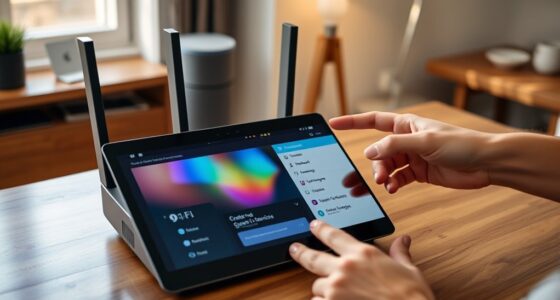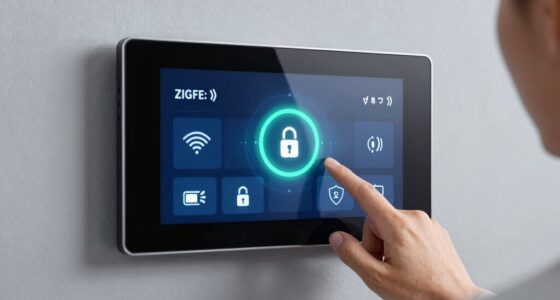
To defend against side-channel attacks on your voice assistant, make certain your device’s firmware is always up to date, as updates often patch vulnerabilities. Limit physical access to prevent nearby interception of signals, and consider using soundproofing or noise-canceling tools to obscure acoustic emissions. Using strong passwords and multi-factor authentication also adds extra security layers. Staying informed about emerging threats and best practices helps you better protect your privacy—if you want to learn more, keep exploring the key strategies.
Key Takeaways
- Regularly update device firmware to patch known vulnerabilities and enhance side-channel resistance.
- Limit physical access to voice assistant devices to prevent signal interception.
- Use soundproofing or noise-canceling measures to obscure acoustic emissions during operation.
- Enable multi-factor authentication and strong passwords to protect sensitive commands and data.
- Stay informed about security best practices and implement layered defenses against side-channel threats.

Voice assistants have become integral to our daily lives, but their convenience also introduces security risks. One of the less obvious threats involves side-channel attacks, where attackers exploit indirect information leaks to compromise your device’s security. These attacks don’t target the software directly; instead, they analyze physical signals or patterns emitted during device operation. Understanding how these vulnerabilities work, especially encryption vulnerabilities and acoustic signal analysis, helps you take practical steps to protect yourself.
Voice assistants can leak sensitive info through side-channel attacks exploiting physical signals.
Encryption vulnerabilities pose a significant threat because even encrypted data isn’t always immune to side-channel analysis. Attackers can observe patterns in how your voice assistant processes data, looking for subtle clues. For example, they might monitor the power consumption or electromagnetic emissions during encryption and decryption processes. These signals can reveal information about the data being processed, including sensitive commands or personal details, even if the data itself is encrypted. Recognizing this risk underscores the importance of employing robust, side-channel resistant encryption methods and ensuring your device firmware is up to date to patch known vulnerabilities.
Acoustic signal analysis is another technique attackers use to breach voice assistant security. Every time your device processes or responds to commands, it emits subtle acoustic signals—like tiny vibrations or sounds in the hardware—that can be intercepted with specialized equipment. An attacker could set up a microphone or other sensors nearby to capture these signals, then analyze the acoustic patterns to infer what you’re saying or doing. For example, the sound of a button press or the electrical noise from internal components can reveal sensitive information without direct access to your voice data or network. This form of side-channel attack highlights the need to be aware of your environment and device placement.
To defend against these threats, you should start by keeping all your devices updated. Manufacturers often release patches that address known vulnerabilities, including those related to side-channel attacks. Using strong, unique passwords and enabling multi-factor authentication adds another layer of security, making it harder for attackers to exploit any leaks. Additionally, consider limiting physical access to your device—placing it in secure locations to prevent nearby interception of acoustic signals. For extra protection, you might use soundproofing or noise-canceling gadgets to obscure acoustic emissions. Being mindful of your environment and monitoring for unusual behavior can also help you spot potential attack attempts early. Furthermore, ongoing research and development in cybersecurity aim to create more side-channel resistant encryption methods, emphasizing the importance of staying informed about emerging vulnerabilities and defenses.
In essence, while voice assistants bring convenience, they also demand vigilance. By understanding encryption vulnerabilities and acoustic signal analysis, and taking proactive security measures, you can better defend yourself against these insidious side-channel threats. Staying informed and cautious ensures your voice-activated devices serve you safely without exposing your private information to unseen eyes—or ears.

VOICEGIFT Play, 10 Hour Capacity Screen-Free Voice Recorder, Playback Tool, Portable Electronic Story Player with Speaker, Clip & Strap, Add Voice to Journals, Albums and Keepsakes
- Screen-Free Audio Player: Plays stories and messages without screens
- Long Recording Capacity: Records up to 2.5 hours of audio
- Portable Design: Includes clip, speaker, and headphone jack
As an affiliate, we earn on qualifying purchases.
As an affiliate, we earn on qualifying purchases.
Frequently Asked Questions
Can Side-Channel Attacks Target All Types of Voice Assistants Equally?
No, side-channel attacks don’t target all voice assistants equally. You’ll find that voice assistant diversity and attack surface variation play a big role; some devices have unique vulnerabilities based on their hardware or software design. You need to understand that more popular or varied voice assistants might face different risks, so your defenses should adapt accordingly, considering each device’s specific characteristics to better protect against potential side-channel exploits.
How Quickly Can a Side-Channel Attack Compromise Voice Assistant Data?
A side-channel attack can compromise your voice assistant data within minutes if cryptographic vulnerabilities exist, risking your user privacy. Attackers analyze signals like power consumption or electromagnetic emissions to extract sensitive info quickly. The speed depends on the attack’s sophistication and the device’s security measures. To protect yourself, guarantee your voice assistant uses robust encryption, regularly updates software, and minimizes side-channel leakages, reducing the risk of rapid data breaches.
Are There Real-World Examples of Successful Side-Channel Attacks on Voice Devices?
Yes, there are real-world examples where attackers used acoustic fingerprinting and voice biometrics to compromise voice devices. For instance, hackers have exploited subtle audio cues to identify individual users or extract sensitive information. By analyzing acoustic signatures, they can bypass security measures. To protect yourself, verify your device’s firmware is updated, and consider advanced voice authentication methods to make side-channel attacks more difficult.
What Organizations Are Most at Risk From These Types of Attacks?
You’re most at risk if you work for healthcare organizations or financial institutions. These groups handle sensitive healthcare data and financial information, making them prime targets for side-channel attacks on voice assistants. Attackers can exploit these vulnerabilities to access confidential data, leading to serious privacy breaches. Protect yourself by implementing strong security measures, regularly updating software, and educating staff about potential threats to minimize your organization’s vulnerability.
How Do Hardware Differences Affect Vulnerability to Side-Channel Attacks?
Your hardware variability and manufacturing differences dramatically influence your vulnerability to side-channel attacks. Slight variations in chips, power consumption, and electromagnetic emissions can give attackers vital clues, making your device a prime target. These differences mean that some voice assistants are inherently more secure than others. By understanding how hardware discrepancies impact security, you can better assess risks and implement tailored defenses, safeguarding your voice data from malicious exploits.
soundproofing for voice assistants
As an affiliate, we earn on qualifying purchases.
As an affiliate, we earn on qualifying purchases.
Conclusion
To protect your voice assistants, stay aware of potential side-channel attacks, stay updated on the latest security measures, and stay cautious about sharing sensitive information. By understanding the risks, by implementing defenses, and by practicing good security habits, you can reduce vulnerabilities. Remember, safeguarding your privacy isn’t a one-time effort; it’s an ongoing process. Stay vigilant, stay informed, and stay confident that you’re doing your part to keep your voice assistant and your data secure.

Yubico – YubiKey 5C NFC – Multi-Factor authentication (MFA) Security Key and passkey, Connect via USB-C or NFC, FIDO Certified – Protect Your Online Accounts
- Security Type: Multi-Factor Authentication (MFA)
- Compatibility: Works with 1000+ Accounts
- Connection Options: USB-C and NFC
As an affiliate, we earn on qualifying purchases.
As an affiliate, we earn on qualifying purchases.

Fixirons WiFi Jammer Signal Blocker Large WiFi Router Cover Blocks 90% of Router Emf & 5G Faraday Cage for WiFi Router for 5G & Standard Routers 12.6" L X 5.3" W X 12.4" H
- Large Universal Dimensions: Fits most standard and 5G routers
- High-Quality Faraday Shielding: Blocks up to 90% of EMF radiation
- Efficient Heat Dissipation: Honeycomb design ensures airflow and cooling
As an affiliate, we earn on qualifying purchases.
As an affiliate, we earn on qualifying purchases.