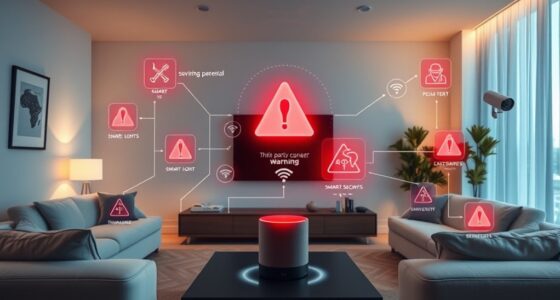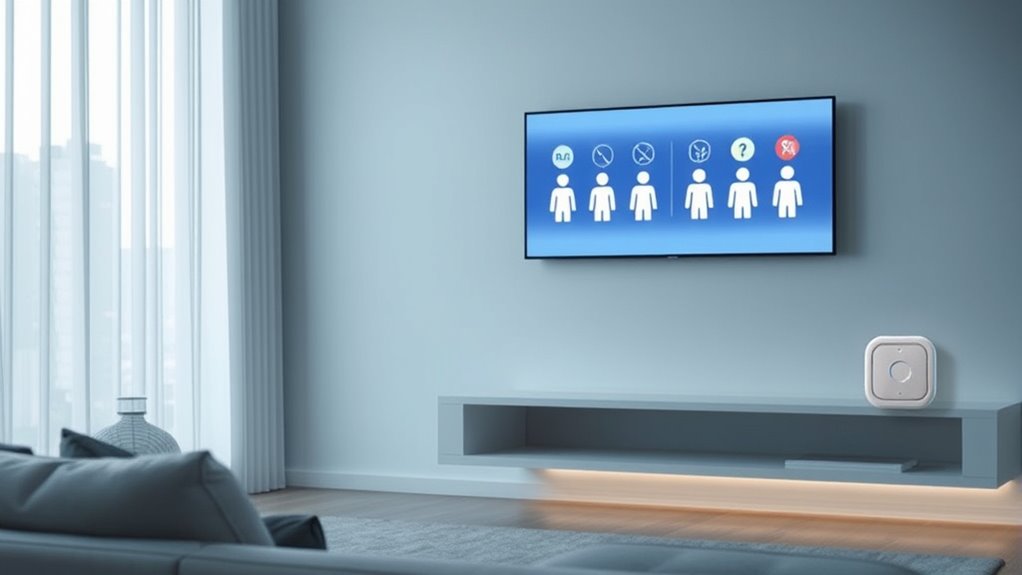

To guarantee privacy while detecting presence without cameras, you can use multiple sensors like infrared, ultrasonic, and radio frequency devices, which can identify occupancy without capturing personal visuals. encrypting the data from these sensors further protects your information during transmission and storage. This approach detects occupancy accurately while respecting individual privacy, avoiding intrusive monitoring. If you want to discover how combining sensors and encryption creates a secure, privacy-friendly system, there’s more to explore.
Key Takeaways
- Utilize multi-sensor systems like infrared, ultrasonic, or RF sensors to detect presence without visual data.
- Encrypt sensor data during transmission and processing to ensure privacy and prevent unauthorized access.
- Employ privacy-preserving techniques such as anonymized signals or device-based detection without identifying individuals.
- Apply homomorphic encryption to perform presence analysis on encrypted data, maintaining confidentiality throughout.
- Focus on occupancy status detection rather than personal identification, minimizing privacy risks effectively.
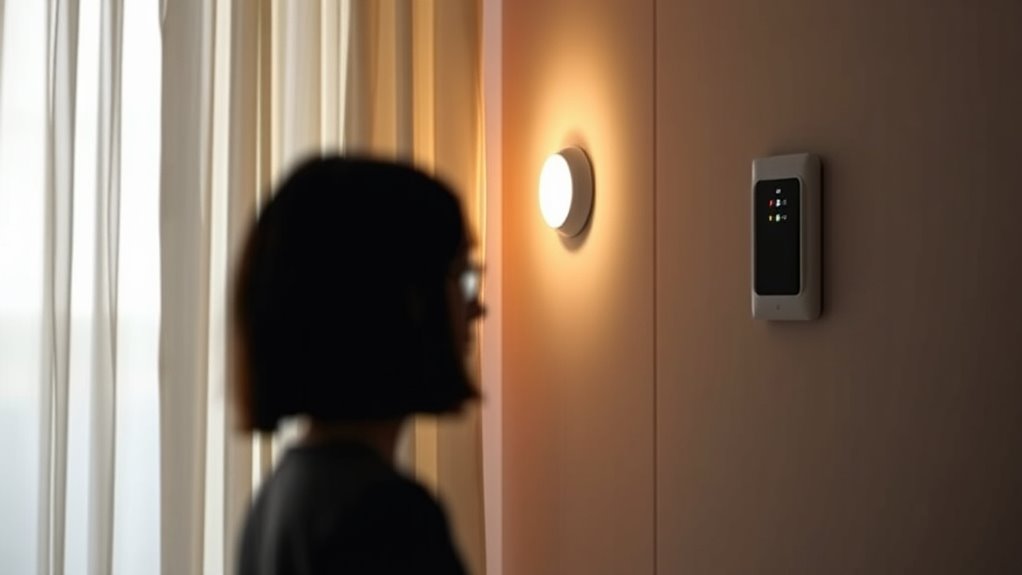
In today’s interconnected world, knowing whether someone is present without compromising their privacy is increasingly important. Traditional presence detection methods, like cameras, often raise privacy concerns and can feel intrusive. Fortunately, advances in sensor integration and encryption techniques now offer viable alternatives that respect individual privacy while providing reliable detection. By harnessing diverse sensors—such as infrared, ultrasonic, or radio frequency-based devices—you can create a system that detects presence without capturing visual data, thereby avoiding the privacy pitfalls associated with cameras.
Effective presence detection without cameras protects privacy using sensors like infrared, ultrasonic, and radio frequency.
Sensor integration plays a vital role here. Instead of relying on a single type of sensor, you combine multiple modalities to enhance accuracy and robustness. For example, infrared sensors can detect heat signatures, ultrasonic sensors can measure movement, and radio frequency sensors can identify device signals or body presence. By integrating these sensors, you develop a composite picture of occupancy that is less susceptible to false positives or negatives. This multi-sensor approach guarantees that the system remains reliable even in complex environments, all while maintaining user privacy because no visual or personally identifiable data is collected. Additionally, implementing multi-sensor fusion techniques can further improve detection reliability and resilience against environmental variations.
Encryption techniques further reinforce privacy during presence detection. When sensor data is transmitted or stored, encrypting this information guarantees that it remains confidential and protected from unauthorized access. You can implement end-to-end encryption, which secures data from the sensor to the processing unit, making interception or tampering practically impossible. Additionally, techniques like homomorphic encryption allow computations on encrypted data without revealing the raw inputs, ensuring that sensitive information stays hidden even during analysis. These encryption methods help you build a privacy-preserving system that not only detects presence accurately but also guarantees data security and user trust.
Moreover, privacy-preserving presence detection doesn’t require storing or sharing detailed personal data. Instead, it can utilize anonymized signals or encrypted tokens that confirm occupancy without identifying individuals. For instance, a system might detect the presence of a device emitting a specific radio frequency signal without knowing whose device it is. This approach minimizes data collection to only what’s necessary for occupancy status, aligning with privacy principles and reducing potential misuse.
In essence, by thoughtfully integrating multiple sensors and applying robust encryption techniques, you can develop a presence detection system that’s both effective and privacy-conscious. This combination guarantees you stay connected and aware of occupancy status without infringing on individual privacy rights. It’s a smart, responsible way to adapt to today’s privacy expectations while maintaining operational functionality in various environments.
Frequently Asked Questions
How Accurate Is Camera-Free Presence Detection?
Camera-free presence detection can be quite accurate, but sensor accuracy depends on the technology used. You might find systems using infrared or ultrasonic sensors perform well in controlled environments, yet environmental factors like lighting, temperature, or obstacles can affect their reliability. While these methods protect your privacy, expect some variance in accuracy based on conditions. Overall, they offer a good balance between privacy and dependable presence detection.
What Are the Main Privacy Risks Involved?
You might think absence of cameras means complete privacy, but risks still lurk. Data encryption helps protect your presence info, yet if user consent isn’t clear, your data could still be misused or leaked. Even with privacy-preserving tech, subtle risks remain—like unauthorized access or tracking. So, while cameras are out, the real challenge is ensuring your consent is genuine and your data stays encrypted and secure.
Can This Technology Detect Multiple People Simultaneously?
Yes, this technology can detect multiple people simultaneously through multi person detection and occupant tracking. It uses non-invasive signals like wireless or acoustic data to monitor presence, ensuring privacy is preserved. You benefit by gaining accurate occupancy information without cameras, reducing privacy risks. This method effectively tracks multiple occupants in real-time, making it suitable for smart buildings or security without compromising individual privacy or needing invasive sensors.
How Does It Compare Cost-Wise to Camera-Based Systems?
You’ll find that privacy-preserving presence detection systems generally cost less than camera-based ones, making them a smart choice for budget considerations. They require fewer components and less infrastructure, which cuts down installation and maintenance expenses. While camera systems can be pricier due to hardware and data handling, these alternative solutions offer a cost-effective way to monitor presence without compromising privacy, fitting well into tighter budgets.
What Are Potential Real-World Applications Beyond Security?
Imagine a busy office where sensor integration quietly tracks occupancy without cameras, respecting user consent. Beyond security, this tech can optimize energy use by adjusting lighting and climate based on presence. It also enhances smart home systems, enabling personalized experiences without invading privacy. In healthcare, it supports patient monitoring discreetly. You benefit from seamless, privacy-respecting automation, making spaces smarter and safer without compromising personal boundaries or requiring costly camera setups.
Conclusion
Imagine a world where you can be seen without compromising your privacy. This approach to presence detection proves that technology can protect your personal space while still keeping you connected. It’s like having your cake and eating it too—balancing security with privacy. By embracing these innovations, you guarantee your presence is known without giving away your secrets. Isn’t it time we trust technology to safeguard our privacy while still keeping us visible?