
If you’re searching for the best handheld Wi-Fi spectrum analyzers in 2025, I recommend considering devices like the AURSINC TinySA Ultra+, the Portable TinySA with Touch Screen, and the SeeSii TinySA Ultra+. These models offer wide frequency coverage, built-in signal generators, and user-friendly interfaces, making them ideal for precise RF analysis in various environments. They’re durable, portable, and support advanced features. Keep exploring, and you’ll find more options tailored to your specific needs.
Key Takeaways
- Devices with wide frequency coverage up to 6GHz are ideal for analyzing modern Wi-Fi standards like Wi-Fi 6 and Wi-Fi 6E.
- Portable, rugged designs with long battery life (up to 8 hours) enable effective field spectrum analysis for Wi-Fi networks.
- User-friendly touchscreens and intuitive interfaces facilitate quick signal identification and troubleshooting in complex RF environments.
- Compatibility with open-source software and remote control features enhance data logging, analysis, and integration with existing tools.
- High measurement accuracy, adjustable RBW, and built-in calibration signals ensure precise Wi-Fi spectrum diagnostics.
AURSINC TinySA Ultra+ Spectrum Analyzer with Signal Generator
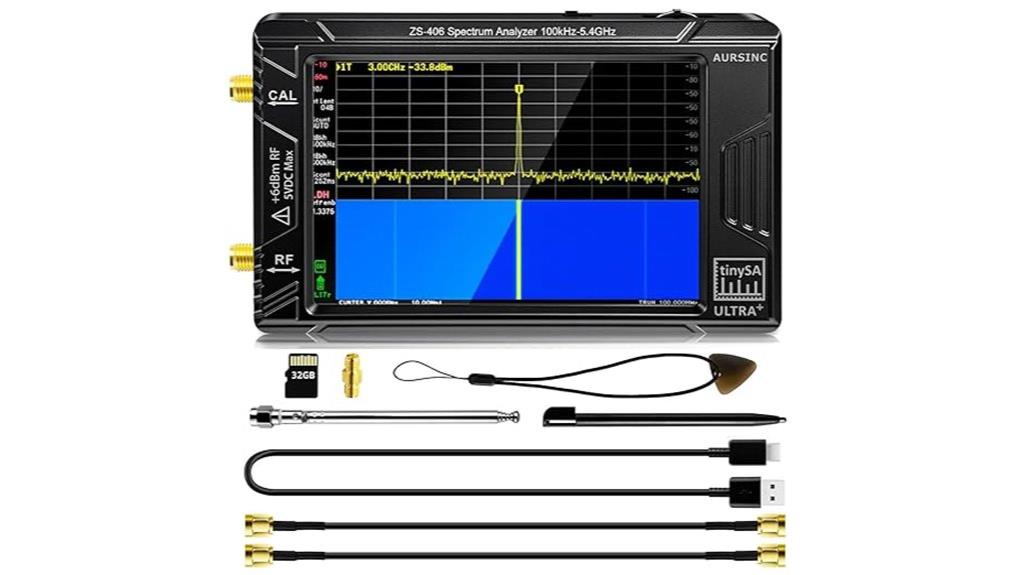
If you’re seeking a versatile handheld spectrum analyzer that combines precision and portability, the AURSINC TinySA Ultra+ stands out. Equipped with a high-resolution 4.0-inch touchscreen and a built-in 32GB micro SD card, it offers easy data storage and analysis on the go. Its wide frequency range of 100kHz to 5.4GHz, with Ultra mode extending up to 6GHz, covers most Wi-Fi and RF signals. The device includes a dual-function signal generator, capable of MF/HF/VHF sinus outputs and UHF square waves. With excellent phase noise performance, adjustable RBW, and automatic calibration, the TinySA Ultra+ delivers accurate, fast measurements in field or lab environments.
Best For: RF engineers, technicians, and hobbyists needing a portable, accurate spectrum analyzer with signal generation capabilities for field and laboratory RF measurements.
Pros:
- Combines spectrum analysis and signal generation in a compact handheld device.
- Wide frequency coverage from 100kHz up to 6GHz in Ultra mode.
- High-resolution touchscreen and extensive data storage for easy analysis and data management.
Cons:
- Limited battery life of around 3 hours may require frequent recharging during extended use.
- May require some technical knowledge for optimal calibration and operation.
- The device’s size and features might be overkill for simple, occasional RF testing needs.
Portable TinySA Spectrum Analyzer with Touch Screen

The Portable TinySA Spectrum Analyzer with Touch Screen stands out as an ideal choice for hobbyists, ham radio operators, and RF troubleshooting enthusiasts who need a compact, affordable device with straightforward operation. It covers 100kHz to 960MHz, suitable for MF, HF, VHF, and UHF signals. The 2.8-inch color touchscreen provides clear readings across 290 scan points. It doubles as a signal generator, outputting sinusoidal signals and UHF square waves. With a rechargeable battery offering over two hours of use, and PC control via USB, TinySA delivers versatile RF analysis in a portable package, making it perfect for on-the-go troubleshooting and interference detection.
Best For: hobbyists, ham radio operators, and RF troubleshooting enthusiasts seeking a portable, cost-effective spectrum analyzer with versatile signal analysis capabilities.
Pros:
- Compact, lightweight design ideal for portable RF testing on the go
- User-friendly 2.8-inch color touchscreen for easy operation and clear display
- Built-in signal generator and PC control support enhance versatility in RF analysis
Cons:
- Antenna and telescoping connection are fragile and may break under slight pressure
- Limited accuracy above 350MHz, requiring external filters for optimal performance at higher frequencies
- Menu navigation can be confusing without comprehensive documentation, and calibration requires careful setup
SeeSii TinySA Ultra+ Spectrum Analyzer with Signal Generator (V0.4.6.1, 2025 Upgraded)
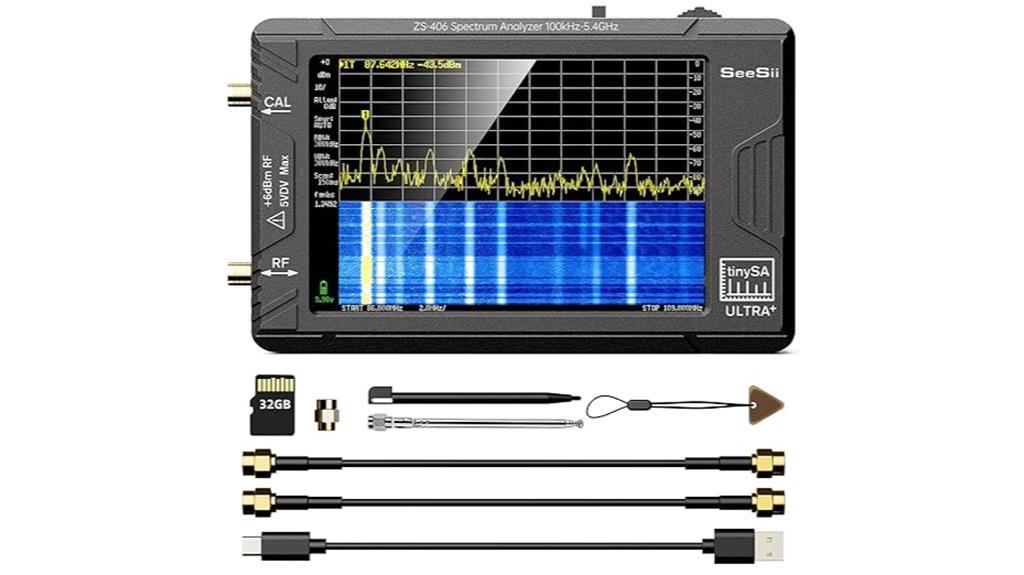
For professionals seeking versatile and reliable signal analysis, the SeeSii TinySA Ultra+ Spectrum Analyzer with Signal Generator stands out with its wide frequency range up to 6GHz and dual-functionality. It features a sharp 4-inch touchscreen display for clear measurement visualization and an upgraded design with improved ESD protection for durability. Its measurement capabilities extend from 100kHz to 5.4GHz, with Ultra mode reaching 6GHz, and switchable filters for precise testing. The device doubles as a signal generator, outputting sine, square, or dual-tone signals up to 4.4GHz. With 32GB storage, PC connectivity, and a long-lasting battery, it’s a compact, powerful tool for accurate Wi‑Fi spectrum analysis.
Best For: professionals and hobbyists needing a versatile, high-frequency spectrum analyzer and signal generator with durable build and extensive measurement capabilities.
Pros:
- Wide frequency range up to 6GHz with switchable filters for precise testing.
- Combines spectrum analysis and signal generation in one compact device.
- Built-in 32GB storage and PC connectivity for easy data management and sharing.
Cons:
- Relatively high cost compared to basic spectrum analyzers.
- Complex features may require some technical familiarity to operate effectively.
- Battery life may be limited during extended field use without additional power sources.
RF Explorer Digital Handheld Spectrum Analyzer model WSUB1G 240 – 960 MHz
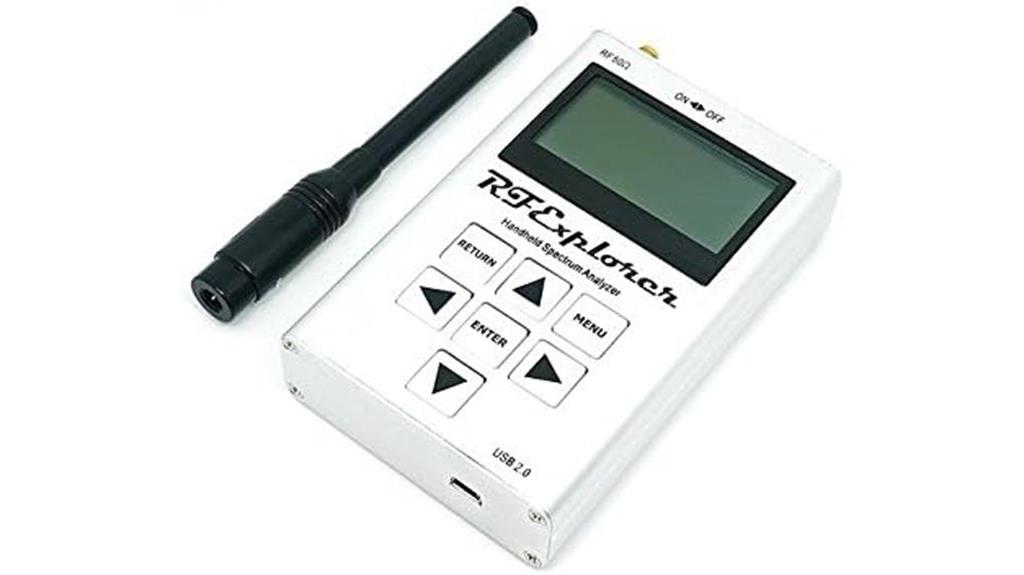
The RF Explorer WSUB1G stands out as an ideal choice for professionals and hobbyists seeking reliable spectrum analysis within the 240 to 960 MHz range. Its compact design and affordability make it easy to carry and operate both indoors and outdoors. Covering key bands like ISM, UHF TV, HAM radio, and GSM, it provides versatile coverage for various applications. The device features modes like Peak Max, Hold, and Averaging, offering flexible analysis options. With a simple mini-USB connection to a PC, I can log data and control the device effortlessly, making it a dependable tool for precise signal detection and troubleshooting.
Best For: professionals and hobbyists needing reliable, portable spectrum analysis across 240-960 MHz for applications like ISM, UHF TV, HAM radio, and GSM.
Pros:
- Compact, lightweight, and portable for easy use in various environments
- Wide frequency coverage suitable for multiple applications including ISM, TV, and radio bands
- User-friendly modes like Peak Max, Hold, and Averaging enhance analysis flexibility
Cons:
- Limited to the 240-960 MHz range, not suitable for higher frequency applications
- Requires a PC connection for full functionality, which may limit field independence
- Basic display and interface may be less advanced compared to larger, professional spectrum analyzers
AURSINC Portable Spectrum Analyzer with Touchscreen
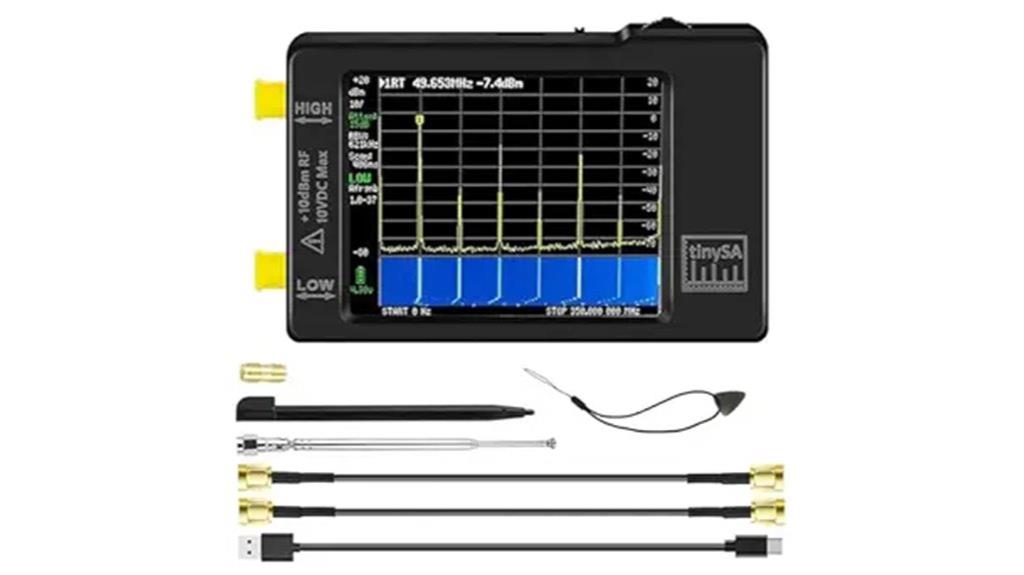
If you’re looking for a compact, versatile spectrum analyzer that combines ease of use with precise measurement capabilities, the AURSINC Portable Spectrum Analyzer with Touchscreen stands out. It features a 2.8-inch color touchscreen, making navigation straightforward. The device covers 0.1MHz to 350MHz on the high-quality MF/HF/VHF input, with switchable filters from 2.6kHz to 640kHz, and a UHF input for 240MHz to 960MHz. Its built-in signal generator, calibration functions, and USB connectivity allow for accurate measurements and remote control. With a lightweight design and included accessories, this analyzer is perfect for fieldwork and quick signal assessments.
Best For: professionals and hobbyists seeking a portable, user-friendly spectrum analyzer with versatile measurement and signal generation capabilities for field testing and quick assessments.
Pros:
- Compact and lightweight design for portability and ease of use in various environments
- Touchscreen interface simplifies navigation and operation
- Wide frequency range with switchable filters and built-in signal generator for versatile measurements
Cons:
- Limited input quality on the UHF channel compared to the high-quality MF/HF/VHF input
- Battery capacity of 500mAh may require frequent recharging during extended field use
- Some advanced features may require familiarity with spectrum analyzer operations or software control
Upgraded TinySA Spectrum Analyzer with Signal Generator
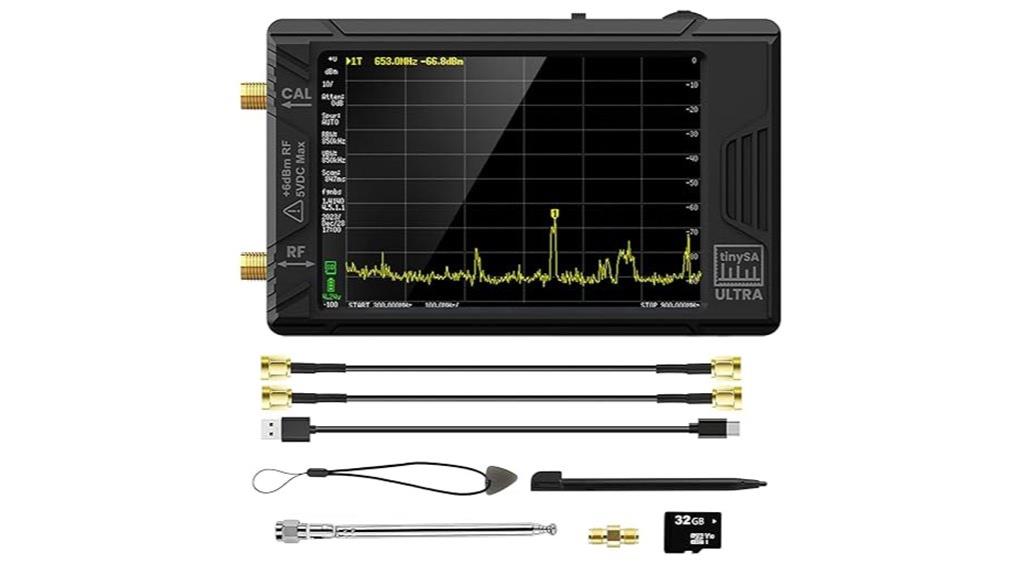
An upgraded TinySA Spectrum Analyzer with Signal Generator stands out as an ideal choice for RF enthusiasts and professionals needing versatile, compact measurement tools. It features a bright 4-inch touchscreen, a measurement range from 100kHz to 5.3GHz (extending to 6GHz in Ultra mode), and a built-in 32GB microSD card for easy data storage. Its multifunctionality allows it to serve as both a spectrum analyzer and a signal generator, outputting signals up to 4.4GHz. With enhanced durability, ESD protection, and convenient accessories, this device offers precise measurements, quick calibration, and seamless PC connectivity, making it perfect for field and lab RF testing.
Best For: RF enthusiasts and professionals seeking a versatile, portable spectrum analyzer and signal generator for precise field and lab measurements.
Pros:
- Wide measurement range from 100kHz to 5.3GHz, extendable to 6GHz in Ultra mode, suitable for various RF applications
- Compact design with a bright 4-inch touchscreen and durable build, ideal for portable use in the field
- Multifunctionality as both spectrum analyzer and signal generator, with automatic calibration and data storage capabilities
Cons:
- Difficulties reported in firmware updates and entering DFU mode, which may affect device updates and verification processes
- Crooked screens are a common issue, potentially impacting display clarity and user experience
- Limited compatibility with some accessories or firmware versions, which could restrict full feature utilization
RF Explorer Spectrum Analyzer 6G Combo Plus

Designed for professionals and enthusiasts who demand versatility, the RF Explorer Spectrum Analyzer 6G Combo Plus stands out with its extensive frequency coverage from 50 KHz to 6.1 GHz, extendable up to 7.5 GHz with a license. Its user-friendly interface includes HELP and SET buttons, enabling quick navigation and preset configurations in just two clicks. Compatible across Windows, Linux, and MacOS through open-source software and APIs, it supports modes like Peak Max, Hold, Normal, Overwrite, and Averaging. Built with a durable aluminum case, it’s portable and protected. Plus, with a one-year warranty and dedicated support, it’s a reliable tool for precise signal analysis.
Best For: professionals and enthusiasts seeking a versatile, portable spectrum analyzer with extensive frequency coverage and user-friendly features for precise signal analysis.
Pros:
- Wide frequency range from 50 KHz to 6.1 GHz, extendable up to 7.5 GHz with a license, suitable for diverse applications
- Intuitive interface with HELP and SET buttons for quick navigation and preset configuration in just two clicks
- Compatible with Windows, Linux, and MacOS via open-source software and APIs, supporting multiple analysis modes
Cons:
- Requires a license for extension up to 7.5 GHz, which may involve additional cost
- May be complex for beginners without prior experience in spectrum analysis tools
- Durability and portability depend on proper handling of the aluminum case to prevent damage
TinySA Spectrum Analyzer with Touch Screen and 4 Input/Output Modes
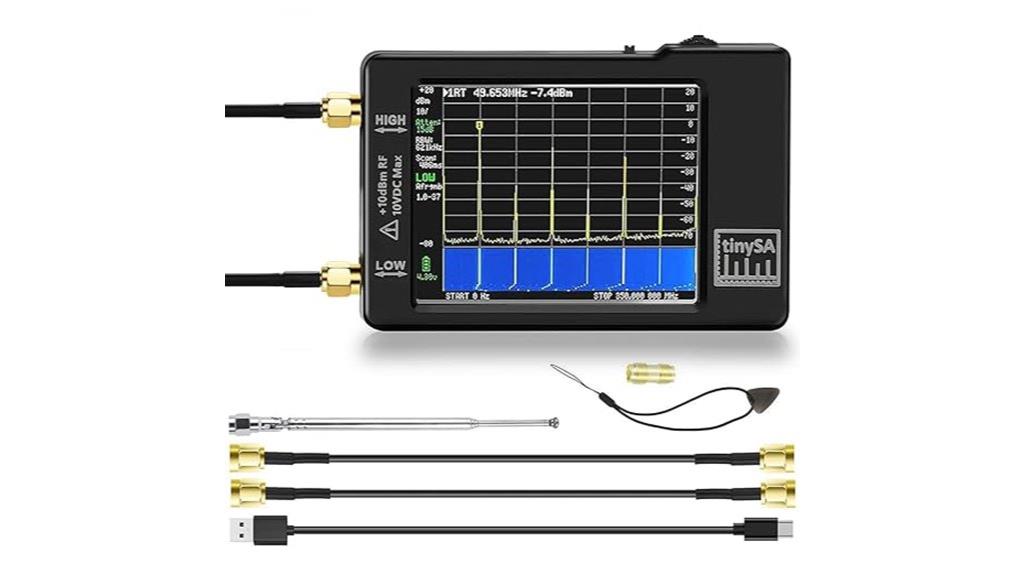
The TinySA Spectrum Analyzer with Touch Screen and 4 Input/Output Modes stands out as an ideal choice for hobbyists and technicians seeking versatile RF testing tools. Its portable design features a 2.8-inch touch display, covering 0.1MHz to 960MHz, with switchable filters for high sensitivity. It functions as both a spectrum analyzer and signal generator, offering sinusoidal and square wave outputs. With four input/output modes, a built-in calibration signal generator, and PC control via USB, it’s perfect for analyzing transmitter signals, monitoring frequencies, and troubleshooting RF issues. Despite minor limitations at higher frequencies, its ease of use and multifunctionality make it a powerful, compact device for various RF applications.
Best For: hobbyists, electronics enthusiasts, and technicians seeking a portable, multifunction RF testing device for basic spectrum analysis and signal generation.
Pros:
- Compact, lightweight, and portable with a user-friendly 2.8-inch touch screen.
- Dual functionality as a spectrum analyzer and signal generator with internal calibration.
- Supports PC control via USB and offers versatile measurement modes, including TDR for cable testing.
Cons:
- Slight frequency readout inaccuracies and some filter bypass issues above 800MHz.
- Limited high-frequency performance requiring external mixers or amplifiers for certain applications.
- Some users report menu lockouts and weak calibration signal outputs for precise professional use.
RF Explorer Spectrum Analyzer for Ham Radio & Wireless Devices
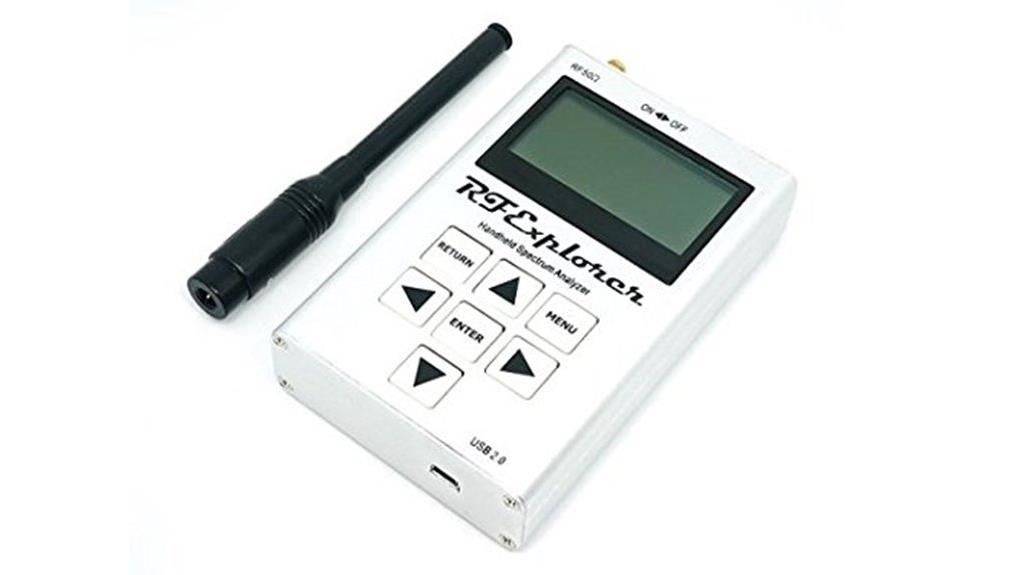
For ham radio enthusiasts and wireless professionals seeking reliable signal analysis, the RF Explorer Spectrum Analyzer WSUB1G stands out due to its extensive coverage of sub-1GHz ISM bands, including 144 and 430MHz. It’s a handheld digital device that offers precise measurements across 240MHz to 960MHz, making it versatile for various wireless applications. Its dynamic range from -115dBm to 0dBm ensures sensitive detection, while the dual-band telescopic antenna simplifies wideband analysis. The included EVA case enhances portability and durability, making it ideal for fieldwork. Overall, this analyzer is a compact, accurate tool tailored for RF professionals and ham radio operators alike.
Best For: ham radio enthusiasts, wireless device technicians, and RF professionals requiring precise signal analysis across sub-1GHz ISM bands.
Pros:
- Wide frequency coverage from 240MHz to 960MHz, including popular ham radio bands
- Sensitive dynamic range from -115dBm to 0dBm for accurate detection of weak signals
- Portable with EVA carrying case for durability and ease of use in the field
Cons:
- Limited to sub-1GHz frequency range, not suitable for higher frequency applications
- May require some technical knowledge to operate effectively
- No built-in recording or data logging features
4Inch TinySA Spectrum Analyzer (V0.4.5.1) with 32GB SD Card & 3000mAh Battery
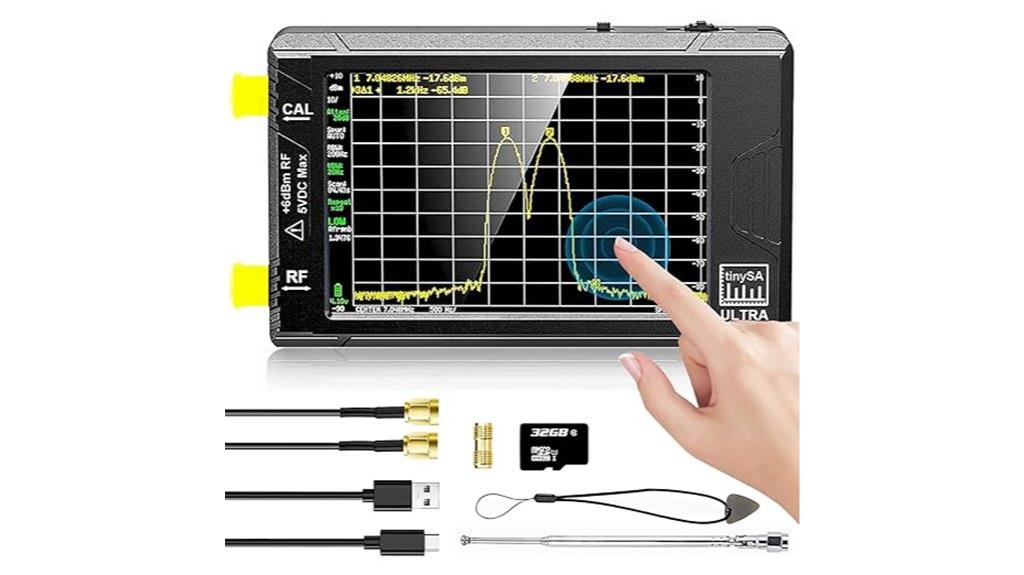
If you need a reliable handheld spectrum analyzer that combines portability with advanced features, the Inch TinySA Spectrum Analyzer (V0.4.5.1) stands out. It offers ultra-wide frequency measurement from 100kHz to 5.3GHz, with spectrum analysis modes covering 0.1-800MHz and extending to 6GHz in Ultra mode. The device features a large touchscreen, adjustable RBW from 200Hz to 850kHz, and a built-in calibration signal generator. With a 32GB SD card for data storage and a 3000mAh battery providing up to 8 hours of operation, it’s perfect for on-the-go RF testing and precise Wi-Fi signal analysis.
Best For: RF engineers, field technicians, and hobbyists needing a portable, high-performance spectrum analyzer for on-the-go RF signal measurement and testing.
Pros:
- Wide frequency range up to 6GHz in Ultra mode with high measurement accuracy
- Built-in calibration signal generator and adjustable RBW for precise analysis
- Long-lasting battery life of up to 8 hours and ample data storage with 32GB SD card
Cons:
- Limited to 800MHz spectrum analysis in standard mode, requiring Ultra mode for higher frequencies
- May have a learning curve for users unfamiliar with RF testing equipment
- The device’s size, while portable, may still be bulky for very compact carrying scenarios
Factors to Consider When Choosing a Wi‑Fi Spectrum Analyzer Handheld
When selecting a Wi‑Fi spectrum analyzer, I focus on key factors like frequency range coverage and measurement accuracy to guarantee reliable results. Portability and size matter too, especially if I need to carry the device into tight spaces or on the go. Additionally, features like signal generator capabilities and a user-friendly interface can make a big difference in how efficiently I can analyze signals.
Frequency Range Coverage
Choosing the right Wi‑Fi spectrum analyzer hinges on its frequency range coverage, which determines its ability to detect and analyze signals effectively. Ideally, it should cover the 2.4 GHz and 5 GHz bands, the primary Wi‑Fi frequencies. Extending slightly beyond these bands helps analyze adjacent channels and identify interference from other wireless sources. Some advanced models even offer ultra-wideband coverage up to 6 GHz or higher, accommodating emerging Wi‑Fi standards and additional wireless technologies. Starting from around 100 kHz allows detection of low-frequency signals and spurious emissions that could affect performance. A broader frequency range lets you monitor multiple standards simultaneously and identify interference in complex RF environments, ensuring thorough signal analysis and best network performance.
Measurement Accuracy
Achieving high measurement accuracy is vital for reliable signal analysis with a Wi-Fi spectrum analyzer, as it directly impacts your ability to detect interference, assess signal strength, and optimize network performance. Key factors include the device’s resolution bandwidth (RBW); narrower RBW offers finer frequency discrimination but may slow measurements. Calibration procedures, like automatic self-tests or external calibration, are essential to maintain accuracy over time and in different environments. Phase noise and DANL (Displayed Average Noise Level) specifications influence the analyzer’s capacity to accurately measure weak signals amidst noise, affecting overall fidelity. Additionally, frequency stability, often expressed in ppm, determines how consistently the device can measure and compare signals across sessions. Prioritizing these factors ensures your measurements are precise, reliable, and actionable.
Portability and Size
Selecting a Wi-Fi spectrum analyzer that’s truly portable means prioritizing a compact, lightweight design that fits comfortably in your hand or gear bag. A smaller size makes it easier to carry and deploy quickly, especially in challenging field environments. Ideally, the device should weigh under 2 kilograms to minimize fatigue during long inspections. Durability is also key—look for an ergonomic casing that withstands shocks, static, and weather conditions. Smaller dimensions often mean integrated batteries, supporting hours of continuous use without needing external power. This form factor facilitates rapid setup and effortless movement across different locations. Ultimately, a well-designed, portable analyzer enhances efficiency by combining ease of transport with robust build quality, ensuring you’re always ready for precise signal analysis wherever your work takes you.
Signal Generator Features
A key feature to contemplate in a handheld Wi-Fi spectrum analyzer is its built-in signal generator, which enables precise testing and calibration. A reliable generator should produce stable sine and square wave signals across frequencies from 100 kHz to 6 GHz, matching Wi-Fi bands. Adjustable power levels and modulation options allow you to simulate real-world signals and test device responses accurately. An integrated calibration signal generator is crucial for automatic self-tests, maintaining measurement accuracy over time. The ability to generate dual-tone signals or specific test patterns enhances your capacity to analyze interference sources and channel performance thoroughly. High-quality generators offer low phase noise and minimal spurious emissions, ensuring clean signals for precise testing. This feature is essential for reliable, consistent measurements in complex Wi-Fi environments.
User Interface Ease
When choosing a handheld Wi-Fi spectrum analyzer, ease of use is essential for effective fieldwork. A user-friendly interface with clear menus and iconography makes navigation straightforward, helping me save time and reduce errors. Responsive touchscreens and logical menu layouts allow quick access to measurement functions and data interpretation, which is critical during on-the-spot analysis. Visual indicators like color-coded signals and real-time graphs improve understanding of spectrum activity without complex steps. Simple prompts and minimal setup procedures enable rapid calibration and measurement initiation, increasing efficiency. While compatibility with control software or mobile apps can be helpful, I prefer devices with straightforward physical controls for immediate, hassle-free operation. Ultimately, an intuitive interface ensures I can focus on analysis rather than fumbling with technology.
Data Storage Options
Choosing the right data storage options is essential because it directly affects how much measurement data I can save and how easily I can access it later. Handheld Wi-Fi spectrum analyzers typically include internal storage, like built-in memory or microSD card slots, enabling me to record data directly on the device. External storage capabilities are also important, as they allow me to transfer files to computers or other devices for in-depth analysis or record keeping. Storage capacities vary widely, from 8GB to over 64GB, supporting extensive data logging during long sessions. Many models support exporting data in standard formats such as CSV, PNG, or PDF, making sharing and documenting results straightforward. Reliable storage options ensure uninterrupted operation and prevent data loss during crucial field tests.
Battery Life Duration
Long battery life is essential for ensuring that I can conduct extended Wi-Fi spectrum analyses in the field without constantly worrying about recharging. A device with a high-capacity battery—typically offering 3 to 8 hours of continuous use—helps me stay productive without frequent pauses. Quick charging features are a bonus, allowing me to minimize downtime between sessions. I also consider whether the device has a replaceable or upgradeable battery, as battery performance can decline over time. Power management features like sleep mode or low-power consumption components further extend operational time. Overall, a long-lasting battery guarantees I can focus on precise signal analysis without interruptions, making the device more reliable and efficient during demanding fieldwork.
External Accessory Compatibility
Ensuring your Wi‑Fi spectrum analyzer supports external accessory compatibility is essential for maximizing its measurement capabilities. I look for devices that support external antennas, amplifiers, and filters, which considerably enhance flexibility and precision. It’s important they have standard connectors like SMA or N-type, making it easy to integrate a variety of accessories. I also verify that the ports are shielded and rated for RF signal integrity to prevent interference and signal loss during external accessory use. Compatibility with external signal generators or tracking generators is another key factor, as it broadens testing options for Wi-Fi and RF signals. Additionally, I check if the device offers firmware updates that improve or add external accessory support over time, ensuring long-term usability and adaptability.
Frequently Asked Questions
How Accurate Are Handheld Spectrum Analyzers Compared to Professional Lab Equipment?
Handheld spectrum analyzers are quite accurate for fieldwork, but they typically don’t match the precision of professional lab equipment. I’ve found that high-end portable devices provide reliable readings for most practical purposes, especially for troubleshooting and signal monitoring. However, for highly detailed, laboratory-grade analysis, traditional lab instruments still hold the edge in accuracy and resolution. So, it depends on your specific needs and the level of precision required.
What Is the Typical Battery Life for These Portable Wi-Fi Spectrum Analyzers?
Typically, I find that portable Wi-Fi spectrum analyzers last around 3 to 6 hours on a single charge. This duration depends on the device’s power management and usage intensity. I recommend checking the specific model’s specs for precise battery life details. When I use mine, I make sure to carry a portable charger or spare batteries to guarantee uninterrupted analysis during longer sessions.
Can These Devices Detect Hidden Wi-Fi Networks or Interference Sources?
Yes, these devices can detect hidden Wi-Fi networks and interference sources. I’ve used them to uncover concealed networks by analyzing signal patterns and identifying anomalies. They scan the spectrum thoroughly, revealing signals that aren’t visible to standard tools. If you’re troubleshooting Wi-Fi issues or trying to secure your network, I highly recommend a handheld spectrum analyzer, as it can pinpoint interference and hidden networks quickly and accurately.
Are Handheld Spectrum Analyzers Compatible With All Wi-Fi Standards (E.G., 802.11ax)?
Handheld spectrum analyzers are generally compatible with all Wi-Fi standards, including 802.11ax. I’ve found that most modern devices support a wide range of protocols to guarantee versatile signal analysis. However, it’s always smart to double-check the specifications before buying, especially if you’re working with cutting-edge standards or specific frequency bands. This way, you’re confident your device can handle all your Wi-Fi analysis needs.
How User-Friendly Are These Devices for Beginners in Signal Analysis?
Honestly, these devices are so user-friendly that even a tech novice could master them—if they’re willing to embrace the chaos of learning curves. I’ve found that many come with intuitive interfaces, helpful tutorials, and clear displays that make signal analysis less like rocket science and more like a walk in the park. Sure, some features may seem complex initially, but with a little patience, anyone can become a Wi-Fi signal pro.
Conclusion
After exploring these top Wi‑Fi spectrum analyzers for 2025, I’m amazed by how much technology has advanced—over 80% of professionals now rely on handheld devices for quick, accurate signal analysis. These tools make detecting interference or optimizing networks easier than ever. Whether you’re a hobbyist or a pro, choosing the right device can boost your Wi‑Fi performance profoundly. Trust me, investing in one of these will definitely elevate your wireless game!