A game camera for home security can watch remote gates, sheds, driveways, and other spots where household Wi-Fi may not reach. My best overall pick is the Oculview 4G LTE Cellular Trail Camera, whose pan-and-tilt coverage suits buyers who need to monitor a wider area from one mounting point. The Moultrie EDGE 3 2-Pack stands out for covering two locations, while the MagicEagle 4G Cellular Camera with Solar Panel pairs cellular access with a way to reduce battery changes. The main tradeoffs are cellular service and recurring plan needs versus local Wi-Fi or SD-card access, plus broad remote coverage versus simpler, lower-maintenance cameras. Read on for the full breakdown and a guide to matching a camera to your property.

Get privacy and security gear delivered free with Prime
- Fast, free delivery on millions of items
- Prime Video, Amazon Music and more included
- Member-only deals all year
Key Takeaways
- Remote access depends on connectivity: Cellular models such as Oculview, Moultrie, and SPYPOINT can suit sites beyond Wi-Fi range, but buyers should check carrier coverage and plan requirements before mounting.
- Coverage can matter more than megapixels: The Oculview’s 336° pan and 90° tilt and the two 360° streaming models offer a different security advantage from high-resolution cameras with fixed fields of view.
- Two-camera kits solve a different problem: Moultrie EDGE 3 and SPYPOINT FLEX-M twin packs can watch separate approaches, reducing blind spots more effectively than one camera pointed at a broad area.
- Solar support is useful at hard-to-reach sites: MagicEagle, MAXDONE, and Cinnado add solar power, but sunlight, placement, and backup power still affect how reliably a camera stays online.
- Local-use cameras can be simpler: The KJK Wi-Fi/Bluetooth, WOSPORTS, and Meidase models may fit buyers who can retrieve footage or use nearby wireless access, while cellular cameras better suit remote monitoring.
| Oculview 4G LTE Cellular Trail Camera with 336° Pan and 90° Tilt |  | Best for Wide-Area Remote Monitoring | Connectivity: 4G LTE; built-in SIM | Pan and tilt: 336° pan; 90° tilt | Digital zoom: 4X | VIEW ON AMAZON | See Our Full Breakdown |
| Moultrie EDGE 3 Cellular Trail Camera, 2-Pack, 40MP, 0.5-Second Trigger |  | Best for Multi-Spot Property Coverage | Pack size: 2 cameras | Photo resolution: 40MP | Video resolution: 1080p | VIEW ON AMAZON | See Our Full Breakdown |
| WOSPORTS 64MP 4K Trail Camera with No-Glow Night Vision |  | Best for Local Recording Without Monthly Service | Photo resolution: Up to 64MP | Video resolution: 4K (3840 × 2160) | Trigger speed: 0.2 seconds | VIEW ON AMAZON | See Our Full Breakdown |
| MagicEagle 4G Cellular Trail Camera with Solar Panel |  | Best for Long-Standby Cellular Placement | Connectivity: 4G cellular; no physical SIM required | Photo resolution: 5MP | Video resolution: 2K | VIEW ON AMAZON | See Our Full Breakdown |
| KJK 4K 64MP WiFi Bluetooth Trail Camera |  | Best for Close-Range Phone Setup | Model: KJK230 | Video resolution: 4K | Photo resolution: 64MP | VIEW ON AMAZON | See Our Full Breakdown |
| SPYPOINT FLEX-M Twin Cellular Trail Cameras | 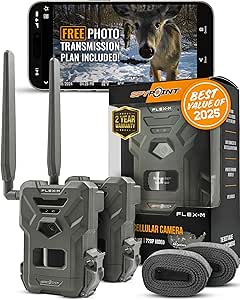 | Best for Two-Zone Cellular Coverage | Pack size: 2 cameras | Photo resolution: 28 MP | Video resolution: 720p with sound | VIEW ON AMAZON | See Our Full Breakdown |
| 4G LTE Cellular Trail Camera with 360° Live Streaming, Solar Power, Night Vision, and Motion Tracking (2-Pack) |  | Best for Live Remote Coverage | Quantity: 2 cameras | Video resolution: 2.5K | Connectivity: 4G LTE cellular | VIEW ON AMAZON | See Our Full Breakdown |
| WOSPORTS 48MP 4K Trail Camera with Night Vision |  | Best for Offline Recording | Photo resolution: Up to 48 MP | Video resolution: Up to 4K | Trigger speed: 0.2 seconds | VIEW ON AMAZON | See Our Full Breakdown |
| Cinnado 4G LTE Solar Trail Camera with 2K Video |  | Best for Two-Way Outdoor Interaction | Connectivity: 4G LTE | Video resolution: 1296p | Still resolution: 3 MP | VIEW ON AMAZON | See Our Full Breakdown |
| MAXDONE Solar Trail Camera with 4K Video and 64MP Photos |  | Best for Solar-Powered Local Capture | Video resolution: 4K | Photo resolution: 64 MP | Night vision range: Up to 65 ft | VIEW ON AMAZON | See Our Full Breakdown |
| WOSPORTS Mini Trail Camera, 30MP 1080P HD with Motion Detection and Infrared Night Vision |  | Best Compact Budget-Style Pick | Photo resolution: 30MP | Video resolution: 1080P HD | Night vision: 850nm infrared LEDs | VIEW ON AMAZON | See Our Full Breakdown |
| 4G LTE Cellular Trail Camera with 2.5K Live Streaming and 360° Coverage |  | Best for Remote Property Monitoring | Connectivity: 4G LTE cellular | Video resolution: 2.5K live streaming | Pan and tilt: 355° horizontal and 100° vertical | VIEW ON AMAZON | See Our Full Breakdown |
| Meidase P70 Trail Camera with 64MP Photos, 1296p Video, and No-Glow Night Vision |  | Best for Discreet Local Recording | Photo resolution: 64MP | Video resolution: 1296p | Trigger speed: 0.1 seconds | VIEW ON AMAZON | See Our Full Breakdown |
| game camera for home security camera | Video resolution | Connectivity | Photo resolution | Trigger speed |
|---|---|---|---|---|
| Oculview 4G LTE Cellular Trail | — | 4G LTE; built-in SIM | — | — |
| Moultrie EDGE 3 Cellular Trail | 1080p | — | 40MP | 0.5 seconds |
| WOSPORTS 64MP 4K Trail Camera | 4K (3840 × 2160) | — | Up to 64MP | 0.2 seconds |
| MagicEagle 4G Cellular Trail C | 2K | 4G cellular; no physical SIM required | 5MP | — |
| KJK 4K 64MP WiFi Bluetooth Tra | 4K | Bluetooth and camera Wi-Fi; no home-router connection | 64MP | 0.1 seconds |
| SPYPOINT FLEX-M Twin Cellular | 720p with sound | — | 28 MP | 0.5 seconds |
| 4G LTE Cellular Trail Camera w | 2.5K | 4G LTE cellular | — | — |
| WOSPORTS 48MP 4K Trail Camera | Up to 4K | Non-cellular; no Wi-Fi | Up to 48 MP | 0.2 seconds |
| Cinnado 4G LTE Solar Trail Cam | 1296p | 4G LTE | — | 0.2 seconds |
| MAXDONE Solar Trail Camera wit | 4K | Wi-Fi and Bluetooth via camera-created hotspot; no home Wi-Fi or cellular | 64 MP | 0.1 seconds |
| WOSPORTS Mini Trail Camera | 1080P HD | — | 30MP | — |
| 4G LTE Cellular Trail Camera w | 2.5K live streaming | 4G LTE cellular | — | 0.2 seconds |
| Meidase P70 Trail Camera with | 1296p | Non-cellular, non-Wi-Fi | 64MP | 0.1 seconds |
More Details on Our Top Picks
Oculview 4G LTE Cellular Trail Camera with 336° Pan and 90° Tilt
For a property without Wi-Fi, I’d put the Oculview near the top of the list for remote access and adjustable coverage. Its 4G LTE connection supports live viewing and motion alerts, while the 336° pan and 90° tilt let me check more of an area from one mounting point than the fixed-view KJK 4K 64MP WiFi Bluetooth Trail Camera. Solar charging and IP65 weather resistance also suit an outdoor installation where frequent battery visits are inconvenient. The tradeoff is ongoing cellular service: the built-in SIM includes only a seven-day trial, cannot be replaced, and is limited to U.S. use. Unlike the non-cellular WOSPORTS 64MP 4K, it can send alerts remotely, but using that advantage requires a data plan; local memory card storage is available, but the card is not included.
Pros:- 4G LTE enables remote live viewing and motion alerts without Wi-Fi
- 336° pan and 90° tilt cover a broader area than fixed-view cameras
- Solar charging and IP65 weather resistance support outdoor placement
- Infrared night vision plus a manually activated spotlight
Cons:- Continued cellular use requires a paid data plan after the seven-day trial
- Built-in SIM is non-replaceable and use is limited to the United States
- Memory card is not included
Best for: U.S. property owners who need app-based live viewing and alerts in an outdoor area without Wi-Fi, and can budget for cellular service.
Not ideal for: Buyers who want service without a recurring data plan, need a replaceable SIM, or want a memory card included.
- Connectivity:4G LTE; built-in SIM
- Pan and tilt:336° pan; 90° tilt
- Digital zoom:4X
- Night vision range:Up to 65 ft
- Spotlight range:Up to 100 ft
- Motion detection:120° PIR; 0.2-second activation
- Storage:Cloud or local memory card up to 128 GB; card not included
- Weather resistance:IP65
Our verdict“Choose the Oculview if you need remote, adjustable monitoring beyond Wi-Fi range and accept the service-plan and U.S.-only limits.”
Moultrie EDGE 3 Cellular Trail Camera, 2-Pack, 40MP, 0.5-Second Trigger
I’d choose the Moultrie EDGE 3 when one camera cannot watch all the entrances, sheds, or boundary points that matter. The two-camera bundle gives a home-security setup broader placement options than the single-unit Oculview, and both cameras can send alerts through cellular service that auto-connects across four major U.S. networks. Its 40MP photos, 1080p video, and 100-foot detection range provide useful detail and reach, while GPS mapping helps track camera locations across a larger property. AI animal detection can also help separate wildlife activity from the alerts a property owner wants to check. This is a more connected, multi-camera choice than the WOSPORTS 64MP 4K, but the latter avoids cellular service requirements. The Moultrie’s drawbacks are the need for a plan and the fact that compatible rechargeable packs and solar panels are not specified as included.
Pros:- Two cameras make it easier to monitor separate property areas
- Auto-connects across four major U.S. cellular networks
- AI animal detection, real-time alerts, GPS mapping, and remote controls
- 40MP photos, 1080p video, and a 100-foot detection range
Cons:- Connected features require a cellular service plan
- Compatible rechargeable battery packs and solar panels are not specified as included
- A 0.5-second trigger is slower than the 0.2-second WOSPORTS and Oculview options
Best for: Rural property owners who want to monitor two separate outdoor locations with remote cellular alerts and app-based controls.
Not ideal for: Buyers who need a single camera, do not want cellular service, or expect rechargeable batteries or solar panels in the box.
- Pack size:2 cameras
- Photo resolution:40MP
- Video resolution:1080p
- Trigger speed:0.5 seconds
- Detection range:100 ft
- Cellular connectivity:Auto-connects across four major U.S. networks
- Night vision:Low-glow infrared
- Warranty:2 years from activation
Our verdict“Pick this bundle if you need cellular alerts from two outdoor locations and are comfortable arranging service and power accessories.”
WOSPORTS 64MP 4K Trail Camera with No-Glow Night Vision
The WOSPORTS suits a buyer who wants a trail camera to record activity locally rather than send security alerts to a phone. Its 4K video, up-to-64MP photos, and 0.2-second trigger make it a capable recorder for fast-moving activity, while no-glow infrared night vision helps keep nighttime monitoring unobtrusive. The included 16GB card means there is storage to start with, unlike the KJK 4K 64MP WiFi Bluetooth Trail Camera, which requires a separately purchased microSD card. Neither camera connects to a home router, but this WOSPORTS has no cellular service requirement and supports cards up to 256GB. That tradeoff matters: I’d choose it over the cellular Oculview for avoiding a data plan, but not for remote live viewing or alerts. AA batteries are not included, and solar or rechargeable power costs extra.
Pros:- Captures up to 64MP photos and 4K video
- 0.2-second trigger and 120° motion detection
- No-glow infrared night vision reaches up to 80 ft
- Includes a 16GB memory card and supports cards up to 256GB
Cons:- No cellular or Wi-Fi connectivity for remote alerts or live viewing
- 8 AA batteries are not included
- Rechargeable battery and solar panel are sold separately
Best for: Homeowners who want high-resolution, no-glow local recording at a remote outdoor spot and do not need phone alerts.
Not ideal for: Buyers who need live viewing or motion alerts away from home, or want solar power or AA batteries included.
- Photo resolution:Up to 64MP
- Video resolution:4K (3840 × 2160)
- Trigger speed:0.2 seconds
- Detection angle:120°
- Night vision:No-glow infrared; up to 80 ft
- Display:2-inch color LCD
- Storage:16GB card included; supports memory cards up to 256GB
- Power:8 AA batteries; rechargeable battery and solar panel sold separately
Our verdict“Choose the WOSPORTS if you prefer detailed local recordings without a cellular plan and can check the camera and its card in person.”
MagicEagle 4G Cellular Trail Camera with Solar Panel
The MagicEagle is a sensible fit when a camera must stay outdoors for long stretches and still provide app-based access. Its 13,000 mAh battery, solar-panel compatibility, and stated standby time of up to three months point toward less frequent visits than a battery-dependent setup such as the KJK 4K 64MP WiFi Bluetooth Trail Camera. Cellular live viewing and tracking also give it a clear home-security advantage over the non-connected WOSPORTS 64MP 4K. It records 2K video and 5MP photos, which is a more modest resolution emphasis than those 4K models, but may be enough when remote checking matters more than maximum detail. The 100MB data offer lasts 30 days after activation; continued use requires a paid plan. Solar compatibility does not mean a panel is included.
Pros:- 13,000 mAh battery and stated standby time of up to three months
- App-based live viewing and tracking over 4G cellular
- IP66 weather resistance and an operating range of -20°C to 50°C
- No-glow 940 nm infrared night vision
Cons:- Only 100MB of data is included for 30 days after activation
- Ongoing cellular data requires a paid plan
- Solar-panel compatibility does not confirm that a panel is included
Best for: Owners of remote outdoor properties who want app-based cellular monitoring, a large onboard battery, and a weather-resistant camera.
Not ideal for: Buyers who need 4K video or high-resolution stills, want to avoid cellular fees, or assume a solar panel comes with the camera.
- Connectivity:4G cellular; no physical SIM required
- Photo resolution:5MP
- Video resolution:2K
- Motion trigger:0.3 seconds
- Night vision:940 nm no-glow infrared
- Battery capacity:13,000 mAh
- Standby time:Up to 3 months
- Weather resistance:IP66
Our verdict“Pick the MagicEagle for extended outdoor cellular monitoring where battery capacity matters more than 4K image resolution.”
KJK 4K 64MP WiFi Bluetooth Trail Camera
I’d place the KJK in the role of a locally managed camera for someone who wants to check recordings and adjust settings while near the device. Bluetooth and the camera’s own Wi-Fi let a phone connect within range, but this is not a home-router camera, so it cannot provide the remote access offered by the cellular Oculview or MagicEagle. Its 0.1-second trigger and 130° detection angle are the quickest and widest listed among these five picks, helping capture activity that passes quickly through the frame. It also records 4K video and 64MP photos, matching the WOSPORTS on headline resolution while adding phone-based local access. The limits are practical: the microSD card is sold separately, and checking footage still requires being close enough to connect. Eight AA batteries and a mounting bracket are included.
Pros:- 0.1-second trigger and 130° detection angle
- 4K video and 64MP photos
- Bluetooth and camera Wi-Fi support phone previews, downloads, and settings nearby
- Includes 8 AA batteries and a mounting bracket
Cons:- Cannot connect to a home Wi-Fi router or provide remote monitoring
- MicroSD card is not included
- Phone access depends on being within the camera’s connection range
Best for: Homeowners who can visit the camera and want phone-based previews and settings without paying for cellular service.
Not ideal for: Buyers who expect remote alerts over home Wi-Fi, need to view footage from elsewhere, or want a memory card included.
- Model:KJK230
- Video resolution:4K
- Photo resolution:64MP
- Trigger speed:0.1 seconds
- Detection angle:130°
- Connectivity:Bluetooth and camera Wi-Fi; no home-router connection
- Memory card support:microSD up to 128GB; card not included
- Included accessories:8 AA batteries and mounting bracket
Our verdict“Choose the KJK for fast, high-resolution local monitoring with nearby phone access, not for remote home-security alerts.”
SPYPOINT FLEX-M Twin Cellular Trail Cameras
The two-camera bundle is a practical choice for monitoring separate approaches to a home, such as a driveway and rear boundary, without relying on Wi-Fi. Its dual-SIM, multi-carrier LTE setup can choose among available networks, while app-based remote management and GPS make it easier to check camera status and location. Compared with the WOSPORTS 48MP 4K Trail Camera, the SPYPOINT can send captures remotely, but its 720p video gives up detail to gain cellular access. A 0.5-second trigger and 90-foot motion range suit routine outdoor activity, though neither replaces a dedicated security camera for continuous monitoring. The optional LIT-22 battery pack can extend operation, but it is a separate purchase; without it, buyers need to plan their power setup.
Pros:- Two cameras cover separate areas with one pack.
- Dual-SIM LTE supports carrier selection for remote access.
- App management and GPS help with off-site monitoring and camera location.
- Low-glow night vision and 90-foot motion detection support outdoor use.
Cons:- 720p video captures less detail than the 2.5K and 4K options in this roundup.
- The compatible LIT-22 rechargeable battery pack is sold separately.
- Trail-camera capture is not the same as continuous home-security video.
Best for: Homeowners who want cellular alerts and remote management from two outdoor monitoring points without depending on a home Wi-Fi signal.
Not ideal for: Buyers who need sharp video evidence, continuous live viewing, or a rechargeable LIT-22 battery included in the box.
- Pack size:2 cameras
- Photo resolution:28 MP
- Video resolution:720p with sound
- Cellular connectivity:LTE, dual-SIM, multi-carrier
- Trigger speed:0.5 seconds
- Motion detection range:90 ft
- Night vision:Low glow
- Water resistance:IP65
- Power:Compatible with optional LIT-22 rechargeable battery pack
Our verdict“Choose this pair if cellular access to two outdoor zones matters more than high-resolution video or continuous surveillance.”
4G LTE Cellular Trail Camera with 360° Live Streaming, Solar Power, Night Vision, and Motion Tracking (2-Pack)
For buyers who want to check a property live rather than wait for motion-triggered captures, this two-camera LTE set offers a different kind of coverage from the SPYPOINT FLEX-M Twin. Its 2.5K streaming, 360° pan-and-tilt, and AI tracking can follow movement across a broad outdoor area, while a solar panel and 7800mAh battery support placement away from an outlet. That combination is more surveillance-oriented than the WOSPORTS 48MP 4K camera, which records locally but has no remote connection. The tradeoff is ongoing connectivity: live streaming needs a cellular data subscription, and cloud storage also carries a paid subscription requirement. A microSD card is not included, so local recording means providing your own card. It makes sense where live viewing is worth the added data and storage planning.
Pros:- 2.5K live video and 360° pan-and-tilt provide broad remote viewing.
- AI tracking follows people, animals, and vehicles.
- Solar panel and 7800mAh battery support off-grid installation.
- App can display up to four cameras together.
Cons:- Live streaming requires a cellular data subscription.
- Cloud storage is paid, and a microSD card must be supplied separately.
- More moving parts and subscription dependencies may be unnecessary for simple motion-triggered recording.
Best for: Property owners monitoring broad outdoor areas without Wi-Fi who want remote live viewing, camera movement, and solar-assisted power.
Not ideal for: Buyers avoiding cellular or cloud subscriptions, or anyone who wants a ready-to-record package with a memory card included.
- Quantity:2 cameras
- Video resolution:2.5K
- Connectivity:4G LTE cellular
- Coverage:360° pan and tilt
- Tracking:AI human and animal auto-tracking
- Night vision:Infrared black-and-white and white-light color
- Battery and solar:7800mAh rechargeable battery; 3W solar panel
- Storage:MicroSD up to 128GB, not included, or paid cloud storage
- Dimensions:5 × 3 × 4 inches
Our verdict“Pick this two-camera set when live, steerable LTE viewing is the priority and subscription costs are acceptable.”
WOSPORTS 48MP 4K Trail Camera with Night Vision
The WOSPORTS is the straightforward choice for buyers who want local recording without subscriptions or network dependence. It captures up to 4K video and 48MP photos, saves footage to an included 32GB SD card, and offers an 80-foot infrared night-vision range. A 0.2-second trigger can help capture brief movement, while the built-in screen lets owners review clips at the camera. Unlike the cellular SPYPOINT FLEX-M Twin, it cannot send footage or alerts to a phone; its advantage is a simpler, offline setup with no signal requirement. That makes it useful for checking a detached structure or boundary where remote access is not needed. The compromise is access: footage must be retrieved from the card, and battery type and runtime are not specified.
Pros:- Records up to 4K video and 48MP photos.
- Includes a 32GB SD card and supports expansion up to 512GB.
- 80-foot infrared night vision and a 90-degree detection angle suit outdoor monitoring.
- Offline operation avoids cellular and cloud service requirements.
Cons:- No Wi-Fi or cellular connection means no remote alerts or viewing.
- Footage access requires retrieving the SD card or viewing it on the camera.
- Battery type and battery life are not specified.
Best for: Homeowners who can retrieve an SD card and want detailed local footage from a remote yard, shed, or property boundary.
Not ideal for: Buyers who need phone alerts, off-site footage access, Wi-Fi, cellular service, or clearly specified battery runtime.
- Photo resolution:Up to 48 MP
- Video resolution:Up to 4K
- Trigger speed:0.2 seconds
- Night vision range:Up to 80 ft
- Infrared LEDs:32 × 850nm low-glow LEDs
- Detection angle:90 degrees
- Display:2-inch color LCD
- Storage:32GB SD card included; expandable up to 512GB
- Connectivity:Non-cellular; no Wi-Fi
Our verdict“Choose this model for detailed, subscription-free local recording when remote access is not part of your security plan.”
Cinnado 4G LTE Solar Trail Camera with 2K Video
The Cinnado adds a feature most trail cameras here do not: two-way audio. Paired with 4G LTE, 360° pan-and-tilt, and a 5W solar panel, it can suit a gate, outbuilding, or yard where an owner wants to check activity and speak through the camera without home Wi-Fi. Compared with the 2.5K streaming two-pack, its 1296p video is lower resolution and this listing describes a single camera, but its 940nm no-glow infrared is a discreet fit for nighttime monitoring. The IP65 housing and stated operating range from -20°F to 140°F support outdoor placement. Cellular access depends on Verizon, AT&T, or T-Mobile coverage, and the claimed solar runtime depends on receiving direct sunlight, so placement and local signal can limit performance.
Pros:- Two-way audio allows remote communication at an outdoor location.
- 4G LTE works without a home Wi-Fi router.
- Solar panel and rechargeable battery reduce reliance on power cords.
- No-glow infrared and IP65 housing suit discreet outdoor monitoring.
Cons:- Cellular streaming depends on coverage from Verizon, AT&T, or T-Mobile.
- Solar performance depends on direct sunlight.
- 1296p video and 3MP stills provide less image detail than the 2.5K and 4K alternatives.
Best for: Owners of gates, sheds, and outdoor entry points who want LTE viewing, discreet night monitoring, and the ability to speak through the camera.
Not ideal for: Buyers in weak cellular coverage areas, those needing a multi-camera bundle, or anyone relying on shade for solar charging.
- Connectivity:4G LTE
- Video resolution:1296p
- Still resolution:3 MP
- Viewing angle:95 degrees
- Night vision:940nm no-glow infrared LEDs
- Water resistance:IP65
- Power:Solar panel and rechargeable battery; 5W panel
- Trigger speed:0.2 seconds
- Mounting:Tree mount or wall mount
Our verdict“Choose the Cinnado for a solar-assisted LTE camera where two-way audio and discreet night vision matter more than maximum resolution.”
MAXDONE Solar Trail Camera with 4K Video and 64MP Photos
The MAXDONE suits buyers who want a solar-assisted camera with strong local capture but do not need footage sent over a network. It pairs 4K video and 64MP photos with a 0.1-second trigger, a 6000mAh rechargeable battery, and an included 32GB SD card. Its adjustable solar panel helps owners direct the panel toward available sunlight, while the camera-created Wi-Fi hotspot lets a phone connect nearby to review or download clips. That is a different proposition from the cellular Cinnado: the MAXDONE avoids cellular service, but it also cannot send real-time alerts and does not connect to home Wi-Fi. The short-range app connection is for local access, not remote security monitoring, so buyers should be comfortable retrieving footage in person.
Pros:- Captures 4K video and 64MP photos with a 0.1-second trigger.
- Adjustable solar panel works with a 6000mAh rechargeable battery.
- Includes a 32GB SD card and supports storage up to 256GB.
- Camera-created hotspot allows short-range app access and downloads.
Cons:- No cellular connection, home Wi-Fi access, or real-time alerts.
- App access is limited to a short-range camera hotspot.
- Solar charging still depends on suitable sunlight and panel placement.
Best for: Property owners who want solar-assisted 4K local recording and nearby phone access without cellular service or cloud storage.
Not ideal for: Buyers who need remote alerts, off-site viewing, home Wi-Fi integration, or a camera that can report activity while they are away.
- Video resolution:4K
- Photo resolution:64 MP
- Night vision range:Up to 65 ft
- Trigger speed:0.1 seconds
- Battery capacity:6000mAh
- Charging methods:Solar, USB Type-C, rechargeable battery
- Included storage:32GB SD card
- Maximum supported storage:256GB
- Connectivity:Wi-Fi and Bluetooth via camera-created hotspot; no home Wi-Fi or cellular
Our verdict“Pick the MAXDONE for detailed, solar-assisted recording with nearby phone access, not for remote home-security alerts.”
WOSPORTS Mini Trail Camera, 30MP 1080P HD with Motion Detection and Infrared Night Vision
For a home-security setup focused on a shed, garden edge, or other spot without nearby power, I’d choose this compact, no-cellular trail camera when basic event recording matters more than remote viewing. It captures 30MP photos and 1080P video, with motion detection and 850nm infrared night vision for monitoring after dark. Compared with the Meidase P70, it is simpler and uses four AA batteries rather than eight, but the P70 offers a faster stated trigger, longer listed night-vision range, and much larger SD-card capacity. This WOSPORTS model’s IP66 rating and included mounting strap suit outdoor placement, though you’ll need to supply both batteries and a card. Product information also gives conflicting dimensions and weights, making exact sizing harder to verify.
Pros:- 30MP photos and 1080P video record motion events locally
- 850nm infrared night vision supports nighttime monitoring
- IP66 water resistance and an adjustable strap support outdoor mounting
- Uses four AA batteries, fewer than the Meidase P70’s eight
Cons:- No cellular or Wi-Fi connection for remote alerts or live viewing
- AA batteries and an SD card are not included
- Published dimensions and weight conflict, complicating placement planning
Best for: Homeowners who want a small, locally recording camera for a garden, outbuilding, or wildlife-access point and are comfortable checking the SD card in person.
Not ideal for: Buyers who need live alerts or remote viewing, or who want clearly verified dimensions before choosing a tight mounting location.
- Photo resolution:30MP
- Video resolution:1080P HD
- Night vision:850nm infrared LEDs
- Water resistance:IP66
- Power:4 AA batteries (not included)
- SD card support:Up to 32GB (card not included)
- Recording modes:Photo, video, or photo plus video
- Mounting:Tree mount with adjustable strap
Our verdict“Choose this compact WOSPORTS model for basic local recording in an outdoor spot, but pick the Meidase P70 for faster triggering and greater storage capacity.”
4G LTE Cellular Trail Camera with 2.5K Live Streaming and 360° Coverage
When a camera needs to cover a broad yard or remote outbuilding, this cellular model offers the most direct path to remote viewing and two-way communication among these three picks. Its 355° pan and 100° tilt can cover more ground than the fixed-view WOSPORTS Mini, while 2.5K live streaming, color night vision, motion alerts, and auto tracking make it more security-oriented than a camera that only saves clips to a card. The 7W solar panel and 12,000mAh battery can reduce routine charging, but they don’t remove the need for a cellular plan: the included trial is limited to seven days and 100MB, then a separate subscription is required for each camera. Compared with the non-connected Meidase P70, this is far more convenient to check remotely, but it brings ongoing service costs and depends on cellular coverage.
Pros:- 2.5K live streaming and two-way audio support active remote monitoring
- 355° pan and 100° tilt cover a broad area from one mounting point
- 7W solar panel and 12,000mAh rechargeable battery can reduce charging visits
- IP66 rating and stated operating range from -4°F to 131°F suit outdoor placement
Cons:- Requires a separate cellular subscription per camera after the limited trial
- The trial provides only 100MB of data over seven days
- Remote functions depend on usable LTE coverage at the installation site
Best for: Owners of remote homes, large yards, or outbuildings with LTE coverage who want live viewing, motion alerts, and the ability to speak through the camera.
Not ideal for: Buyers seeking a one-time local-recording setup, living outside reliable cellular coverage, or unwilling to pay a separate service plan for each camera.
- Connectivity:4G LTE cellular
- Video resolution:2.5K live streaming
- Pan and tilt:355° horizontal and 100° vertical
- Trigger speed:0.2 seconds
- Night vision range:Up to 100 feet; color night vision
- Power:12,000mAh rechargeable battery and 7W solar panel
- Water resistance:IP66
- Audio:Two-way audio
- Data trial:7 days, 100MB
Our verdict“Pick this model when remote live monitoring and broad pan-and-tilt coverage justify cellular service; choose the Meidase P70 for local recording without recurring connectivity costs.”
Meidase P70 Trail Camera with 64MP Photos, 1296p Video, and No-Glow Night Vision
I’d choose the Meidase P70 for a home perimeter where quiet, discreet recording matters more than checking footage remotely. Its 36 no-glow 940nm LEDs are designed to avoid the visible glow associated with some infrared setups, while the stated 0.1-second trigger speed helps capture quick movement before it leaves the frame. The 64MP photo resolution and 1296p video exceed the WOSPORTS Mini’s listed resolutions, and support for cards up to 512GB gives it a substantial local-storage advantage over that model’s 32GB limit. The tradeoff is a more hands-on setup: it needs eight AA batteries or a separately sold solar panel, plus a separately purchased card. Unlike the cellular 2.5K camera, the P70 has no Wi-Fi or cellular connection, so retrieving footage means accessing the camera.
Pros:- 36 no-glow 940nm LEDs support discreet night monitoring up to 100 feet
- 0.1-second trigger speed is suited to fast-moving subjects
- 64MP photos, 1296p video, and support for cards up to 512GB
- IP66 waterproofing and an optional solar panel support outdoor use
Cons:- No cellular or Wi-Fi connection for live viewing or remote alerts
- Requires eight AA batteries, sold separately
- SD card and optional SP350 solar panel are also sold separately
Best for: Homeowners who want discreet, locally stored footage of wildlife or movement near a boundary and can visit the camera to retrieve recordings.
Not ideal for: Buyers who need live feeds, phone alerts, two-way audio, or a simple setup without separately sourcing batteries, storage, or optional solar power.
- Photo resolution:64MP
- Video resolution:1296p
- Trigger speed:0.1 seconds
- Night vision:100 feet; 36 no-glow 940nm IR LEDs
- Display:2.4-inch color screen
- Storage:SD/SDHC/SDXC cards up to 512GB
- Power:8 AA batteries or optional SP350 solar panel
- Connectivity:Non-cellular, non-Wi-Fi
- Water resistance:IP66
Our verdict“Choose the P70 for high-resolution, no-glow local recording and generous card support, but select the cellular 2.5K model if you need to monitor footage remotely.”

How We Picked
I ranked these cameras for home-security tasks, not just wildlife recording. The main criteria were how a buyer can receive footage or alerts, how much area each camera can cover, whether power and storage suit a fixed installation, and how clearly the stated features translate into practical monitoring. I also weighed setup and upkeep: a camera that needs dependable cellular service or frequent battery visits may be a poor fit for a remote property, even if it offers live viewing.
The ranking favors the Oculview 4G LTE for its stated pan-and-tilt range and cellular access, then distinguishes multi-location kits, solar-assisted cellular options, and local-connectivity or simpler recording cameras. A high-resolution label alone does not move a camera to the top: trigger response, network access, coverage, and maintenance can matter more when the goal is to notice activity and retrieve useful footage. Specifications and network compatibility can vary by version, so buyers should confirm service coverage, storage options, and plan terms before purchase.
Factors to Consider When Choosing Game Camera For Home Security Cameras
Choosing a trail camera for security starts with the site, not the resolution printed on the box. These cameras range from remote cellular systems to local-use models, and the right tradeoff depends on whether you need live access, broad coverage, or a low-maintenance recording setup.
Match Connectivity to the Camera’s Location
Start by checking whether the mounting spot has reliable home Wi-Fi or cellular coverage, rather than assuming either will reach. Cellular models can send alerts or images from a remote outbuilding, but they may require an active data plan and a compatible carrier signal. Wi-Fi and Bluetooth models can avoid cellular service, yet their usefulness may depend on being close enough to a network or returning to the camera to retrieve files. A common mistake is buying for the property’s general signal instead of testing the exact location behind walls, trees, or metal siding. If live access is central to your security plan, confirm the camera’s network bands and service terms before installation.
Plan the View Around Entrances and Blind Spots
A wide or moving camera view can monitor a large open area, but it does not automatically capture the detail you need at a doorway or gate. Pan-and-tilt and 360-degree models may reduce blind spots from one mounting point, while a two-camera kit can place one camera at each approach. Fixed cameras can be easier to aim and may suit a narrow path better than a camera that scans a broad scene. Avoid mounting directly toward strong light or where branches will trigger repeated motion alerts. Sketch the approaches you want to cover before choosing between one movable camera and multiple fixed positions.
Choose Power for How Often You Can Visit
Battery-powered cameras are straightforward to mount, though frequent recordings, live streaming, cold weather, and weak signal can increase power demands. Solar panels can reduce routine battery changes when the panel receives enough suitable light, but they do not make a camera maintenance-free. A shaded fence line or north-facing outbuilding may not provide the conditions the panel needs. Check whether the camera has backup power support and whether the panel can be positioned separately from the lens. Buyers who cannot visit often should plan for seasonal light changes and test the full setup before relying on it.
Decide How You Need to Review Footage
Live viewing is useful when you need to check an event promptly, while local storage can work for routine monitoring when immediate access is less important. Cellular systems may send selected images or clips, but the actual delivery method and service limits depend on the model and plan. An SD card can preserve recordings if a network drops, though someone may need to retrieve it. Check whether the camera supports the storage method you prefer and whether recorded clips remain available without an active service plan. For security use, test alert timing and playback before treating the camera as your only record of an incident.
Prioritize Night Coverage and Trigger Placement
Night vision labels do not tell the whole story: the useful distance depends on the scene, mounting height, and subject movement. No-glow infrared can be less visible to people, which may suit discreet monitoring, while placement still determines whether faces or license plates are captured clearly. A fast trigger can help with subjects crossing a narrow path, but it cannot compensate for aiming too far from the activity. Set the camera to cover the approach rather than the empty space beyond it, and test both daytime and nighttime clips. If identifying a person matters, choose an angle and distance that support detail instead of relying on megapixel claims alone.
Balance Upfront Simplicity Against Ongoing Costs
A lower-complexity local camera may be easier to operate, while a cellular model can add recurring service costs and account setup. The camera’s total ownership burden also includes batteries, storage cards, panel positioning, and occasional visits to check mounting or signal. Paying more for remote access makes sense when a property is far away and timely alerts have real value; it may be unnecessary for a backyard where Wi-Fi is already available. Before buying, list who will receive alerts, who can retrieve footage, and how often someone can maintain the camera. This simple plan can prevent paying for features that the site cannot use.
Frequently Asked Questions
Do I need a cellular plan to use a trail camera for home security?
Not always. Cellular models need compatible service for remote image delivery or live access, and plan terms can vary by camera and provider. A Wi-Fi or local-storage model may work without cellular service if you can connect nearby or retrieve its memory card. Check whether basic recording works without a subscription and what features stop when service lapses. For a remote shed or gate, confirm signal at the mounting point before choosing a cellular camera.
Is one 360-degree camera better than two cameras pointed at separate entrances?
It depends on the layout and the detail you need. A rotating or 360-degree camera can cover a broad area from one location, but moving coverage may not show every approach at the same moment. Two cameras can watch separate entrances continuously and create more useful angles, though they require more mounting and power planning. If activity could happen at either of two gates simultaneously, separate cameras may be the safer arrangement. For one open yard with no fixed entry points, broad coverage may be more convenient.
Can a solar trail camera run reliably through winter or in a shaded spot?
Solar support depends on usable sunlight, panel placement, weather, and how often the camera records or streams. Winter days and heavy shade can reduce the energy available, so a solar panel should not be treated as a guarantee of uninterrupted operation. Keep a backup power plan and check whether the panel can face a sunnier direction than the camera itself. Test the setup during the season and conditions when you expect the most use. For a deeply shaded site, a replaceable-battery setup may be easier to manage.
Should I choose a high-megapixel camera or a faster trigger for identifying visitors?
Neither specification alone guarantees useful identification. A fast trigger can capture someone crossing a monitored path, while resolution helps only if the person is close enough and the camera is aimed at a suitable angle. For a gate or doorway, place the camera where a person approaches the lens rather than moving quickly across the frame. Review sample footage at night as well as during the day, since lighting changes what details remain visible. Prioritize placement and alert access before treating a large megapixel number as a security advantage.
What should I check before mounting a cellular camera on a remote property?
Check carrier coverage at the exact mounting location, not just the nearest town or the property entrance. Confirm the camera supports a carrier available there and learn what the service plan includes, such as image delivery, video access, or data limits. Test the camera where it will be installed and see whether alerts arrive consistently before relying on it. Also plan for power, storage, and a way to reach the camera if it needs adjustment. A weak signal can affect remote access even when the camera still records locally.
Conclusion
For the broadest remote view from one mounting point, my best overall choice is the Oculview 4G LTE camera with pan-and-tilt coverage. The best value for covering multiple locations is the Moultrie EDGE 3 2-Pack, while the best premium-style fit for remote sites with power concerns is the MagicEagle cellular camera with solar support. Beginners who want a simpler, local-use setup can start with a WOSPORTS or Meidase model, provided they do not need dependable remote alerts. For a property with separate approaches, choose a twin pack such as Moultrie or SPYPOINT; for a broad open area, compare the 360-degree cellular options. Match the camera to signal, power, and coverage needs first, then choose resolution and extras.