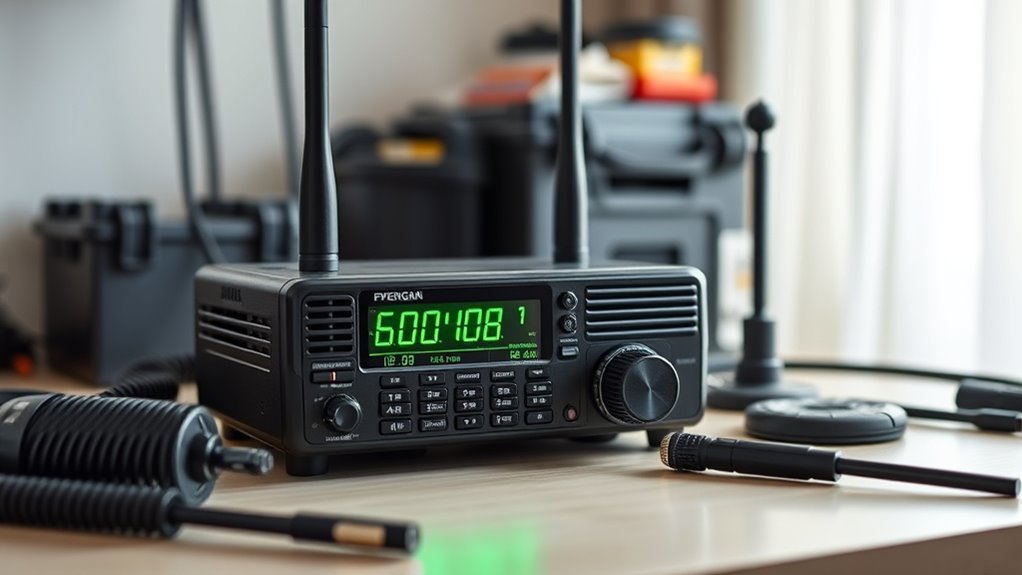

For most households, the BTECH GMRS-50PRO is the best overall base station radio for home emergency comms because it pairs 50-watt GMRS output with weather alerts and weather-resistant construction. The ABBREE AR-8118 is a more approachable GMRS alternative with a programming cable and car adapter, while the Galaxy DX-2547 suits people who need a CB setup rather than a licensed GMRS or amateur-radio system. The main tradeoffs are radio-service compatibility, the skill needed to program and operate the set, and the antenna and backup power your home setup requires. A high wattage number alone does not guarantee communication when power or local coverage fails. Read on for the full comparison and advice on matching a radio to your household and emergency plan.

Get privacy and security gear delivered free with Prime
- Fast, free delivery on millions of items
- Prime Video, Amazon Music and more included
- Member-only deals all year
Key Takeaways
- The BTECH GMRS-50PRO leads for a fixed GMRS setup: its 50-watt output, IP54-rated housing, NOAA reception, Bluetooth, and GPS give it a broader emergency-oriented feature set than the 25-watt ABBREE AR-8118 and QYT KT-8900.
- The ABBREE AR-8118 is the more accessible GMRS pick: it includes a programming cable and car adapter, but its lower output and less feature-rich profile make it a simpler alternative rather than the most capable fixed base.
- Radio service matters more than matching wattage: GMRS models, amateur radios, CB equipment, and 10-meter radios are not interchangeable; each has different operating rules, compatibility, and user requirements.
- The 50-watt amateur radios favor capable operators: the TH-9800D and BTECH UV-50X2 offer broader VHF/UHF flexibility than GMRS choices, but their usefulness depends on licensing, programming, and the repeaters or contacts available nearby.
- A radio is only one part of a resilient home station: these mobile-style units need a suitable power supply and an effective antenna installation, so emergency readiness depends on the complete setup rather than the radio alone.


| base station radio for home emergency comm | Channels | Frequency range | Water resistance | Dimensions |
|---|---|---|---|---|
| ABBREE GMRS Mobile Radio | 200 | 462–467 MHz | Not water resistant | — |
| TH-9800D Quad Band 50W VHF UHF | 800 | 28–29.7, 50–54, 144–148, and 420–450 MHz | Not water resistant | 140 × 40 × 168 mm |
| Ham Radio Base Station AT-778U | 200 | 144–148 MHz / 420–450 MHz | Not water resistant | — |
| BTECH GMRS-50PRO IP54 Weatherp | 180 | — | IP54 | 3 × 3 × 11 in |
| BTECH UV-50X2 Second Generatio | 200 | — | Not water resistant | 7.5 × 5.7 × 1.85 in |
| Galaxy DX-2547 AM/SSB CB Base | 19 | — | — | 11-1/8"W x 11-1/2"D x 4-1/4"H |
| QYT KT-8900 25W GMRS Mobile Ra | 200 | 136–174 MHz VHF; 400–480 MHz UHF; listed GMRS frequencies 462.5625–462.7125 MHz | — | 4.65"D x 3.86"W x 1.38"H |
| Retevis RT95 Dual Band Mobile | 200 | 144–148 MHz / 420–450 MHz | Not water resistant | 4.88"D x 6.42"W x 1.54"H |
| ABBREE Mobile Ham Radio 30W GP | 500 | 136–174 MHz; 400–480 MHz | Not water resistant | — |
| Retevis Ailunce HS4 10 Meter R | 360 | 28.000–29.700 MHz | — | 11.02"D x 7.87"W x 2.36"H |
More Details on Our Top Picks
ABBREE GMRS Mobile Radio, 25W Long Range AR-8118 GMRS Repeater Capable Base Station, NOAA Emergency Weather Two Way Radio with Programming Cable and Car Adapter
For a household that wants one radio for a powered home setup and compatible vehicle use, the ABBREE AR-8118 is a practical middle-ground pick. Its 25W GMRS output, 200 channels, repeater capability, and NOAA weather alerts cover useful emergency basics without the extra features of the 50W BTECH GMRS-50PRO. The included car adapter also makes temporary vehicle use simpler, though a dependable home setup still calls for a suitable antenna and stable power source. Compared with the amateur-radio TH-9800D, the ABBREE is aimed at GMRS users rather than licensed ham operators, but its supplied programming cable may still require software for deeper customization. The main compromises are meaningful for home preparedness: it is not water resistant, and Dual-Watch scanning may produce noise. I would choose it for straightforward GMRS coverage, not unattended outdoor placement.
Pros:- 25W output and repeater capability support communication beyond basic simplex use.
- NOAA weather alerts add a useful source of hazard information.
- 200 channels offer room for organizing local and repeater channels.
- Programming cable and car adapter support setup and vehicle use.
Cons:- Not water resistant, so it needs a dry, protected location.
- Dual-Watch scanning may introduce noise.
- Full customization requires programming software.
Best for: GMRS households seeking a 25W radio that can move between a home base setup and a vehicle, with weather alerts and repeater support.
Not ideal for: Buyers who need a weather-sealed radio for an exposed installation, or who want extensive programming without using software.
- Model:AR-8118
- Power:25W
- Channels:200
- Frequency range:462–467 MHz
- Claimed talking range:Up to 30 km
- Weather alerts:NOAA
- Water resistance:Not water resistant
- Additional features:VOX, dual PTT, repeater capable
Our verdict“Choose the AR-8118 if you want a flexible 25W GMRS radio for a protected home station that can also serve in a vehicle.”
TH-9800D Quad Band 50W VHF UHF Mobile Ham Radio Transceiver
The TH-9800D suits a home emergency station built around licensed amateur-radio operation and access to several bands. Its quad-band coverage, 800 channels, dual display, and cross-band repeat give an experienced operator more coordination options than the dual-band BTECH UV-50X2. The detachable control head can also make a fixed installation easier to arrange, while the radio itself needs a 13.8V DC supply capable of handling its stated transmit current. That added capability is not a benefit for every household: this is not a GMRS radio, and amateur-radio privileges are required to transmit on the relevant amateur frequencies. Unlike the GMRS-50PRO, it also lacks a stated water-resistance rating, so I would keep it indoors and protect its antenna connections. I’d rank it for licensed operators who value band coverage over plug-and-play simplicity.
Pros:- Quad-band frequency coverage offers more operating options than dual-band radios.
- 800 channels provide extensive memory capacity for programmed frequencies.
- Dual display and cross-band repeat support flexible monitoring and relaying.
- Detachable control head allows adaptable mounting.
Cons:- Requires an amateur-radio license for transmitting on amateur frequencies.
- Not water resistant, limiting use to a protected location.
- Transmit current reaches about 8.5A, calling for an appropriate power supply.
Best for: Licensed amateur-radio operators building a powered home station who want quad-band coverage, many memories, and cross-band repeat capability.
Not ideal for: Families seeking a simple GMRS emergency radio, or anyone who cannot provide a suitable 13.8V supply and protected indoor installation.
- Frequency range:28–29.7, 50–54, 144–148, and 420–450 MHz
- Maximum output power:Up to 50W
- Channels:800
- Dimensions:140 × 40 × 168 mm
- Weight:Approx. 1.2 kg
- Operating voltage:13.8V DC ±5%
- Transmit current:Approx. 8.5A
- Water resistance:Not water resistant
Our verdict“Pick the TH-9800D if you are a licensed operator who wants a versatile, indoor quad-band station rather than a simple GMRS setup.”
Ham Radio Base Station AT-778UV II with Car 20in Magnetic Mount Antenna
The AT-778UV II stands out for including a 20-inch magnetic-mount antenna, which gives a buyer a more complete starting point than the BTECH UV-50X2, whose full setup depends on additional accessories. Its 25W selectable output and VHF/UHF coverage make it a reasonable fit for a home operator who also wants an antenna option for an RV or vehicle. The rotatable TFT display can help when the radio is mounted at an awkward angle, and 200 memories leave space for local channels. This is still an amateur radio, not a ready-made family GMRS solution; buyers need the appropriate license to transmit. It is also not water resistant, and the supplied data says a USB programming cable is not included, so customization may take extra effort. I’d choose it for bundled hardware, not for the strongest power or outdoor durability.
Pros:- Included 20-inch magnetic-mount antenna provides a useful starting accessory.
- Selectable 25W, 15W, and 5W output supports different operating needs.
- Rotatable TFT display offers flexible viewing when mounting the radio.
- 200 memory channels and VOX support organized, hands-free operation.
Cons:- Not water resistant and needs a protected operating location.
- USB programming cable is not included.
- The listed warranty period is only 90 days.
Best for: Newer amateur-radio operators who want a dual-band radio and included magnetic-mount antenna for a protected home or RV setup.
Not ideal for: Buyers needing a weather-resistant fixed installation, included programming cable, or the 50W output available from the TH-9800D and UV-50X2.
- Model:AT 778UV II
- Power output:25W / 15W / 5W
- Channels:200
- Frequency range:144–148 MHz / 420–450 MHz
- Voltage:13.8V
- Claimed talking range:Up to 20 km
- Antenna:20-inch magnetic-mount antenna included
- Water resistance:Not water resistant
Our verdict“Choose the AT-778UV II if an included antenna and adjustable display matter more than 50W output or weather protection.”
BTECH GMRS-50PRO IP54 Weatherproof 50-Watt GMRS Base Station Radio with Bluetooth, GPS, NOAA, and Advanced Features
For a GMRS station that may sit in a garage, workshop, or other less-controlled space, the IP54-rated GMRS-50PRO has a clear advantage over the non-weather-resistant ABBREE AR-8118. Its 50W output, repeater support, NOAA alerts, Bluetooth, and GPS give a household more tools for communicating and coordinating than a basic mobile radio. The app-based programming and fleet-management features may also help when several compatible radios need consistent channel setups. This is still not a sealed outdoor or submersible unit: IP54 offers limited protection, not permission to leave it exposed to heavy rain. Its size and need for a vehicle or base power arrangement make it less convenient as a grab-and-go radio. I’d rank it ahead of the ABBREE for a more feature-rich, weather-resistant GMRS installation, while noting that the supplied maximum-range claim depends heavily on antenna placement, terrain, and repeater access.
Pros:- IP54 weather resistance offers more protection than the non-weather-resistant radios in this group.
- 50W output and repeater support suit a more capable GMRS base setup.
- Bluetooth, GPS, and NOAA alerts add coordination and weather-information features.
- App-based programming can simplify managing compatible radios.
Cons:- IP54 does not make the radio submersible or suitable for unprotected exposure to heavy weather.
- Its size and setup needs make it less suited to portable use.
- Best operation depends on an appropriate base or vehicle installation.
Best for: GMRS users who want a higher-powered, feature-rich station for a garage, workshop, or protected base location, with GPS and app-based setup.
Not ideal for: Buyers who need a submersible or fully outdoor radio, or a compact handheld device that works without a base or vehicle setup.
- Channels:180
- Frequency band:GMRS
- Maximum output power:50W
- Claimed maximum talking range:Up to 100 miles
- Operating voltage:13.8V
- Water resistance:IP54
- Dimensions:3 × 3 × 11 in
- Connectivity and features:Bluetooth, GPS, NOAA alerts
Our verdict“Choose the GMRS-50PRO if you want a higher-powered GMRS station with limited weather protection and added coordination features.”
BTECH UV-50X2 Second Generation 50 Watt Dual Band Mobile Radio VHF UHF Amateur Ham
The BTECH UV-50X2 is a strong fit for amateur operators who already have a plan for their antenna, power supply, and programming. Its 50W dual-band output, 200 channels, and ability to monitor multiple frequencies make it more capable than the 25W AT-778UV II for a fixed station where power and simultaneous monitoring matter. The broad accessory compatibility is useful for tailoring microphones and audio gear to a home communications desk. But that flexibility brings setup work: the radio needs a suitable 13.8V DC supply and extra accessories, while programming may feel demanding for a newcomer. Compared with the quad-band TH-9800D, it covers fewer bands, so it is a more focused choice rather than the lineup’s widest-frequency option. It is also not water resistant. I’d pick it for an established ham setup, not as an all-in-one family emergency radio.
Pros:- 50W output gives it more transmit power than the 25W AT-778UV II.
- Dual-band VHF/UHF operation supports flexible amateur-radio use.
- Multiple-frequency monitoring helps an operator keep track of more than one channel.
- Wide accessory compatibility allows a tailored home setup.
Cons:- Requires additional accessories, including a suitable power supply and antenna for a home installation.
- Complex setup may challenge first-time radio users.
- Not water resistant and requires a protected location.
Best for: Licensed amateur-radio operators who want a 50W VHF/UHF base or mobile radio and already have compatible power, antenna, and audio accessories.
Not ideal for: Beginners seeking a simple, ready-to-operate emergency station, or households needing GMRS channels and weather-resistant construction.
- Channels:200
- Frequency coverage:VHF and UHF
- Maximum output power:50W
- Operating voltage:13.8V DC
- Dimensions:7.5 × 5.7 × 1.85 in
- Water resistance:Not water resistant
- Use:Mobile or base station
- Accessory compatibility:Wide aftermarket audio accessory support
Our verdict“Choose the UV-50X2 if you are a licensed ham operator who values 50W output and accessory flexibility over a beginner-friendly bundle.”
Galaxy DX-2547 AM/SSB CB Base Station with Frequency Counter, Talkback & Roger Beep
I’d choose the Galaxy DX-2547 when a household’s emergency-radio plan centers on CB rather than ham or GMRS. Its AM/SSB modes and built-in frequency counter give CB operators useful tuning and listening options that the QYT KT-8900’s GMRS-focused design does not provide. Readable meters, an SWR meter, and a noise filter also support routine setup and signal checks from a fixed station.
The tradeoff is its narrower role: 19 channels offer less room for organizing contacts than the 200-channel QYT or Retevis RT95, and CB capability is not a substitute for local emergency services or a tested communications plan. Its 120V AC/12V DC supply options help with home or backup-power arrangements, but the 10.7-pound chassis is less convenient to move. I’d skip it if you need a compact, programmable multi-band radio.
Pros:- AM and SSB modes serve CB users who want more than AM operation.
- Built-in frequency counter and SWR meter support tuning and antenna checks.
- 120V AC and 12V DC power options suit fixed use and compatible backup power.
- Talkback, Roger Beep, and noise filter provide useful operating controls.
Cons:- Only 19 channels, far fewer than the QYT KT-8900 or Retevis RT95.
- At 10.7 pounds, it is cumbersome to move compared with compact mobile radios.
- CB-only focus is a poor fit for buyers needing programmable VHF/UHF communications.
Best for: CB users who want a dedicated home radio with SSB, readable meters, and both AC and 12V DC power options.
Not ideal for: Buyers seeking a lightweight portable unit, a large programmable channel bank, or VHF/UHF communications.
- Channels:19
- Power supply:120V AC / 12V DC
- Weight:10.7 pounds
- Dimensions:11-1/8″W x 11-1/2″D x 4-1/4″H
- Impedance:50 ohm
- Modes:AM / SSB
- Features:Frequency counter, talkback, Roger Beep, SWR meter, noise filter
Our verdict“Choose the DX-2547 for a feature-rich CB home station, but pick a programmable VHF/UHF model if broader radio coverage matters more.”
QYT KT-8900 25W GMRS Mobile Radio & Base Station, Long Range Two-Way Radio
The QYT KT-8900 is the lineup’s compact pick for a home station built around GMRS communication. Its 200 programmable channels, privacy codes, and repeater programming give families or small teams more ways to organize contacts than the 19-channel Galaxy DX-2547. The integrated control mic and light 14.4-ounce body also make it easier to place on a desk or move between a vehicle and a home setup.
That flexibility comes with setup dependencies: it runs on 13.8V DC and requires an additional antenna, so it is not a ready-to-use AC tabletop radio. Programming software compatibility is limited to Windows versions below 11, which may complicate channel setup. Its stated range of up to 12 miles depends heavily on terrain and conditions, so I would not treat that figure as a dependable emergency link. Buyers wanting weather resistance should compare it with the BTECH GMRS-50PRO.
Pros:- 200 programmable channels provide more contact organization than the Galaxy DX-2547.
- Privacy codes and repeater programming support tailored GMRS communication.
- Compact, lightweight radio with an integrated control mic.
- VHF output is listed at up to 25W, with UHF output up to 20W.
Cons:- Antenna is an additional purchase, and the radio requires a 13.8V DC supply.
- Programming software compatibility is limited to Windows versions below 11.
- Advertised range varies with terrain and weather, so coverage is not predictable from the stated maximum.
Best for: GMRS households or small teams comfortable supplying a 13.8V source, adding an antenna, and programming channels for local and repeater use.
Not ideal for: Buyers who want an out-of-box AC-powered station, simple channel setup on Windows 11, or documented weather resistance.
- Channels:200
- Frequency range:136–174 MHz VHF; 400–480 MHz UHF; listed GMRS frequencies 462.5625–462.7125 MHz
- Output power:VHF up to 25W; UHF up to 20W
- Power:13.8 volts DC
- Weight:14.4 ounces
- Dimensions:4.65″D x 3.86″W x 1.38″H
- Privacy codes:50 CTCSS and 104 DCS
- Additional features:Integrated control mic; programmable for repeater use
Our verdict“Pick the KT-8900 if you want a compact, programmable GMRS base setup and can provide its antenna, DC power, and programming needs.”
Retevis RT95 Dual Band Mobile Radio Starter Kit
I’d favor the Retevis RT95 when channel organization and day-to-day screen usability matter more than a high stated power figure. Its 200 channels, dual-band operation, and CHIRP compatibility give ham operators a more manageable setup than the 360-channel Ailunce HS4, especially when maintaining a planned list of local repeaters and contacts. The 180-degree rotatable color LCD can also be positioned for a desk or vehicle installation where a fixed screen angle would be awkward.
The RT95 is not a self-contained household emergency station: it needs an external 13.8V supply, and its listing does not claim water resistance. Its stated range of up to 5 km is not a guarantee for every location. The interface may also be less approachable for a first-time radio user than a basic handheld. Compared with the Galaxy DX-2547, it trades CB simplicity for dual-band ham capability and software-based channel management.
Pros:- Dual-band VHF/UHF operation supports more ham-radio use cases than the Galaxy DX-2547’s CB focus.
- CHIRP compatibility can simplify channel programming and maintenance.
- Rotatable color LCD offers flexible viewing in desk and vehicle placements.
- 200 channels provide room to organize contacts and repeaters.
Cons:- Requires an external 13.8V power source for a home base setup.
- Not water resistant, limiting use where the radio may face rain or moisture.
- Interface complexity may challenge beginners, and the stated 5 km range is not assured.
Best for: Licensed ham operators who want a dual-band mobile radio for a home desk or vehicle and value CHIRP channel management.
Not ideal for: Beginners wanting a simple plug-in emergency radio, or anyone needing a station rated for rain or outdoor exposure.
- Channels:200
- Frequency range:144–148 MHz / 420–450 MHz
- Power:13.8V
- Dimensions:4.88″D x 6.42″W x 1.54″H
- Weight:645 g
- Display:180° rotatable color LCD
- Connectivity:VHF / UHF
- Water resistance:Not water resistant
Our verdict“Choose the RT95 if you are a ham operator who values dual-band coverage and manageable programming over plug-and-play simplicity.”
ABBREE Mobile Ham Radio 30W GPS Dual Band 136-174MHz/400-480MHz NOAA VHF/UHF Long Range Base Station Two Way Radio with Speaker Mic, Air Band, Dual PTT, DTMF, 500 Channels
The ABBREE 30W stands out for buyers who want monitoring and coordination features in one mobile ham-radio unit. Its NOAA weather alerts, GPS, air-band reception, and 500-channel capacity go beyond the more focused Retevis RT95, making it better suited to operators who want several services and contact groups programmed into one station. Dual PTT and DTMF add control options for users already familiar with those functions.
That breadth makes the setup less beginner-friendly. Programming may require software, and the product data does not specify a power-supply voltage or dimensions, so I would verify installation requirements before planning a fixed station. It is also not water resistant, which matters if the radio will sit near an exposed window or be used outdoors. The Galaxy DX-2547 is simpler for CB-only households; this ABBREE is for users prepared to configure a more involved VHF/UHF system.
Pros:- NOAA alerts and GPS add weather and location functions absent from the Retevis RT95 listing.
- 500 channels offer more programming capacity than the RT95’s 200.
- 30W listed output and dual-band coverage support a flexible mobile or base configuration.
- Air-band reception, DTMF, and dual PTT extend its monitoring and control options.
Cons:- Programming setup may require software and can be complex for inexperienced operators.
- Not water resistant, so it is unsuitable for exposed outdoor placement.
- Product data does not state power-supply voltage or dimensions, requiring buyers to confirm installation details.
Best for: Experienced ham operators who want GPS, NOAA alerts, air-band reception, and a large channel bank in a single mobile radio.
Not ideal for: New radio users seeking straightforward setup, or households needing a weather-resistant radio for exposed locations.
- Frequency range:136–174 MHz; 400–480 MHz
- Power output:30W
- Channels:500
- Features:GPS, NOAA, air band, dual PTT, DTMF, scrambling, emergency alarm
- Water resistance:Not water resistant
- Compatible devices:Two-way radios, headsets, and earpieces with PTT/VOX
Our verdict“Choose this ABBREE if you can manage radio programming and want weather, GPS, and broad monitoring features in one station.”
Retevis Ailunce HS4 10 Meter Radio, SSB CW AM FM PA Ham Radio Base Station
The Retevis Ailunce HS4 is the distinct choice here for licensed operators prioritizing 10-meter operation and multiple transmission modes. Its CW, SSB, AM, and FM support gives it a broader operating mix within the 28.000–29.700 MHz band than the Galaxy DX-2547’s CB-oriented AM/SSB offering. Noise reduction, an SWR and voltage protection feature, and a VFO knob suit an operator who expects to adjust and monitor a more hands-on base setup.
This is not the best fit for a household seeking simple local emergency communications: it is a 10-meter radio, not a GMRS or general-purpose VHF/UHF station like the QYT KT-8900 or ABBREE. The 13.8V DC supply means a separate suitable power source is needed, and the radio is not water resistant. Its 1,500 g weight and installation needs also make it less convenient to relocate than the compact QYT.
Pros:- CW, SSB, AM, and FM provide more mode options than the Galaxy DX-2547’s listed AM/SSB modes.
- 360 channels and VFO control support hands-on frequency and channel management.
- Noise reduction and SWR/voltage protection features support signal management and equipment monitoring.
- 13.8V DC power suits installations built around a compatible DC supply.
Cons:- 10-meter frequency coverage is narrower in purpose than the VHF/UHF options from QYT and ABBREE.
- Requires a separate 13.8V DC power source for home use.
- Not water resistant and weighs 1,500 g, making exposed or frequently moved setups less suitable.
Best for: Licensed amateur operators who specifically want 10-meter access with CW, SSB, AM, and FM modes in a home or vehicle installation.
Not ideal for: Households seeking simple GMRS or VHF/UHF emergency communications, or anyone wanting an AC-powered, weather-resistant portable station.
- Channels:360
- Frequency range:28.000–29.700 MHz
- Power:High power; specific wattage not provided
- Modes:CW, PA, USB, LSB, AM, FM
- Power supply:13.8 volts DC
- Dimensions:11.02″D x 7.87″W x 2.36″H
- Weight:1,500 g
- Additional features:Noise reduction, ASQ, VFO knob, SWR and voltage protection
Our verdict“Pick the HS4 if you are a licensed operator seeking a mode-rich 10-meter base radio, not a straightforward household GMRS station.”

How We Picked
I ranked these radios around the job implied by the search: maintaining useful two-way communications from home during an outage or local disruption. I weighed radio-service fit, emergency-relevant functions such as NOAA reception, output and band capability, setup demands, construction, and how readily a buyer can build a complete station around the radio. I also separated radios that suit household GMRS use from amateur, CB, and 10-meter choices, since those services have different licensing, operating, and compatibility rules.
The BTECH GMRS-50PRO ranks first because its combination of GMRS operation, 50-watt output, weather-resistant design, and alert and positioning features makes the strongest all-around case for a home emergency station among these options. The ABBREE AR-8118 ranks higher for buyers who value an included programming cable and car adapter over maximum features, while the Galaxy DX-2547 serves a distinct CB use case. The amateur models can be better fits for licensed operators who want band or repeater flexibility, but they rank lower for general household readiness because they demand more service-specific knowledge. I treated included accessories and advertised features as evidence of setup convenience, not proof of range or performance in a particular location.
| base station radio for home emergency comm | Water resistance |
|---|---|
| ABBREE GMRS Mobile Radio | Not water resistant |
| TH-9800D Quad Band 50W VHF UHF | Not water resistant |
| Ham Radio Base Station AT-778U | Not water resistant |
| BTECH GMRS-50PRO IP54 Weatherp | IP54 |
| BTECH UV-50X2 Second Generatio | Not water resistant |
| Galaxy DX-2547 AM/SSB CB Base | — |
| QYT KT-8900 25W GMRS Mobile Ra | — |
| Retevis RT95 Dual Band Mobile | Not water resistant |
| ABBREE Mobile Ham Radio 30W GP | Not water resistant |
| Retevis Ailunce HS4 10 Meter R | — |
Factors to Consider When Choosing Base Station Radio For Home Emergency Comms
I would choose the radio service and the communication plan before comparing wattage. A home emergency station must work with the people, equipment, and local systems you expect to contact, and it needs power and an antenna when household utilities are down.
Choose a Radio Service Your Household Can Actually Use
GMRS can make sense for households that want straightforward operation with compatible radios, while amateur radio offers broader capabilities for operators prepared to learn its rules and procedures. CB is a separate option with its own equipment and conventions; it will not communicate directly with GMRS or amateur radios just because all are called two-way radios. Before buying, identify who needs to communicate and what radios those people already own. Check the applicable licensing rules for your country and the exact service you plan to use. A common mistake is buying the most powerful radio first, then discovering that family members cannot legally or practically use it. Pick compatibility and shared operating knowledge before extra bands or advanced menus.
Plan for Outages, Not Just Normal AC Power
Many mobile-style radios in this roundup are designed to run from a suitable external DC source, so a home installation may need a power supply that is not included. For emergency use, plan how the radio will receive power if the grid fails: a charged battery, generator, or appropriately designed backup system may be part of the setup. Match the supply to the radio manufacturer’s voltage and current requirements rather than assuming a phone power bank will work. Keep charging and connection methods simple enough for another household member to use. Test the full setup during routine practice, not for the first time during an outage. Backup power adds cost and upkeep, but it can matter more than choosing between two radios with similar output.
Treat the Antenna as Part of the Radio System
A radio’s stated wattage does not describe how well it will reach a contact from your home. Antenna placement, height, matching, feed line, nearby obstructions, and the frequencies in use all affect results. A car adapter or magnetic-mount antenna can help with vehicle use, but that does not automatically make it the best permanent home antenna. Before mounting anything, check the antenna’s frequency coverage and the radio’s intended service, then plan safe routing and installation. Avoid assuming that a more powerful radio can compensate for a poorly placed antenna. A modest radio paired with a well-planned antenna may serve a particular location better than a higher-output unit with a weak installation.
Compare Coverage Claims With Local Communication Options
Advertised range figures rarely predict what a home user will reach across varied terrain and buildings. Ask what you need to contact: a nearby household, a local GMRS repeater, an amateur repeater, or a CB user. Repeater capability only helps if a compatible, accessible repeater is available and you know how to use it. Check local coverage and community communication plans before paying for features aimed at a network that does not reach your area. Higher output may help in some circumstances, but it cannot guarantee a working path through obstructions or a distant station. Build a backup contact plan that does not rely on one radio or one repeater.
Balance Features Against Setup and Maintenance
Bluetooth, GPS, many channels, air-band reception, and programmable options can serve specific needs, but each may add setup steps or require accessories and configuration. For a beginner-focused household, a radio that can be programmed clearly and operated by more than one person may be a better choice than a feature-dense unit. Save configuration files or written channel plans where available, and keep a printed quick-reference sheet with the station. Check whether programming software or cables are included before assuming the radio is ready out of the box. Practice basic controls and scheduled check-ins so settings do not become a mystery during an emergency. Pay more for features you will use and can maintain, not for a long specification list alone.
Frequently Asked Questions
Can I use one of these radios to talk with any handheld two-way radio?
No. Radios must share compatible frequencies and radio services, and they must be configured with matching channel or signaling settings where applicable. A GMRS radio will not automatically communicate with a CB or amateur radio. Even two radios in the same broad category may need compatible programming, antennas, and operating settings. Before buying a base station, check the exact handheld models your household or neighbors use and confirm the service rules that apply to each device.
Do I need a license to operate the GMRS or amateur radio options?
Licensing rules depend on your location and the radio service; GMRS and amateur radio have different requirements, and CB has its own rules. Do not assume a radio is license-free because it is marketed for emergency use or sold with a car adapter. Check the current rules from the relevant communications regulator before transmitting, including which family members may operate under a license. If you are not ready to meet amateur-radio requirements, a GMRS choice may be easier to integrate into a household plan, subject to local rules.
Will a 50-watt radio reach farther than a 25-watt model from my home?
Not necessarily. Output power is only one part of a radio link; antenna height and placement, terrain, buildings, frequency, and the receiving station all affect communication. Moving from 25 to 50 watts does not double practical range, and it cannot fix a blocked path or an unavailable repeater. Compare models by service compatibility and the quality of the complete station you can install. For emergency planning, verify contact routes locally instead of relying on a wattage or range claim.
What else do I need to make a mobile radio work as a home base station?
Most mobile-style units need an appropriate DC power source, an antenna matched to the radio’s service and frequencies, and suitable coaxial cable and connections. You may also need a safe mounting location and a way to preserve power during an outage. Check the manufacturer’s requirements for the specific radio rather than choosing a supply by appearance or connector alone. Plan antenna placement and cable routing before installation, and test the setup with the people and stations you expect to reach. Accessories included in a kit can reduce setup work, but they may not suit a permanent home installation.
Should I buy a GMRS radio or an amateur-radio model for family emergency communication?
That depends on who will operate the radios and what communication options exist in your area. GMRS can suit a household seeking a shared service with compatible GMRS handhelds, while amateur radio offers more flexibility for operators willing to obtain the required license and learn the equipment. The TH-9800D and UV-50X2 are not direct substitutes for the GMRS-50PRO; they serve amateur-radio use and need a compatible amateur setup. Compare local coverage, family members’ willingness to learn, and the radios already in your plan before choosing. A simple, practiced system is more useful to a household than a capable radio nobody can operate.
Conclusion
For a general home emergency station, I would choose the BTECH GMRS-50PRO as best overall: it combines 50-watt GMRS capability with weather-resistant construction and useful alert and positioning features. The ABBREE AR-8118 is my value-oriented pick for buyers who want a simpler GMRS package with a programming cable and car adapter, while the Galaxy DX-2547 is best for a CB-focused setup. For licensed operators seeking broader VHF/UHF options, I would compare the TH-9800D and BTECH UV-50X2; the Retevis RT95 or AT-778UV II may suit buyers who prefer a more compact or kit-style approach. Beginners should start with the service their household can share and operate confidently, rather than the most complex radio on the list. Whatever you choose, budget for an antenna, suitable backup power, and practice before relying on the station.