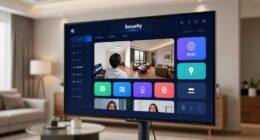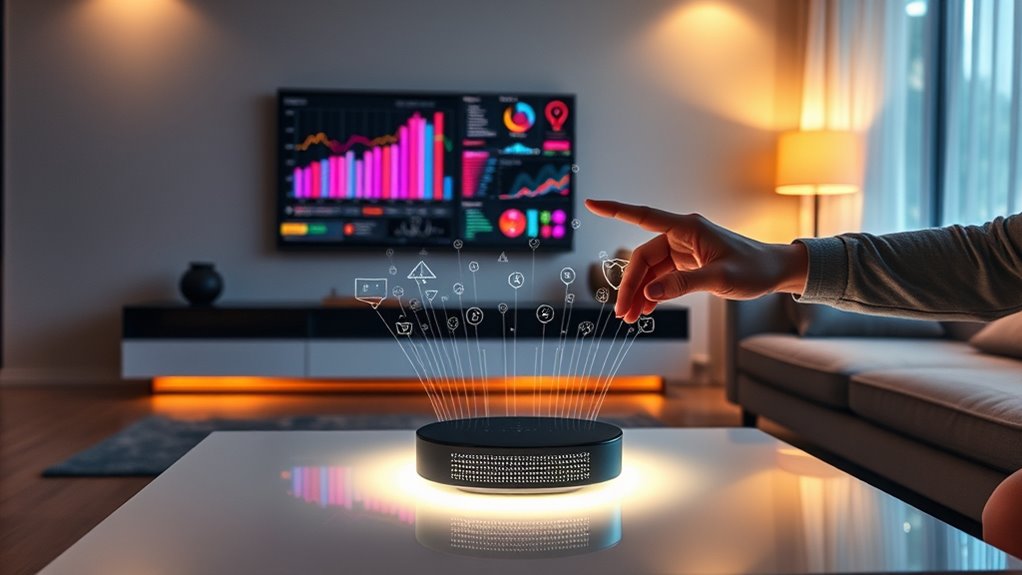

By leveraging AI to analyze smart home data, you can proactively identify potential security threats before they happen. Combining information from devices like cameras, locks, and sensors allows AI to spot patterns and anomalies that signal vulnerabilities or breaches. This integrated approach reduces false alarms and enhances threat detection accuracy. Ensuring proper data security and privacy measures are essential. Continue exploring to discover how to implement these strategies effectively for your smart home security.
Key Takeaways
- AI analyzes integrated smart home device data to identify patterns and anomalies indicating potential security threats.
- Centralized data platforms enable AI to process diverse data sources for comprehensive security event prediction.
- Implementing privacy-preserving techniques ensures AI-driven threat detection respects user privacy and data security.
- Combining signals from sensors, cameras, and voice commands improves AI accuracy in early threat detection.
- Ensuring secure data transmission and storage enhances the reliability of AI-based security event predictions.

As smart homes become more common, they generate vast amounts of data that can reveal security vulnerabilities before incidents occur. This surge in data provides an unprecedented opportunity to leverage AI for predicting security events, but it also raises important privacy concerns. When you connect multiple devices—such as cameras, thermostats, locks, and voice assistants—they create a web of data that must be integrated seamlessly for AI to analyze effectively. Without proper data integration, insights become fragmented, reducing the accuracy of security predictions. You need a holistic system that consolidates data from all your smart devices, enabling AI algorithms to identify patterns and anomalies indicative of potential threats.
However, privacy concerns are at the forefront of implementing AI in smart homes. As your devices collect sensitive information—voice recordings, activity logs, location data—the risk of unauthorized access or misuse increases. You must ensure that data is securely stored and transmitted, with robust encryption and strict access controls. Transparency is also critical; you should be aware of what data is being collected, how it’s used, and who has access to it. Implementing privacy-preserving AI techniques, such as anonymization and differential privacy, can help mitigate these concerns while still allowing the system to detect threats accurately. Additionally, data security best practices are essential to protect your information from potential breaches.
Data integration plays a vital role in enhancing AI’s predictive capabilities. When all your smart devices communicate and share data within a unified platform, AI can analyze this combined information to spot subtle signs of security breaches. For example, unusual activity detected by your door sensors combined with abnormal camera footage or voice assistant commands can signal a potential intrusion. The challenge lies in harmonizing data from different manufacturers and formats, which often use incompatible standards. You need a centralized hub that can unify this data, creating a coherent dataset for AI to interpret. This integration not only improves threat detection but also reduces false alarms caused by isolated data points.
Frequently Asked Questions
How Accurate Are AI Predictions in Real-World Smart-Home Environments?
AI predictions in real-world smart-home environments can be quite accurate, but they depend heavily on sensor calibration and data bias. If sensors are properly calibrated, the system gathers reliable data, improving accuracy. However, data bias from skewed or incomplete information can reduce prediction reliability. You should regularly calibrate sensors and address data bias to guarantee your AI system provides the most precise security event predictions possible.
What Privacy Concerns Arise From AI Monitoring Home Data?
You might worry about privacy when AI monitors your home data. Concerns include data breaches and unauthorized access. To protect yourself, make sure data anonymization is used, removing personal identifiers. Also, check that your smart-home system has clear consent management, so you’re aware of what data’s collected and how it’s used. These measures help safeguard your privacy while still benefiting from AI’s security insights.
Can AI Adapt to New or Evolving Security Threats?
Think of AI as a vigilant gardener, constantly pruning and nurturing to adapt to threat evolution. It employs adaptive learning, enabling it to recognize new patterns and respond to emerging security threats swiftly. You can rely on AI’s ability to evolve alongside danger, ensuring your smart home stays one step ahead. With ongoing updates, it becomes a resilient shield, adapting seamlessly to the ever-changing landscape of security challenges.
How Does AI Handle False Positives in Security Event Detection?
You can manage false positives in security event detection by implementing false positive mitigation strategies and refining anomaly detection techniques. AI continuously learns from data patterns, adjusting its sensitivity to distinguish between legitimate threats and benign activity. By fine-tuning models and incorporating context-aware analysis, you minimize false alarms, ensuring you’re alerted only to genuine security events. This approach helps you maintain reliable security without overwhelming you with unnecessary notifications.
What Are the Cost Implications of Implementing Ai-Based Security Systems?
Implementing AI-based security systems involves significant costs, including initial setup, ongoing maintenance, and updates. You should conduct a thorough cost analysis to understand expenses versus benefits. Budget considerations are vital, as advanced AI requires investment in hardware, software, and skilled personnel. While initial costs might be high, the improved security and automation can save you money long-term by reducing false alarms and preventing security breaches.
Conclusion
By harnessing AI to analyze smart-home data, you can anticipate security events before they happen, much like a weather forecast predicts storms. This proactive approach helps you stay one step ahead, providing peace of mind and enhanced safety. As smart devices become more integrated into your life, using AI transforms your home into a vigilant guardian that’s always alert, ready to protect you just like a loyal watchdog watching over your neighborhood.