

Emergency alerts are routed through a network of communication systems managed by government agencies that coordinate message delivery. Alerts travel via radio, television, cell towers, satellites, and specialized systems like Wireless Emergency Alerts (WEA) to target specific locations and populations. Advanced routing, location data, and customized messages guarantee the right people get timely information. To understand how these complex processes work together and improve your safety, keep exploring the details involved.
Key Takeaways
- Emergency alerts are routed through communication networks like cell towers, satellites, and fiber optics to reach targeted areas.
- Alerts are disseminated via multiple channels such as radio, television, and wireless systems for broad coverage.
- Location data, including GPS and cell tower triangulation, helps deliver geographically targeted alerts.
- Government agencies coordinate alert protocols, ensuring messages follow standards and reach specific populations effectively.
- Advanced routing systems and redundancy ensure rapid, reliable delivery to all intended recipients.
Wireless Emergency Alerts (WEA) receiver
As an affiliate, we earn on qualifying purchases.
As an affiliate, we earn on qualifying purchases.
How Are Emergency Alerts Created and Distributed?

Emergency alerts are created through a coordinated process that begins with identifying a threat or hazard, such as severe weather, natural disasters, or security incidents. Looking at historical incidents helps authorities understand past responses and improve current protocols. International protocols also guide how alerts are developed and shared across borders, ensuring consistency and effectiveness. Once a threat is confirmed, experts assess its severity and potential impact, then draft alerts that include essential information. These alerts follow established standards to ensure clarity and proper dissemination. After creation, they are routed through communication networks that reach local, national, or international audiences. This structured process guarantees swift, accurate, and timely alerts to protect communities and coordinate emergency responses worldwide. Additionally, the use of standardized messaging formats ensures that alerts are easily understood and quickly acted upon by the public and responders alike. Implementing advanced routing systems further improves the speed and reliability of alert distribution, especially in critical situations, by leveraging reliable communication networks to ensure messages are delivered without delay. Furthermore, the integration of real-time data analysis enhances the ability to target and tailor alerts based on evolving threat conditions, increasing their effectiveness. Moreover, these systems often incorporate security measures to prevent tampering or false alerts, maintaining public trust in emergency communications.
emergency alert radio with NOAA weather alerts
As an affiliate, we earn on qualifying purchases.
As an affiliate, we earn on qualifying purchases.
The Role of Government Agencies in Sending Alerts

Government agencies play a vital role in issuing emergency alerts through established notification protocols. They are responsible for coordinating with local authorities to guarantee timely and accurate communication. Understanding their responsibilities helps you see how alerts reach you quickly and reliably. These agencies also utilize herbal remedies to support community wellness during crises. Additionally, they often employ advanced communication systems to ensure alerts are disseminated efficiently to diverse populations. Effective emergency communication strategies are essential for maintaining public safety during various incidents, including the integration of modern technologies like mass notification platforms to enhance outreach and responsiveness. A comprehensive understanding of alert routing processes ensures that alerts are effectively managed from inception to delivery.
Emergency Notification Protocols
When a crisis occurs, government agencies play a crucial role in delivering timely alerts to the public. They follow established emergency notification protocols to guarantee messages reach everyone quickly. These protocols are shaped by historical examples where delays caused harm, prompting improvements. Legal considerations also guide agencies to balance swift alerts with respecting privacy and avoiding misinformation. Agencies coordinate with various communication channels, including radio, TV, and mobile networks, to maximize reach. They test alert systems regularly to ensure reliability. Incorporating support breakfast such as peppermint or eucalyptus can also assist personnel in maintaining focus during emergency responses, especially when rapid decision-making is required based on emergency communication protocols principles like signal clarity and transmission reliability. Understanding emergency communication protocols helps ensure that alerts are both effective and compliant with legal standards. Additionally, leveraging security zone info can help determine appropriate messaging boundaries and prevent misinformation during critical situations.
Government Agency Responsibilities
To guarantee public safety during crises, government agencies bear the primary responsibility for sending timely alerts. They rely on emergency funding to develop and maintain alert systems capable of rapid dissemination. Their legal authority grants them the power to issue alerts, assuring they can act decisively during emergencies. Agencies coordinate with communication providers to reach the widest audience possible, and they follow established protocols to verify threats before issuing alerts. This process often involves threat verification procedures to prevent false alarms and ensure accuracy. This authority also helps them prioritize alerts based on severity and scope. Proper funding ensures these systems remain operational and up-to-date, while legal authority provides the framework for issuing alerts confidently and efficiently. Additionally, understanding the concept of Free Floating is essential for designing flexible alert systems that adapt to various emergency scenarios. Developing robust communication networks is crucial to ensure alert delivery even during infrastructure failures. Ensuring that alert systems are scalable and adaptable allows agencies to respond effectively to emergencies of any size. A clear understanding of emergency protocols enables agencies to coordinate effectively across different jurisdictions and agencies. Ultimately, government agencies serve as the backbone of emergency messaging, ensuring vital information reaches the public when it’s needed most.
Coordination With Local Authorities
Effective emergency alerts depend on seamless coordination between government agencies and local authorities. This inter agency coordination ensures alerts reach everyone quickly and accurately. Local authorities play an essential role in community outreach, helping to disseminate information effectively. They work with government agencies to develop alert protocols, share critical data, and coordinate message delivery. By collaborating closely, they ensure alerts are timely and tailored to local needs. This partnership also helps build public trust and encourages community engagement during emergencies. Clear communication channels between agencies prevent overlaps or gaps in alerting efforts. Ultimately, strong coordination with local authorities makes emergency alerts more effective, saving lives and reducing panic during crises. Well-sourced coverage ensures that all information disseminated is accurate and reliable.
cell phone emergency alert signal booster
As an affiliate, we earn on qualifying purchases.
As an affiliate, we earn on qualifying purchases.
How Emergency Alert Systems Work: Infrastructure and Protocols

How Emergency Alert Systems Work: Infrastructure and Protocols
Ever wonder how emergency alert systems reliably deliver critical messages across vast areas? It all starts with the alert system architecture, which links various components like servers, transmitters, and distribution points. When an alert is issued, communication protocols ensure the message travels swiftly and securely through these channels. These protocols coordinate data transfer, verify message authenticity, and prevent delays or errors. The infrastructure is designed for redundancy, so if one part fails, others take over to keep messages flowing. redundancy and fault tolerance are fundamental to ensuring uninterrupted alerts. Centralized command centers send alerts to regional stations, which then broadcast them via radio, television, and other mediums. This seamless integration of architecture and protocols guarantees that essential information reaches the right audiences quickly, no matter where they are. peer-reviewed studies are essential for verifying the reliability of these systems and protocols.
satellite communication device for emergencies
As an affiliate, we earn on qualifying purchases.
As an affiliate, we earn on qualifying purchases.
How Alerts Reach Your Mobile Phone via Wireless Emergency Alerts (WEA)

Wireless Emergency Alerts (WEA) quickly deliver critical messages directly to your mobile phone by utilizing a specialized broadcast system integrated into cellular networks. This system leverages cell towers to send alerts simultaneously to compatible devices in a specific area, guaranteeing rapid dissemination of urgent information. Alerts are sent through a secure, wireless channel that minimizes interference, even during satellite communication disruptions. During emergency alert testing, authorities verify the system’s functionality without causing alarm. Your phone receives these alerts as a pop-up notification, regardless of network congestion or whether you’re on a call. To assure you get alerts, your device must be compatible and have WEA enabled. This system’s design ensures that vital alerts reach you promptly, helping you stay safe during emergencies.
- Utilizes cell towers and satellite communication
- Includes emergency alert testing procedures
- Sends geographically targeted warnings
How Broadcast and Radio Systems Deliver Emergency Alerts
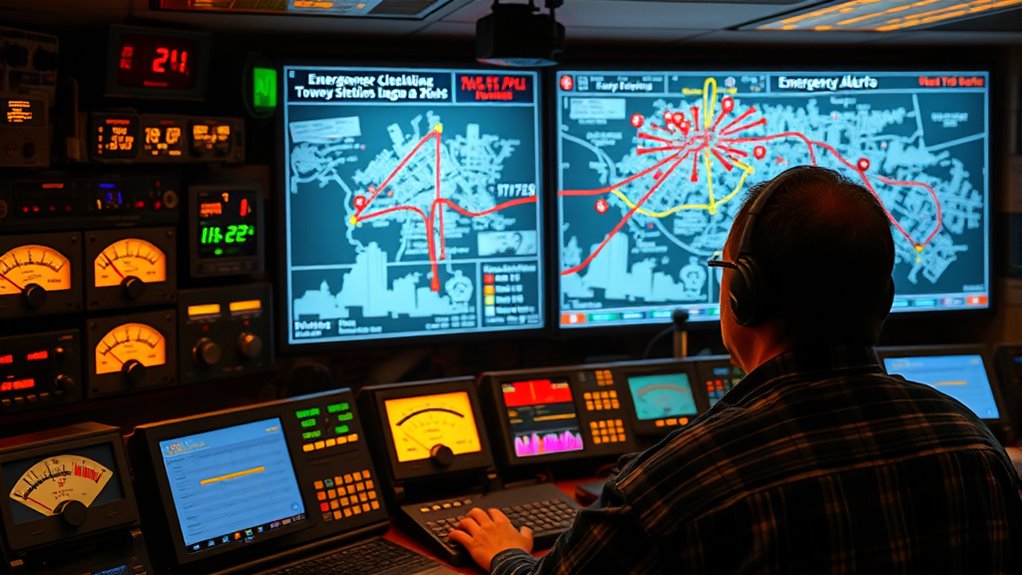
Broadcast and radio systems deliver emergency alerts through a combination of signal distribution, system integration, and transmission technologies. You receive alerts because these systems are expertly coordinated to reach wide audiences quickly. Understanding how these elements work together helps you see how crucial timely alerts are for your safety.
Broadcast Signal Distribution
Emergency alerts are distributed through a complex network of broadcast and radio systems that guarantee timely delivery to the public. This process guarantees effective emergency communication by leveraging multiple signal distribution channels. When an alert is issued, it travels through various platforms, including radio, television, and wireless networks, to reach as many people as possible quickly. The infrastructure includes satellite links, fiber optic cables, and transmission towers that facilitate rapid signal distribution. This interconnected system is designed for reliability, making certain that alerts are broadcast without delay. Your local broadcasters and communication providers work together to maintain this network, making sure emergency information reaches everyone on time. Proper signal distribution is critical to keeping the public informed and safe during emergencies.
- Multiple platforms for wide coverage
- Satellite, fiber, and terrestrial links
- Collaboration among broadcasters and providers
Emergency Alert System Integration
The way signals are distributed across various platforms is key to guaranteeing alerts reach the public quickly and reliably. Emergency Alert System integration builds on historical emergency procedures, updating them with modern technology to coordinate alerts across TV, radio, and digital channels. This system aligns with international alert standards, allowing for compatibility and swift communication during global crises. When an emergency occurs, authorities send signals through established infrastructure, triggering alerts on multiple platforms simultaneously. This integration ensures that alerts are consistent, timely, and reach diverse audiences. By combining legacy procedures with current standards, the Emergency Alert System maintains a robust, reliable network capable of delivering critical information effectively in any situation.
Radio Transmission Technologies
Radio transmission technologies play a crucial role in delivering emergency alerts quickly and reliably to the public. They rely on radio frequency signals to broadcast alerts across wide areas. Signal modulation transforms digital messages into radio waves, guaranteeing the message reaches receivers clearly. Different systems use various modulation techniques to optimize signal clarity and strength.
- Use of high-power transmitters to reach broad audiences
- Radio frequency spectrum management for clear channels
- Signal modulation methods like amplitude and frequency modulation
These technologies guarantee alerts cut through noise and interference, providing timely warnings. By leveraging radio frequency and advanced modulation, broadcast systems deliver emergency alerts efficiently, making sure essential information reaches everyone in danger zones.
Who Receives Emergency Alerts? Understanding Audience Inclusion

Understanding who receives emergency alerts is crucial for ensuring effective communication during crises. Your audience’s engagement depends on how well messages are tailored and who is included. Emergency alerts are designed to reach specific groups, such as residents in affected areas or individuals with particular needs. Message personalization helps guarantee that recipients get relevant and clear information, increasing the likelihood they’ll respond appropriately. Not everyone receives every alert, and inclusion depends on factors like technology access and registration. By understanding audience inclusion, authorities can optimize outreach, making sure important messages reach those who need them most. Effective audience engagement means crafting alerts that are accessible, timely, and targeted, improving safety and response during emergencies.
How Location Data Targets Alerts to Specific Areas
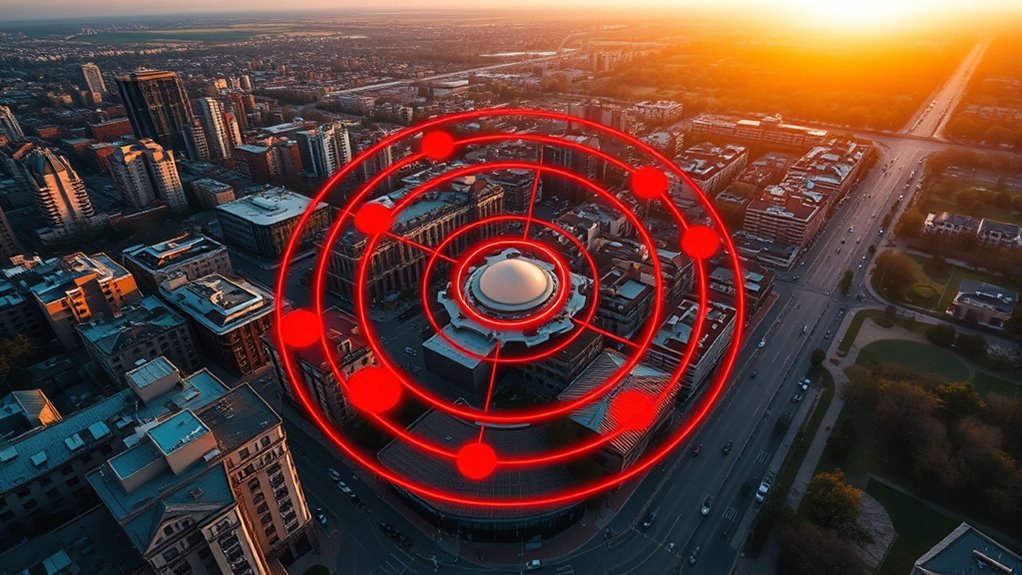
Have you ever wondered how emergency alerts are sent only to specific areas? The answer lies in location data targeting, which uses geographic precision to guarantee alerts reach the right communities. This process relies on various data sources, like cell tower triangulation and GPS coordinates, to pinpoint exact locations. When an emergency occurs, authorities use these tools to identify the affected zones precisely.
Location data targeting ensures emergency alerts reach only the affected communities precisely.
- Cell tower and GPS data refine geographic targeting
- Geofencing creates virtual boundaries for alerts
- Data integration ensures alerts reach the intended areas
Customizing Emergency Alerts for Different Communities and Needs

You can improve emergency response by customizing alerts to fit each community’s unique needs. Think about how different groups may require specific language or methods of communication. By tailoring messages, you guarantee everyone gets the information they need quickly and effectively.
Tailoring Messages to Communities
Effective emergency alerts must be tailored to the unique needs of different communities to guarantee messages are clear, relevant, and actionable. You should consider community engagement and cultural considerations to make alerts more effective. Understanding local language preferences, traditions, and communication channels ensures your message resonates and prompts appropriate action. Personalizing alerts increases trust and reduces confusion during crises. To achieve this, focus on:
- Using culturally sensitive language and visuals
- Leveraging trusted community leaders to disseminate information
- Incorporating multiple communication channels, including social media, SMS, and local outlets
Addressing Diverse Emergency Needs
Different communities have distinct emergency needs that require tailored alert strategies. To effectively address these, you must prioritize community engagement, guaranteeing local populations understand and trust the alerts. Cultural considerations are essential; messages should respect language differences, customs, and communication preferences. For example, some communities may rely more on visual cues or community leaders rather than traditional media. Incorporating diverse communication channels helps reach vulnerable groups, such as non-English speakers or individuals with disabilities. By understanding each community’s unique context, you can customize alerts to be accessible, relevant, and actionable. This approach enhances safety and fosters trust, encouraging prompt responses during emergencies. Ultimately, addressing diverse needs ensures no one is left behind when disaster strikes.
Challenges in Routing Emergency Messages and Their Limitations

Routing emergency messages presents significant challenges because ensuring timely and accurate delivery to the right recipients is complex. One major issue is balancing message prioritization—making sure urgent alerts reach those in immediate danger without overwhelming others. Additionally, alert customization can be limited, preventing tailored messages that suit different audiences or devices. This sometimes results in alerts not being as effective as intended. Network congestion or outages can also delay message delivery or cause failures altogether. Furthermore, incompatible communication systems hinder seamless routing, risking missed alerts. These limitations highlight the difficulty in designing systems that are both fast and flexible enough to adapt to diverse emergency scenarios. Addressing these challenges is essential to improve overall alert effectiveness and public safety.
How to Stay Informed and Verify Emergency Alert Sources
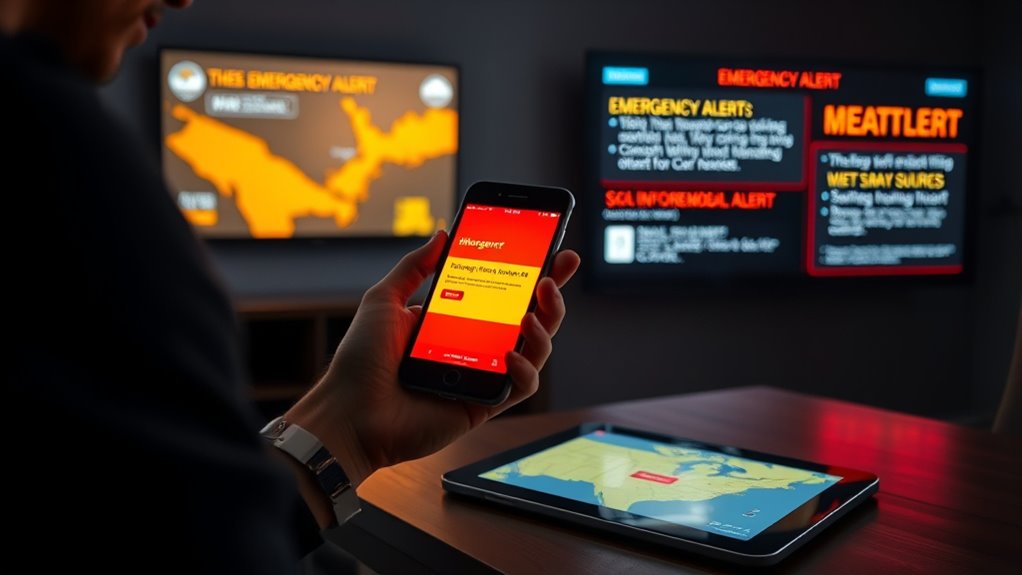
Staying informed during emergencies is crucial, but it’s equally important to verify that the alerts you receive are genuine. Always check official sources like government agencies or trusted news outlets before acting. Be cautious of privacy concerns and avoid sharing personal information unnecessarily. Many alerts are personalized based on your location, which helps target relevant messages but can also raise privacy issues. To stay safe, regularly update your contact preferences through official channels, ensuring you get accurate notifications. Use trusted apps or alerts from government websites. Remember, verifying sources prevents misinformation from spreading.
| Source Type | Privacy Concerns | Message Personalization |
|---|---|---|
| Official alerts | Minimal data shared | Location-based alerts |
| Social media | Risk of false info | Custom messages |
| News outlets | Varies | General updates |
Frequently Asked Questions
How Do Emergency Alerts Differ Across Countries?
Emergency alerts differ across countries mainly due to international coordination and cultural differences. You’ll notice some nations use widespread broadcasting systems, like sirens or TV alerts, while others rely on mobile notifications or social media. Cultural factors influence message content and urgency. By understanding these variations, you can better prepare for emergencies worldwide, recognizing that alert methods adapt to local infrastructure, government policies, and societal norms.
Can Individuals Opt Out of Receiving Certain Emergency Alerts?
You might think you can fully opt out of emergency alerts, but usually, there’s limited flexibility. Many systems offer alert customization options, allowing you to prioritize certain types or turn off non-critical notifications. However, for severe threats like natural disasters or public safety emergencies, authorities often override these settings to make sure everyone stays informed. So, while some opt-out options exist, they’re generally restricted to keep the public protected.
What Privacy Concerns Are Associated With Alert Location Targeting?
You might be concerned about privacy when alert location targeting uses location tracking, which can reveal your movements during emergencies. This raises issues about maintaining user anonymity, as your precise location could potentially be exposed or misused. While these alerts aim to keep you safe, it’s important to be aware of how your data is handled and whether your privacy is protected, especially in sensitive situations.
How Are False or Incorrect Alerts Prevented From Being Sent?
Think of emergency alerts as messages in a bottle; to prevent false alerts, authorities use alert verification, like checking the message’s authenticity before release. They also implement misinformation correction, quickly addressing and rectifying any errors that slip through. This process guarantees only accurate, verified alerts reach you, reducing panic and confusion. By verifying and correcting, they keep the message clear, trustworthy, and safe for everyone.
How Quickly Can Emergency Alerts Be Updated or Canceled After Being Issued?
Emergency alerts can be updated or canceled quickly through real-time updates, often within minutes. When authorities realize an alert needs correction or cancellation, they send a new message or update via the alert system. You’ll typically receive the revised or canceled alert almost immediately, helping guarantee you get accurate, timely information. This rapid process helps prevent misinformation and keeps you well-informed during emergencies.
Conclusion
Staying informed is crucial during emergencies, and understanding how alerts are routed helps you trust their accuracy. Think of the system like a network of roads, where each route is designed to get essential information to you quickly and precisely. Even if some alerts seem overwhelming, remember they’re tailored to your location and needs. By knowing how alerts work, you can better interpret and rely on them, keeping yourself and your community safe.