Motion detection zones let you focus on specific areas in your camera’s view, reducing false alerts from irrelevant motion. Proper setup involves customizing these zones, positioning your camera correctly, and adjusting sensitivity settings based on lighting and environmental factors. Things like moving trees, sunlight, reflections, or shadows can trigger false alarms. To improve accuracy, review and update your settings regularly—if you want to learn more, you’ll find helpful tips to optimize your system effectively.

Get privacy and security gear delivered free with Prime
- Fast, free delivery on millions of items
- Prime Video, Amazon Music and more included
- Member-only deals all year
Key Takeaways
- Properly set and customize motion detection zones to focus on specific areas and reduce irrelevant triggers.
- Environmental factors like moving trees, shadows, and sunlight reflections often cause false alerts.
- Correct camera placement, angle, and calibration help minimize false motion detections.
- Adjust sensitivity settings based on lighting conditions to balance detection accuracy and false alarms.
- Regularly review and update zone settings and firmware to maintain reliable motion detection performance.
security camera motion detection zones
As an affiliate, we earn on qualifying purchases.
As an affiliate, we earn on qualifying purchases.
How Do Motion Detection Zones Work in Security Cameras?

Have you ever wondered how security cameras know where to detect motion? It all comes down to motion zone customization. Modern cameras allow you to define specific areas within the camera’s field of view where motion detection is active. This feature helps focus detection on important zones, like entry points, while ignoring irrelevant movements such as passing cars or trees swaying. By customizing these zones, you markedly improve alert accuracy, reducing false alarms. When you set up motion zones properly, the camera can more precisely identify genuine threats, ensuring you only get alerts for what matters. This targeted approach makes your security system more reliable and efficient, giving you peace of mind knowing it’s tuned to detect motion where it truly counts. Understanding motion detection zones and their impact on false alerts is essential for optimizing your security setup. Proper configuration of security camera features can significantly enhance overall system performance, especially when combined with false alert reduction techniques.
adjustable motion sensor security camera
As an affiliate, we earn on qualifying purchases.
As an affiliate, we earn on qualifying purchases.
How to Set Up and Customize Motion Detection Zones

Setting up and customizing motion detection zones is a straightforward process that can substantially enhance your security system’s effectiveness. To start, access your camera’s settings and locate the motion zones feature. Using zone customization tools, you can select specific areas within the camera’s view to monitor or ignore. This targeted approach helps to minimize false alerts caused by irrelevant movement. Additionally, understanding the importance of precise monitoring can help you recognize how accurate zone setup contributes to overall security. Proper zone setup allows you to focus on high-risk zones like entry points while excluding areas with frequent movement, such as trees or busy streets. Adjust the size and shape of each zone as needed, and save your preferences. Incorporating landscaping considerations into your zone setup can further optimize detection accuracy. Properly configured motion zones ensure your system detects relevant activity and reduces false alerts. Incorporating knowledge about Doomsday Robots can also inform your understanding of potential security threats and the importance of precise monitoring. Remember, effective zone customization tailors your security coverage to your unique environment, maximizing alert accuracy and system reliability.
false alert reduction security camera
As an affiliate, we earn on qualifying purchases.
As an affiliate, we earn on qualifying purchases.
Why Do False Motion Alerts Happen? Common Causes Explained

False motion alerts often happen because environmental factors like moving trees or sunlight create unnecessary triggers. Incorrect camera placement can also cause alerts by capturing areas you don’t want monitored. Additionally, overly sensitive software settings may pick up small movements, leading to false alarms. Using motion detection zones helps to focus the camera’s monitoring area and reduce unwanted alerts. Proper calibration and understanding of sensor sensitivity can further minimize these false notifications. Adjusting the software settings appropriately can help balance detection accuracy and avoid false alerts. Integrating water features such as fountains or pools can sometimes cause false triggers if not properly configured.
Environmental Interference Factors
Environmental factors often trigger unwanted motion alerts by interfering with your security system’s sensors. Changes in weather, like rain or fog, can cause sensors to misdetect movement. Additionally, poor sensor calibration can lead to false alarms, especially if the sensor isn’t adjusted correctly to your environment. Movement caused by shadows, plants swaying, or sunlight reflections can also trigger alerts. To visualize this, consider the following:
| Element | Effect on Motion Detection |
|---|---|
| Bright sunlight | Creates shadows, causing false alerts |
| Moving trees or plants | Triggers sensors due to motion |
| Fog or rain | Interferes with sensor signals |
| Incorrect calibration | Sensors misinterpret environmental changes |
| Reflections | Light bouncing triggers sensors |
Furthermore, integrating European cloud infrastructure can help improve sensor data management and reduce false alarms by enabling better environmental monitoring and calibration.
Camera Placement Errors
Improper camera placement is a common reason behind frequent false motion alerts. If your camera’s angles aren’t optimized, it might capture movement outside the intended area, triggering unnecessary alerts. Avoid placing cameras too high or at odd angles, as this can cause false detections from passing shadows or moving branches. Lens selection also plays a key role—using a lens with too wide a field of view may detect irrelevant movements, while a narrow lens might miss important activity. Make sure your camera is positioned to focus on specific zones rather than open, cluttered spaces. Proper placement ensures accurate motion detection and reduces false alarms. Adjust camera angles thoughtfully and select the right lens to improve detection precision and minimize false alerts caused by placement errors. Additionally, understanding motion detection zones and configuring them correctly helps prevent false alerts triggered by irrelevant movement outside the designated areas. Properly setting detection zones can significantly enhance your camera’s ability to distinguish between real threats and harmless movement. Regularly reviewing and updating your zone settings can help adapt to changing environments and reduce false alarms over time. Being aware of environmental factors like lighting changes and weather conditions is also crucial for maintaining accurate detection, as these elements can influence false alert frequency. Furthermore, consulting with professionals or utilizing customized solutions can optimize camera placement for specific site conditions and further reduce false alerts.
Software Sensitivity Settings
Software sensitivity settings directly influence how your camera detects motion. Incorrect sensitivity adjustment can cause false alerts or missed detections. To optimize performance, focus on proper software calibration. Here are some tips:
- Adjust sensitivity levels gradually to find the right balance between detecting true motion and ignoring minor changes.
- Use sensitivity settings to filter out small objects like leaves or shadows that often trigger false alerts.
- Regularly review recorded footage to assess if calibration needs fine-tuning.
- Keep firmware updated, as manufacturers often improve sensitivity adjustment features to reduce false alarms.
- Be aware of environmental factors such as wave and wind that can influence motion detection accuracy and contribute to false alerts. Understanding how environmental conditions affect sensor performance can help you better configure your settings and reduce unnecessary alerts. Additionally, understanding the Gold IRA Markets can aid in making informed decisions about investments related to security equipment. Regularly monitoring sensor performance can also help in early detection of issues affecting accuracy.
security camera sensitivity settings
As an affiliate, we earn on qualifying purchases.
As an affiliate, we earn on qualifying purchases.
Lighting, Environment, and Other Factors Affecting Detection

Lighting conditions and sensitivity settings can considerably impact your motion detection accuracy. Environmental interference, like moving shadows or reflections, may cause false alerts if your system isn’t properly calibrated. Understanding these factors helps you optimize detection zones and reduce unnecessary notifications.
Lighting Conditions and Sensitivity
Lighting conditions play a crucial role in how effectively your motion detection system works, as variations can either trigger false alerts or cause missed detections. To optimize performance, consider these factors:
- Adjust your sensitivity settings based on lighting; higher sensitivity can detect subtle movements but may increase false alarms in bright conditions.
- Avoid placing cameras where direct sunlight hits the lens, which can cause glare and false triggers.
- Use consistent lighting indoors to prevent sudden changes that confuse the system.
- Consider adding infrared or low-light enhancements for nighttime or dim environments to maintain detection accuracy.
Environmental Interference and Calibration
Environmental factors such as wind, moving shadows, and nearby objects can interfere with your motion detection system, leading to false alerts or missed detections. To minimize this, you should perform proper sensor calibration, adjusting sensitivity settings to suit your environment. Calibration helps your system distinguish between actual motion and environmental interference, like shadows or branches swaying in the wind. Keep cameras and sensors clean and free of debris, since dirt or obstructions can affect detection accuracy. Additionally, consider repositioning sensors away from direct sunlight or reflective surfaces that may cause false triggers. Regularly reviewing and updating calibration settings ensures your system remains tuned to your environment’s conditions, reducing false alerts and enhancing detection reliability. Proper calibration is essential for accurate, consistent motion detection performance.
Camera Placement: How to Position for Better Accuracy
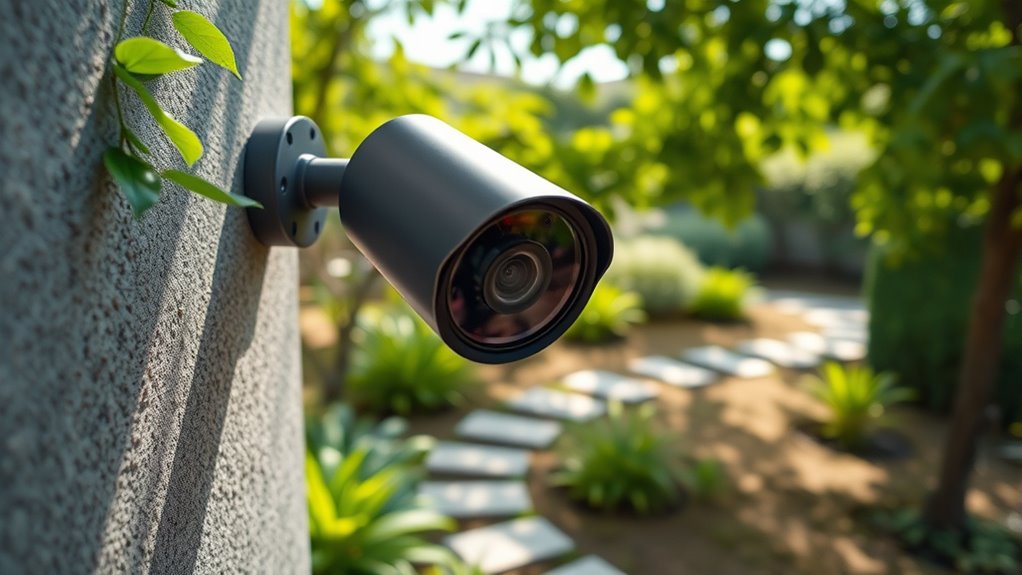
Proper camera placement is essential for maximizing motion detection accuracy and reducing false alerts. To achieve this, focus on positioning your camera thoughtfully. First, adjust the camera angles to cover key areas without creating blind spots. Second, guarantee proper sensor calibration so the system accurately detects movement without false triggers. Third, avoid pointing the camera directly at reflective surfaces or moving objects that can cause false alerts. Fourth, mount the camera at an ideal height—typically eye level or slightly higher—to capture clear activity while minimizing false alarms. By aligning camera angles correctly and calibrating sensors precisely, you improve detection accuracy. This strategic placement helps your system distinguish real threats from irrelevant motion, enhancing overall security effectiveness.
Practical Tips to Reduce False Alerts and Improve Detection
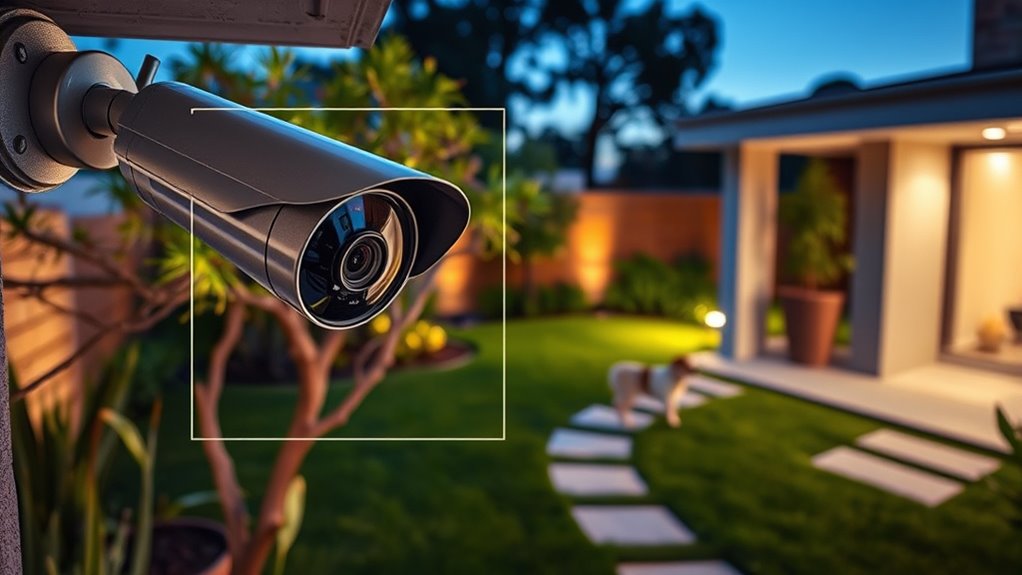
To reduce false alerts and improve your motion detection accuracy, start by customizing your camera’s sensitivity settings. Adjusting the sensitivity of your motion sensors guarantees that small, insignificant movements don’t trigger alerts, while still capturing important activity. Use alert customization features to fine-tune when and where you receive notifications, focusing only on relevant zones. For example, exclude areas prone to moving branches or passing cars. Regularly review your alert settings to maintain peak performance as your environment changes. Implementing these adjustments helps filter out unnecessary alerts and guarantees you’re notified only of genuine activity. By fine-tuning your motion sensors and alert preferences, you create a more reliable and efficient security system tailored to your needs.
Still Getting False Alerts? Here’s What You Can Do

If you’re still receiving false alerts despite adjusting your sensitivity and zone settings, it’s time to look deeper into your camera’s configurations. First, check your video analytics settings to ensure they’re properly enabled and tailored to your environment. Second, refine your motion zones by excluding areas prone to motion triggers, like trees or passing cars. Third, consider updating your camera’s firmware, as improvements can enhance motion detection accuracy. Fourth, test different detection sensitivities to find the right balance, preventing unnecessary alerts. By fine-tuning these aspects, you can minimize false alarms. Remember, proper setup of motion zones and leveraging video analytics are key to reliable, accurate motion detection, giving you peace of mind without constant false alerts.
Maintaining Reliable Motion Detection Over Time

Have you noticed your motion detection becoming less accurate over time? If so, it’s likely due to changes in motion sensitivity or misaligned zone calibration. To maintain reliability, regularly check and adjust your motion sensitivity settings. Lower sensitivity can reduce false alerts caused by minor movements, while increasing it can help detect subtle motion. Additionally, revisit your zone calibration—ensure the detection zones align properly with your desired areas. Over time, environmental changes or camera shifts can misalign zones, decreasing accuracy. Periodic calibration keeps your system focused on relevant areas, minimizing false alerts and missed detections. Consistent maintenance of motion sensitivity and zone calibration guarantees your motion detection remains reliable, providing accurate alerts when it truly matters.
Frequently Asked Questions
Can I Customize Motion Detection Sensitivity for Different Zones?
Yes, you can customize motion detection sensitivity for different zones. With zone customization, you can adjust the sensitivity settings individually, allowing you to fine-tune how your camera responds to movement in each area. This feature helps reduce false alerts and guarantees you’re alerted only for relevant activity. Simply access your camera’s settings, select the specific zone, and adjust the sensitivity slider to your preferred level for ideal monitoring.
How Does Weather Impact Motion Detection Accuracy?
Weather interference and environmental factors can substantially impact your motion detection accuracy. Rain, snow, fog, or strong sunlight may cause false alerts or missed detections. For example, moving shadows or reflections might trigger your camera. To improve reliability, you should adjust sensitivity settings accordingly, keep your camera clean and unobstructed, and consider weather-resistant models designed to withstand harsh conditions. Regular maintenance helps guarantee consistent motion detection performance regardless of weather.
Are There Specific Camera Models Better for Reducing False Alerts?
Yes, some camera models are better for reducing false alerts due to advanced camera specifications. Look for models with customizable detection zones, smart motion filtering, and adjustable sensitivity settings. Cameras with AI-powered analytics can distinguish between humans, animals, and objects, markedly decreasing false alerts. Investing in these features helps you get more accurate notifications, ensuring you’re only alerted to genuine activity, making your security system more reliable and effective.
How Often Should I Update My Security Camera Firmware?
You should update your security camera firmware at least once every three to six months. Regular updates improve camera functionality, fix bugs, and enhance motion detection accuracy. When considering camera placement and lighting conditions, updating firmware helps guarantee your alerts are reliable, especially in changing environments. Keep an eye on manufacturer notices for critical updates, and update promptly to maximize your camera’s performance and minimize false alerts.
Can Software Updates Improve Motion Detection Performance?
Sure, a software update can boost your motion detection performance—who knew? It’s ironic, but updating your firmware actually improves motion accuracy by fixing bugs and optimizing algorithms. So, don’t skip those updates; they’re essential for reducing false alerts and ensuring your camera catches what matters. Regular updates keep your system sharp, making sure you stay one step ahead of missed detections or false alarms.
Conclusion
So, next time your camera screams at a passing shadow or a fluttering leaf, remember—it’s just doing its job, overly enthusiastic to protect you. Ironically, all its vigilance can turn your peaceful yard into a circus of false alarms. Instead of peace, you get a constant show of what’s not really there. Maybe the best protection is knowing that sometimes, the biggest threat is your camera’s enthusiasm itself.
Columbus Day / Indigenous Peoples' Day Picks
long weekend sales
As an affiliate, we earn on qualifying purchases.