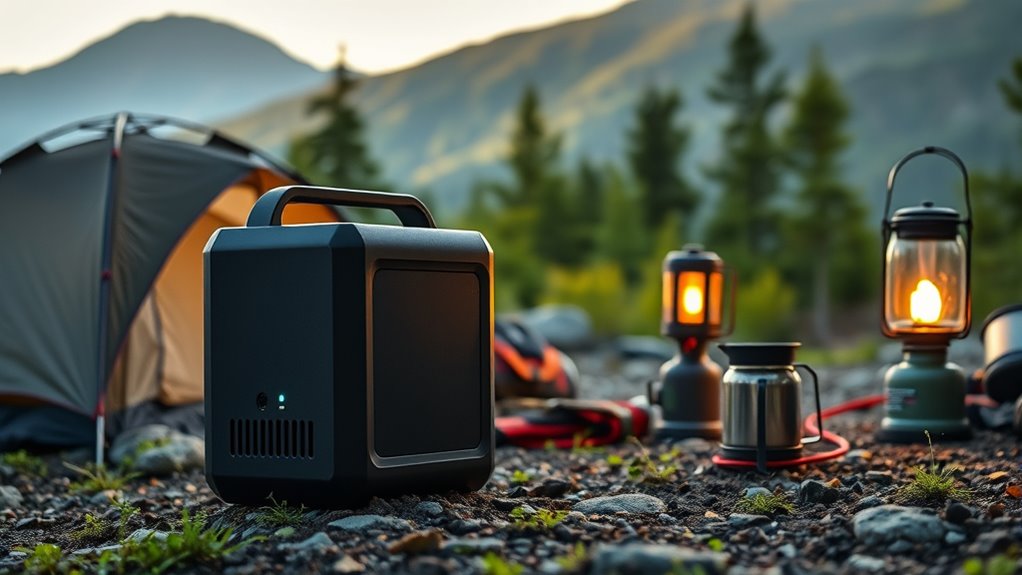
For a lithium power station that can cover both camping and emergency backup, I’d start with the BLUETTI Elite 100 V2: its 1,024Wh capacity and 1,800W output offer a broader mix of runtime and appliance support than the compact models here. The Jackery Explorer 1000 v2 and BALDR INFINITY PLUS1200 are other standouts for buyers prioritizing around 1,000Wh of stored energy, while the BLUETTI Elite 30 V2 suits lighter loads in a smaller capacity class. The main tradeoff is straightforward: more capacity and output can help during longer outages, but usually mean a larger unit to transport and recharge. Smaller stations are easier to take camping, though they can run out sooner or lack the output for demanding equipment. Read on for how all 15 options compare and which one best fits your plans.

Get privacy and security gear delivered free with Prime
- Fast, free delivery on millions of items
- Prime Video, Amazon Music and more included
- Member-only deals all year
Complete the kit


Key Takeaways
- BLUETTI Elite 100 V2 leads this lineup on the combination of listed capacity and output: 1,024Wh and 1,800W give it more headroom than the many 200–300Wh models.
- The two roughly 1,000Wh alternatives, Jackery Explorer 1000 v2 and BALDR INFINITY PLUS1200, are the capacity-focused contenders; compare their actual output, charging options, and portability before choosing between them.
- Several compact options cluster around 288–300Wh, but their power ratings differ: the Powkey R600 lists 600W, while the Jackery Explorer 300 lists 292Wh. Capacity and output answer different buyer questions.
- The DaranEner 300W and Daran 600W specify LiFePO4 batteries, making battery chemistry a visible point of comparison with models whose supplied specifications identify only lithium batteries.
- The HOWEASY 120W at 88Wh is the smallest listed choice, better aligned with a narrow set of low-draw needs than with running several essentials through an extended outage.
| MARBERO M823 Portable Power Station, 300W, 237Wh |  | Best for Lightweight Camping | Capacity: 237Wh | Battery chemistry: Lithium-ion | AC output: 300W; 375W peak | VIEW ON AMAZON | See Our Full Breakdown |
| DaranEner 300W Portable Power Station with 192Wh LiFePO4 Battery |  | Best for Frequent Short Trips | Capacity: 192Wh | Battery chemistry: LiFePO4 | AC output: 300W pure sine wave; 600W surge | VIEW ON AMAZON | See Our Full Breakdown |
| HOWEASY Portable Power Station, 260W (500W Peak) |  | Best for USB-C Device Charging | Running output: 260W | Peak output: 500W | Battery capacity: 48,000mAh | VIEW ON AMAZON | See Our Full Breakdown |
| 500W Portable Power Station, 519.48Wh |  | Best for Longer Emergency Runtime | Capacity: 519.48Wh | AC output: 500W pure sine wave, 110V | AC outlets: 2 | VIEW ON AMAZON | See Our Full Breakdown |
| Jackery Explorer 300 Portable Power Station, 292Wh |  | Best for a Balanced Camping Kit | Capacity: 292Wh | Battery chemistry: LiFePO4 | Peak surge output: 600W | VIEW ON AMAZON | See Our Full Breakdown |
| HOWEASY Portable Power Station, 120W (240W Peak), 88Wh |  | Best Ultralight Emergency Companion | Capacity: 88Wh | Continuous output: 120W | Peak output: 240W | VIEW ON AMAZON | See Our Full Breakdown |
| Powkey R600 Portable Power Station, 600W, 296Wh |  | Best for Mixed Device Charging | Battery capacity: 296Wh | Continuous output: 600W | Starting wattage: 700W | VIEW ON AMAZON | See Our Full Breakdown |
| BLUETTI Elite 100 V2 Portable Power Station, 1024Wh, 1800W |  | Best for Emergency Home Backup | Battery capacity: 1,024Wh | Battery type: LiFePO₄ | AC output: 1,800W | VIEW ON AMAZON | See Our Full Breakdown |
| Jackery Explorer 1000 v2 Portable Power Station |  | Best for Fast, Flexible Recharging | Battery capacity: 1,070Wh | Battery type: LFP (LiFePO₄) | AC output: 1,500W | VIEW ON AMAZON | See Our Full Breakdown |
| LiTHELi 218 Series Portable Power Station, 142Wh |  | Best Compact Expandable Pick | Capacity: 142Wh | Expandable capacity: Up to 216Wh with one compatible 74Wh battery | AC output: 200W | VIEW ON AMAZON | See Our Full Breakdown |
| EnginStar 300W Portable Power Station with 296Wh Lithium Battery |  | Best Lightweight Pick | Battery capacity: 296Wh | Maximum output: 300W | AC outlets: 2 x 110V pure sine wave | VIEW ON AMAZON | See Our Full Breakdown |
| Daran 600W Portable Power Station with 80W Solar Panel, 288Wh LiFePO4 Battery |  | Best Solar-Included Value | Battery capacity and type: 288Wh LiFePO4 | Continuous and surge output: 600W continuous; 1,200W surge | AC outlets: 2 | VIEW ON AMAZON | See Our Full Breakdown |
| GRECELL EB300 Portable Power Station, 330W, 230.88Wh |  | Best for Charging Several Small Devices | Battery capacity: 230.88Wh | AC output: 120V pure sine wave | USB-C outputs: 60W PD and 18W PD | VIEW ON AMAZON | See Our Full Breakdown |
| BLUETTI Elite 30 V2 Portable Power Station, 288Wh, 600W |  | Best for Fast Emergency Backup | Capacity: 288Wh | Continuous and surge output: 600W continuous; up to 1,500W in Power Lifting Mode | Total power outlets: 9 | VIEW ON AMAZON | See Our Full Breakdown |
| BALDR INFINITY PLUS1200 Portable Power Station, 1042Wh |  | Best for Extended Emergency Runtime | Capacity: 1,042Wh | Ports: 16 total: 6 AC, 4 USB-A, 4 USB-C, 2 DC | AC recharge: 1,000W; reaches 80% in 55 minutes | VIEW ON AMAZON | See Our Full Breakdown |
| lithium power station for camping and emergencie | Weight | Capacity | AC output |
|---|---|---|---|
| MARBERO M823 Portable Power St | 4.6 lbs | 237Wh | 300W; 375W peak |
| DaranEner 300W Portable Power | About 5.7 lbs | 192Wh | 300W pure sine wave; 600W surge |
| HOWEASY Portable Power Station | 5 lbs | — | — |
| 500W Portable Power Station | 18 lbs | 519.48Wh | 500W pure sine wave, 110V |
| Jackery Explorer 300 Portable | Listed as 7.1 lbs; description states 7.5 lbs | 292Wh | — |
| HOWEASY Portable Power Station | 2.3 lbs | 88Wh | — |
| Powkey R600 Portable Power Sta | 9.9 lbs | — | 110V pure sine wave |
| BLUETTI Elite 100 V2 Portable | 25 lbs | — | 1,800W |
| Jackery Explorer 1000 v2 Porta | 23.8 lbs | — | 1,500W |
| LiTHELi 218 Series Portable Po | 5.3 lbs | 142Wh | 200W |
| EnginStar 300W Portable Power | — | — | — |
| Daran 600W Portable Power Stat | — | — | — |
| GRECELL EB300 Portable Power S | — | — | 120V pure sine wave |
| BLUETTI Elite 30 V2 Portable P | — | 288Wh | — |
| BALDR INFINITY PLUS1200 Portab | — | 1,042Wh | — |
More Details on Our Top Picks
MARBERO M823 Portable Power Station, 300W, 237Wh
I’d shortlist the MARBERO M823 for campers who want basic AC power without carrying a large battery. At 4.6 pounds, it is lighter than the HOWEASY 260W and the Jackery Explorer 300, while its 237Wh capacity sits between the HOWEASY’s unspecified Wh figure and the Jackery’s 292Wh. Two AC outlets plus USB-A, USB-C, and DC connections cover phones, lights, and other modest loads; the 300W ceiling rules out many appliances and limits what you can run at once. Its built-in lights, including an SOS mode, add useful campsite and outage support. I like its flexibility to recharge from AC, a car, or compatible solar, but the solar panel is separate and wall charging takes six hours. Choose this for packability, not extended backup runtime.
Pros:- At 4.6 pounds, it is lighter than the HOWEASY 260W and Jackery Explorer 300.
- 237Wh capacity and two AC outlets suit short trips and small electronics.
- Offers AC, car, and compatible solar recharging.
- Two built-in LED lights include brightness settings and SOS mode.
Cons:- 300W output limits appliance choices.
- Compatible solar panel is not included.
- Six-hour AC recharge takes longer than the DaranEner 300W’s stated two-hour recharge.
Best for: Campers and emergency-kit owners who prioritize low carry weight, device charging, and built-in lighting over long runtimes.
Not ideal for: Buyers who need to run appliances above 300W or keep a CPAP or other sustained load powered for an extended period.
- Capacity:237Wh
- Battery chemistry:Lithium-ion
- AC output:300W; 375W peak
- AC outlets:2
- USB ports:4 USB-A, including 2 QC3.0; 1 USB-C, 18W PD
- Recharge methods:AC, 12V car adapter, or compatible solar panel
- AC recharge time:6 hours
- Weight:4.6 lbs
- Dimensions:8.15 × 5.83 × 3.90 inches
Our verdict“Choose the MARBERO M823 if light carry weight and useful campsite lighting matter more than appliance power or long backup runtime.”
DaranEner 300W Portable Power Station with 192Wh LiFePO4 Battery
The DaranEner 300W is the pick I’d favor for repeat camping trips where quick wall charging and battery cycle life matter more than stored energy. Its LiFePO4 battery is rated for 3,500+ cycles, and the stated two-hour AC recharge is much faster than the MARBERO M823’s six hours. That convenience comes with a clear capacity tradeoff: at 192Wh, it stores less energy than the MARBERO’s 237Wh or Jackery Explorer 300’s 292Wh, so it is better for topping up devices than sustaining larger loads. The 300W pure sine wave output, two AC outlets, and 60W USB-C cover common small electronics, while a 600W surge rating helps with brief startup demands. I would skip it for long CPAP sessions or appliances above its output limit; solar charging also requires a separate panel.
Pros:- LiFePO4 battery is rated for more than 3,500 life cycles.
- Stated two-hour AC recharge is quicker than the MARBERO M823’s six-hour figure.
- 60W USB-C PD and multiple AC, USB, and DC outputs support varied small devices.
- 600W surge capacity is higher than its 300W running output.
Cons:- 192Wh capacity is the lowest among these five products, limiting runtime.
- 300W output cannot support high-power appliances such as hair dryers or rice cookers.
- Solar charging requires an optional panel.
Best for: Frequent campers and emergency-preparedness buyers who value a long-rated LiFePO4 cycle life and fast AC recharging for small devices.
Not ideal for: People needing extended CPAP runtime, larger battery reserves, or power for high-wattage appliances.
- Capacity:192Wh
- Battery chemistry:LiFePO4
- AC output:300W pure sine wave; 600W surge
- AC outlets:2
- USB-C output:PD, 60W
- USB-A outputs:2, 18W
- AC recharge time:2 hours
- Weight:About 5.7 lbs
- Solar recharge time:3.5 hours with a 60W panel
Our verdict“Pick the DaranEner if quick recharging and a cycle-life-rated LiFePO4 battery outweigh the need for a larger energy reserve.”
HOWEASY Portable Power Station, 260W (500W Peak)
For campers carrying a laptop alongside phones and lights, I’d give the HOWEASY 260W a close look: its 65W USB-C output is stronger than the MARBERO M823’s 18W USB-C and the Jackery Explorer 300’s 100W USB-C is the only listed option here that exceeds it. Nine output ports provide plenty of connection choices, although the 260W running limit still makes this a small-device station rather than an appliance solution. At five pounds, it is easy to carry and can recharge from AC, a car, or a compatible solar panel. Its stated 500W peak should not be confused with continuous output. The main drawback for emergency planning is that the supplied details give battery capacity only in mAh, not Wh, making direct runtime comparisons harder. Listed dimensions also conflict, so I would verify fit before buying.
Pros:- 65W USB-C output is well suited to compatible laptops and is stronger than the MARBERO M823’s 18W USB-C.
- Nine output ports offer several connection options.
- Five-pound weight and built-in handle make it portable.
- Supports AC, car, and compatible solar recharging.
Cons:- 260W running output limits appliance use despite the 500W peak figure.
- Capacity is listed in mAh without a Wh figure, complicating runtime comparisons.
- Product information gives conflicting dimensions, and solar panel inclusion is not stated.
Best for: Car campers and travelers who need a compact station with 65W USB-C charging for a laptop and several smaller devices.
Not ideal for: Buyers planning around exact runtime estimates, needing more than 260W continuously, or requiring confirmed dimensions before fitting it into a tight kit.
- Running output:260W
- Peak output:500W
- Battery capacity:48,000mAh
- USB-C output:65W
- Output ports:9 total: 2 AC, 1 USB-C, 3 USB-A, 3 DC
- Recharge methods:Solar panel (18–24V), AC adapter, or car charger
- Weight:5 lbs
- Dimensions:Conflicting listings: 8.19 × 4.72 × 5.43 inches and 8.71 × 4.72 × 5.43 inches
Our verdict“Choose the HOWEASY 260W if laptop-friendly USB-C and easy carrying are priorities, but not if you need precise capacity comparisons or higher continuous output.”
500W Portable Power Station, 519.48Wh
When extra stored energy matters more than a light pack, I’d rank this 519.48Wh power station ahead of the smaller MARBERO M823 and DaranEner 300W. Its capacity is more than double the MARBERO’s 237Wh, giving you a larger reserve for phones, lights, and modest appliances during a campsite stay or outage. The 500W pure sine wave output also gives it more headroom than the 300W models, though devices above 500W remain out of reach. Ten output ports, including 60W USB-C and wireless charging, suit a group sharing power. The cost of that extra reserve is a substantial 18-pound carry weight, so I would not choose it for backpacking. Wall charging takes six to seven hours, and solar charging depends on a separate compatible panel.
Pros:- 519.48Wh capacity exceeds the MARBERO M823 and DaranEner 300W by a wide margin.
- 500W pure sine wave AC output provides more headroom than the 300W options.
- Ten output ports include 60W USB-C and wireless charging.
- Can recharge from wall power, a car charger, or compatible solar.
Cons:- At 18 pounds, it is much heavier than the four-to-seven-pound compact options.
- Devices above 500W are not supported.
- Solar panel is sold separately, and wall charging takes six to seven hours.
Best for: Car campers, households building an outage kit, and small groups who need more stored energy and several simultaneous charging connections.
Not ideal for: Backpackers or anyone who needs a very light station, or buyers who want to run appliances rated above 500W.
- Capacity:519.48Wh
- AC output:500W pure sine wave, 110V
- AC outlets:2
- USB outputs:3 QC3.0 USB-A ports, 18W max each; 1 USB-C PD port, 60W max
- Total output ports:10
- Charging methods:Wall outlet, car charger, or compatible 100W or 200W solar panel
- Wall recharge time:6–7 hours
- Weight:18 lbs
- Dimensions:11.57 × 7.95 × 7.95 inches
Our verdict“Choose this model for car camping or home backup when its 519.48Wh reserve matters more than portability.”
Jackery Explorer 300 Portable Power Station, 292Wh
The Jackery Explorer 300 lands between the lightweight MARBERO M823 and the much heavier 519.48Wh station: its 292Wh capacity offers a useful step up from the MARBERO’s 237Wh without moving into the 18-pound class. Two AC outlets and a 100W USB-C PD port suit a mixed set of camping electronics, and the listed LiFePO4 chemistry is rated for over 4,000 charge cycles. That combination makes it a balanced choice for repeated trips and short outages, rather than a high-output appliance source. Its 300W rated output matches the MARBERO and trails the 500W model, while the 600W surge figure is not continuous power. Solar charging can reach 80% in about 2.8 hours with a 100W panel, but the panel is separate. Conflicting listed dimensions and weights make packing plans less certain.
Pros:- 292Wh capacity is greater than the MARBERO M823’s 237Wh while staying below the 519.48Wh model’s weight class.
- 100W USB-C PD provides more output than the HOWEASY 260W’s 65W port.
- LiFePO4 battery is rated for more than 4,000 charge cycles.
- Listed solar charging reaches 80% in approximately 2.8 hours with a 100W panel.
Cons:- 300W rated output limits appliance choices compared with the 500W model.
- Solar panel is sold separately.
- Product details conflict on weight and dimensions, making physical planning less certain.
Best for: Car campers and emergency-kit owners seeking a middle-ground capacity, useful USB-C charging, and a cycle-life-rated LiFePO4 battery.
Not ideal for: Buyers who need output above 300W, a solar panel included, or dependable sizing details for a tightly packed setup.
- Capacity:292Wh
- Battery chemistry:LiFePO4
- Peak surge output:600W
- AC outlets:2
- USB-C output:100W PD
- Solar charging:Approximately 80% in 2.8 hours with a 100W panel
- Weight:Listed as 7.1 lbs; description states 7.5 lbs
- Dimensions:Conflicting listings: 9.1 × 5.2 × 7.8 inches and 15.43 × 9.92 × 11.89 inches
Our verdict“Pick the Jackery Explorer 300 for a balanced, repeat-use camping setup when moderate capacity and strong USB-C output matter more than appliance power.”
HOWEASY Portable Power Station, 120W (240W Peak), 88Wh
At just 2.3 pounds, this HOWEASY is the easiest choice here to tuck into a daypack or keep in a car for phone charging, lights, and other small essentials. Its eight output ports include AC and USB-C, while steady, flashing, and SOS lighting add practical value during a roadside stop or campsite setup. Compared with the LiTHELi 218 Series, it is lighter and smaller, but gives up battery capacity and AC output, so it suits short, low-draw use rather than powering larger gear. The 88Wh battery and 120W continuous limit rule out many appliances, and the solar panel is sold separately. I’d choose it for portable backup, not as a main power source for an extended outage.
Pros:- Light 2.3-pound body with a built-in handle
- Eight ports include AC, USB-C, and DC outputs
- Can recharge from an outlet, compatible solar panel, or 12V/24V car socket
- Built-in light offers steady, flash, and SOS modes
Cons:- 88Wh capacity provides limited runtime for multiple devices
- 120W continuous output cannot handle many appliances
- Compatible solar panel is not included
Best for: Campers and drivers who want a very light backup for phones, small electronics, and emergency lighting.
Not ideal for: Buyers who need to run appliances, power several devices for long periods, or recharge from solar without purchasing a separate panel.
- Capacity:88Wh
- Continuous output:120W
- Peak output:240W
- Output ports:8
- USB-C output:18W
- Recharging methods:AC outlet, 15V–24V solar panel, or 12V/24V car socket
- Weight:2.3 lbs
- Dimensions:6.6 × 4 × 3 inches
- Cycle life:More than 1,500 cycles
Our verdict“Choose this HOWEASY for lightweight, short-duration backup and skip it if you need meaningful appliance power or extended runtimes.”
Powkey R600 Portable Power Station, 600W, 296Wh
The Powkey R600 is a useful middle ground for campers who need more than phone-sized backup but aren’t ready to carry a 1,000Wh station. Its 600W pure sine wave output and two AC outlets cover compatible small electronics, while USB-C, DC, and wireless charging make it easier to power a mix of devices without bringing as many adapters. Compared with the HOWEASY 88Wh, it offers substantially more capacity and AC power, but at 9.9 pounds it is less convenient for backpack-style trips. Its 296Wh capacity still limits long runtimes, and devices must stay below the 600W continuous rating. Solar charging is supported, though panels are not included; I’d treat it as a flexible car-camping unit rather than a long-outage solution.
Pros:- 600W pure sine wave AC output with two outlets
- USB-A, USB-C, DC, and wireless charging support varied devices
- Can recharge from a wall outlet, car outlet, or compatible solar panels
- Flexible handle and 9.9-pound weight suit car camping
Cons:- 296Wh capacity limits runtimes for larger loads
- Devices drawing more than 600W are not supported
- Solar panels are sold separately
Best for: Car campers and emergency-kit owners who need several charging formats and enough output for compatible small appliances.
Not ideal for: Backpackers seeking minimal carry weight or households expecting to run high-wattage appliances or maintain power through a long outage.
- Battery capacity:296Wh
- Continuous output:600W
- Starting wattage:700W
- AC output:110V pure sine wave
- AC outlets:2
- Charging ports:2 USB-A, 2 USB-C, 2 12V DC, and 2 charging ports
- Wireless charging:2 × 10W
- Weight:9.9 lbs
- Dimensions:8.1 × 7 × 10.6 inches
Our verdict“Pick the Powkey R600 for car camping and mixed-device charging when portability matters less than having varied outputs and 600W of AC power.”
BLUETTI Elite 100 V2 Portable Power Station, 1024Wh, 1800W
For a camping-and-emergency station that can cover more than phones and lights, the BLUETTI Elite 100 V2 combines a 1,024Wh LiFePO₄ battery with 1,800W of AC output. That makes it a more capable backup choice than the Powkey R600, whose 296Wh capacity and 600W output are better matched to lighter loads. The BLUETTI’s four AC outlets, 11 total ports, and ≤10ms UPS switchover broaden its use to home electronics that need near-continuous backup. Rapid AC charging can reach 80% in about 45 minutes, helpful when an outage warning leaves little time. The tradeoff is a 25-pound carry weight: manageable for car camping, less appealing for long walks from the vehicle. Vehicle fast charging also requires a separate BLUETTI Charger 1.
Pros:- 1,024Wh LiFePO₄ battery with 1,800W AC output
- Four AC outlets and 11 total ports support multiple devices
- UPS switchover of 10ms or less supports backup for compatible electronics
- AC charging reaches 80% in about 45 minutes
Cons:- At 25 pounds, it is cumbersome for carrying far from a vehicle
- Vehicle fast charging requires a separate BLUETTI Charger 1
- Its capacity and output are more than needed for buyers charging only small devices
Best for: Households and car campers who want substantial battery capacity, strong AC output, and UPS backup for essential electronics.
Not ideal for: Backpackers or buyers who need a very light station, and drivers who expect vehicle fast charging without buying the separate charger.
- Battery capacity:1,024Wh
- Battery type:LiFePO₄
- AC output:1,800W
- Surge power:3,600W
- Power lifting output:2,700W
- Ports:11, including 4 AC outlets
- AC charging:Up to 80% in about 45 minutes
- UPS switchover:10ms or less
- Weight:25 lbs
Our verdict“Choose the Elite 100 V2 when emergency backup and higher-power camping needs justify carrying 25 pounds.”
Jackery Explorer 1000 v2 Portable Power Station
The Jackery Explorer 1000 v2 pairs a 1,070Wh LFP battery with 1,500W of AC output, making it capable of supporting more substantial camping loads and emergency essentials than compact units such as the LiTHELi 218 Series. It is also slightly lighter than the BLUETTI Elite 100 V2 at 23.8 pounds, while still offering three AC outlets and a 100W USB-C port. Standard charging takes about 1.7 hours, and an app-enabled emergency mode can shorten that to one hour when a quick top-up matters. The tradeoff is a more restricted solar setup: compatible solar charging is limited to Jackery panels, which are not included. I’d favor it when charging flexibility from AC and app control matter more than choosing from a wide range of solar panels.
Pros:- 1,070Wh LFP battery with 1,500W AC output and 3,000W surge peak
- 100W USB-C output supports capable devices
- Standard charging takes about 1.7 hours, with an app-enabled one-hour option
- 23.8-pound weight is slightly lower than the BLUETTI Elite 100 V2
Cons:- Solar panels are not included and solar charging supports Jackery panels only
- One-hour emergency charging must be enabled through the app
- Still weighs 23.8 pounds for buyers who need a portable-on-foot setup
Best for: Car campers and emergency-prepared households who want a high-capacity LFP station, strong USB-C charging, and rapid AC recharge options.
Not ideal for: Buyers who want broad third-party solar-panel compatibility or a station light enough for frequent long-distance carrying.
- Battery capacity:1,070Wh
- Battery type:LFP (LiFePO₄)
- AC output:1,500W
- Surge peak:3,000W
- Ports:3 AC, 2 USB-C, 1 USB-A, and 1 DC car port
- USB-C output:100W
- Standard charging time:About 1.7 hours
- Solar compatibility:Jackery panels only; panel not included
- Weight:23.8 lbs
Our verdict“Choose the Explorer 1000 v2 if you want high capacity and quick AC recharging and are comfortable using Jackery solar panels.”
LiTHELi 218 Series Portable Power Station, 142Wh
The LiTHELi 218 Series gives buyers a step up from pocket-sized backup without moving into the 20-plus-pound class occupied by the Jackery Explorer 1000 v2 and BLUETTI Elite 100 V2. Its 142Wh capacity and 200W AC output suit small electronics and modest loads, while USB-C output up to 100W can charge compatible laptops at a useful rate. Solar, car-charger, and USB-C inputs add flexibility for trips where wall power is not available. The standout difference is expandability: a compatible 74Wh battery can raise capacity to 216Wh. That adds room for longer use, though it requires buying a specific extra battery; without it, this remains far below the large stations’ runtimes. At 5.3 pounds, it is better for short carries than the HOWEASY 88Wh, but not as light.
Pros:- 100W USB-C output supports compatible laptops and other demanding devices
- AC, USB-C, USB-A, and car outlet outputs cover several device types
- Accepts solar, car-charger, and USB-C inputs
- Capacity can expand to 216Wh with a compatible 74Wh battery
Cons:- 142Wh base capacity is limited for long emergencies
- 200W AC output rules out many appliances
- Expansion requires a separate compatible battery, and the solar panel is not included
Best for: Campers and mobile workers who need laptop-capable USB-C charging, modest AC power, and the option to add compatible battery capacity.
Not ideal for: Buyers who need to run high-wattage appliances, want long outage runtimes out of the box, or require expansion without a separate compatible battery.
- Capacity:142Wh
- Expandable capacity:Up to 216Wh with one compatible 74Wh battery
- AC output:200W
- USB-C output:Up to 100W
- USB-A output:Up to 18W
- Car outlet output:Up to 126W
- Maximum input:100W
- Input methods:Solar, car charger, and USB-C
- Weight:5.3 lbs
Our verdict“Pick the LiTHELi for portable, laptop-friendly power with modest expandability, not for high-draw appliances or long-duration backup.”
EnginStar 300W Portable Power Station with 296Wh Lithium Battery
At 6.5 pounds, the EnginStar is the easiest of these five to carry from the car to a campsite, and its 296Wh capacity gives it a little more stored energy than the GRECELL EB300. Two pure sine wave AC outlets and a mix of USB and DC connections suit phones, lights, cameras, and other modest loads. Its 300W ceiling is the tradeoff: unlike the BLUETTI Elite 30 V2 or Daran 600W, it is not meant for devices that need higher continuous output. AC, car, and compatible solar charging offer useful flexibility, but the solar panel is sold separately, and the listed recharge guidance is conflicting. I’d choose it for portability and simple campsite essentials, not as a high-demand emergency power source.
Pros:- Lightweight 6.5-pound design is easy to pack and carry.
- 296Wh capacity is higher than the GRECELL EB300’s 230.88Wh.
- Two pure sine wave AC outlets plus USB and DC ports support varied small-device charging.
- Can recharge from an AC adapter, compatible solar panel, or car charger.
Cons:- 300W maximum output rules out many higher-draw appliances.
- Solar panel is sold separately.
- Product description gives conflicting battery-recharge guidance.
Best for: Campers and road trippers who prioritize a light, compact unit for phones, lights, and other devices drawing under 300W.
Not ideal for: Buyers who need to run appliances above 300W, want a solar panel included, or need clear recharge guidance before relying on it in an emergency.
- Battery capacity:296Wh
- Maximum output:300W
- AC outlets:2 x 110V pure sine wave
- Other outputs:3 USB ports, including 1 USB-C 18W; 12V car port; 12V DC port; 24V DC barrel port
- Charging options:AC wall adapter, 12–25V solar panel, or car charger
- AC recharge time:About 7 hours
- Weight and dimensions:6.5 lb; 9 x 5.5 x 7.5 in
- Battery cycle life:Up to 1,000 cycles
Our verdict“Choose the EnginStar for lightweight camping and small electronics, but skip it if your backup plan depends on loads above 300W.”
Daran 600W Portable Power Station with 80W Solar Panel, 288Wh LiFePO4 Battery
The Daran is the clearest pick here for buyers who want a solar panel in the box: its included 80W panel gives campsite charging a starting point without a separate panel purchase. Its 600W continuous output also doubles the EnginStar’s rating, while the 288Wh battery remains compact enough for car camping. The capacity is still modest for extended outages, so higher output does not mean long runtimes. A LiFePO4 battery rated for 3,500+ cycles favors repeated use, and the 100W USB-C PD port can handle more demanding device charging than the GRECELL EB300’s 60W USB-C output. Solar replenishment will depend on strong sunlight, and connected devices must stay below 600W. I’d pick it for solar-ready weekend use, not for powering a household’s larger appliances overnight.
Pros:- Includes an 80W solar panel for off-grid recharging.
- 600W continuous output is higher than the EnginStar’s 300W limit.
- LiFePO4 battery is rated for 3,500+ cycles.
- 100W USB-C PD output and four-mode LED light add practical campsite utility.
Cons:- 288Wh capacity limits runtime despite the relatively high output rating.
- Solar charging speed depends on strong sunlight.
- Total connected device load must remain below 600W.
Best for: Car campers and emergency-kit owners who want an included solar panel, LiFePO4 chemistry, and enough output for compatible devices up to 600W.
Not ideal for: People who need long runtimes for high-draw appliances or expect reliable solar charging in shaded or poor-weather conditions.
- Battery capacity and type:288Wh LiFePO4
- Continuous and surge output:600W continuous; 1,200W surge
- AC outlets:2
- USB-C output:100W PD
- Included solar panel:80W
- AC input:120W
- Weight and dimensions:8.4 lb; 9.6 x 8.1 x 6.1 in
- LED light:4 modes
Our verdict“Choose the Daran if you want a solar panel included and a higher output ceiling; look elsewhere for longer appliance runtimes.”
GRECELL EB300 Portable Power Station, 330W, 230.88Wh
The GRECELL EB300 suits campsites where the main job is keeping several personal devices topped up. It can charge up to six devices at once, with two USB-A QC 3.0 ports and USB-C outputs rated at 60W and 18W. That port mix makes it more useful for a group’s phones and accessories than the EnginStar, though its 230.88Wh capacity is lower than the EnginStar’s 296Wh. Its 330W pure sine wave output and 600W surge rating cover compatible small AC loads, but neither figure turns it into a source for larger appliances. AC, solar, and car recharging help on trips, while the solar panel is not listed as included. I’d favor this model for multi-device charging and portability, and choose the Daran instead when included solar or higher continuous output matters more.
Pros:- Six-device charging capacity with a useful mix of USB-C and USB-A ports.
- 60W USB-C PD output supports compatible higher-demand devices.
- Pure sine wave AC output with 600W surge capacity.
- Supports AC, solar, and car recharging and weighs 7.3 pounds.
Cons:- 230.88Wh capacity is lower than the EnginStar’s 296Wh.
- 330W rated output limits the size of compatible AC devices.
- Solar panel is not listed among the included components.
Best for: Small camping groups who need to charge several phones, tablets, and accessories from one compact station.
Not ideal for: Buyers who need longer energy reserves, an included solar panel, or continuous power above 330W.
- Battery capacity:230.88Wh
- AC output:120V pure sine wave
- USB-C outputs:60W PD and 18W PD
- USB-A outputs:2 QC 3.0 ports, 18W each
- Recharging methods:AC outlet, solar panel, or car outlet
- Weight and dimensions:7.3 lb; 9.61 x 6.72 x 6.97 in
- Warranty:2 years
Our verdict“Pick the GRECELL EB300 for charging several small devices at camp, but choose a higher-capacity unit for longer emergency backup.”
BLUETTI Elite 30 V2 Portable Power Station, 288Wh, 600W
The BLUETTI Elite 30 V2 is the strongest fit for buyers who value quick recovery between outages or want a backup source with a UPS switch time of 10 ms or less. Its 288Wh capacity matches the Daran’s, but its 600W continuous output and 1,500W Power Lifting Mode offer more headroom for compatible loads than the EnginStar or GRECELL. The standout is wall charging: the listed 0–80% time is about 45 minutes, with a full charge in about 70 minutes. That speed can matter when a short outage window is all you have to recharge. The tradeoff is familiar for this size class: 288Wh can run out quickly with high-power equipment. At 9.5 pounds, it is also heavier than the EnginStar, and no solar panel is listed as included.
Pros:- Fast AC charging reaches 80% in about 45 minutes and full charge in about 70 minutes.
- 600W continuous output with 1,500W Power Lifting Mode.
- UPS switch time of 10 ms or less supports backup for compatible equipment.
- Multiple charging methods include solar, AC, car, lead-acid, and generator.
Cons:- 288Wh capacity limits runtime for higher-power devices.
- At 9.5 pounds, it is heavier than the EnginStar and GRECELL.
- 380W AC charging requires a suitable outlet and compatible charging setup.
Best for: Emergency-prepared households and campers who need fast wall recharging, several outlet options, and UPS-style backup for compatible equipment.
Not ideal for: Buyers who need extended runtimes for high-power devices, the lightest carry, or a solar panel included with the station.
- Capacity:288Wh
- Continuous and surge output:600W continuous; up to 1,500W in Power Lifting Mode
- Total power outlets:9
- AC charging:Up to 380W
- AC recharge time:0–80% in 45 minutes; 0–100% in 70 minutes
- UPS switch time:10 ms or less
- Charging sources:Solar, AC, car, lead-acid, or generator
- Weight and dimensions:9.5 lb; 9.8 x 7 x 6.6 in
Our verdict“Choose the Elite 30 V2 when fast recharging and UPS backup matter more than extended runtime or minimum carry weight.”
BALDR INFINITY PLUS1200 Portable Power Station, 1042Wh
The BALDR INFINITY PLUS1200 stands apart from the four smaller stations here by offering 1,042Wh of capacity, making it the clearest choice for longer outages or multi-day trips with several devices. Its 1,200W rated output and 2,400W surge power also give it room for compatible loads that exceed the limits of the 600W Daran and BLUETTI Elite 30 V2. Six AC outlets and a total of 16 ports make group charging easier, while the LFP battery is rated for 5,000+ cycles. That extra runtime comes with a weight penalty: at 20.9 pounds, it is much less convenient to carry than the compact models. Fast 1,000W AC charging helps refill it at home, but car charging is limited to 96W. I’d choose it for capacity, not ultralight camping.
Pros:- 1,042Wh capacity offers much longer potential runtime than the 288Wh Daran and BLUETTI.
- 1,200W rated output and 2,400W surge support higher-demand compatible devices.
- 16 ports, including six AC outlets, support multiple devices at once.
- LFP battery rated for 5,000+ cycles and 1,000W AC charging.
Cons:- At 20.9 pounds, it is substantially heavier than the other four products in this batch.
- Car charging is limited to 96W, making vehicle replenishment comparatively slow.
- A 1,042Wh capacity still requires buyers to match appliances and expected runtime to available energy.
Best for: Households preparing for longer outages and campers who need to power several compatible devices for extended periods.
Not ideal for: Backpackers and weight-conscious campers, or buyers who expect fast recharging from a vehicle.
- Capacity:1,042Wh
- Ports:16 total: 6 AC, 4 USB-A, 4 USB-C, 2 DC
- AC recharge:1,000W; reaches 80% in 55 minutes
- Car charging:96W
- Weight and dimensions:20.9 lb; 10.6 x 7.5 x 9.1 in
- Warranty:2 years
Our verdict“Choose the BALDR when extended runtime and broad device support outweigh the burden of carrying a 20.9-pound station.”

How We Picked
I compared each station through the two use cases in the title: carrying power for a campsite and keeping selected essentials running during an outage. The main criteria were listed battery capacity in watt-hours, continuous and peak output where provided, battery chemistry when specified, and practical fit for transport. Capacity suggests how much energy is stored; output indicates whether the unit can support a particular device. I treated those as separate measures rather than assuming a higher watt rating means longer runtime.
The ranking favors models with the clearest balance of usable capacity and output for a wider range of likely needs, then gives lower-capacity and lower-output units distinct roles for lighter camping setups or simpler backup plans. I also considered how much the listed information supports a confident comparison: missing specifications are not assumed to be strengths. Solar panels, charging speeds, weight, ports, and safety details can change the choice, so buyers should confirm those details for the exact model before purchase.
Factors to Consider When Choosing Lithium Power Station For Camping And Emergencies
Choosing a station starts with the devices you actually need to power, not the largest number on the label. I’d make a short load plan for an ordinary camping day and for a likely outage, then check whether the unit can handle both the devices’ draw and the runtime you want. These factors help prevent two common mismatches: buying a compact station that cannot run a key appliance, or hauling a large unit whose capacity and weight are unnecessary for your trips.
Match Output to the Devices You Need
List each device’s running wattage and check it against the station’s continuous AC output, not just its peak figure. Peak output may cover a brief startup surge, but it does not mean a station can run above its continuous rating for a long period. This matters for equipment with motors or compressors, which can draw more power when starting than while running. A 300W-class station can suit phones, lights, and some modest electronics, but it should not be assumed to run a refrigerator, heater, or cooking appliance. If a device’s startup requirement is unclear, check its manual or label before buying. A margin between expected load and rated output leaves room for extra small devices without pushing the station to its limit.
Estimate Runtime From Watt-Hours, Not the Device Count
Watt-hours describe stored energy, while the number of outlets does not tell you how long that energy will last. Add up the energy needs of the devices you plan to use; for a rough estimate, multiply a device’s watts by its hours of use. Real runtime will be lower than a simple capacity calculation because power conversion and the station’s own operation use some energy. Intermittent use can stretch a battery much longer than running a high-draw device continuously. For emergencies, plan around a few priority loads—such as communication, lighting, and medical equipment—instead of assuming one battery will power an entire household. A written load plan also makes it easier to decide whether a compact 200–300Wh model is enough or whether a roughly 1,000Wh station is a better match.
Choose Battery Chemistry With Service Life in Mind
Some models in this roundup specify LiFePO4, while others are described more generally as lithium batteries. Chemistry can affect expected cycle life, weight, and how a unit fits frequent use, but a chemistry label by itself does not answer every question about battery quality. Check the manufacturer’s stated cycle-life conditions and warranty for the exact model rather than relying on a broad chemistry claim. A station used for occasional outages has a different duty pattern from one recharged after every weekend trip. Storage instructions matter too: follow the maker’s guidance on charge level, temperature, and periodic maintenance. If two options otherwise meet your needs, these details can be a more useful tie-breaker than a small difference in listed watt-hours.
Plan How You Will Recharge Away From an Outlet
For a campsite or a long outage, the charging method can matter as much as battery capacity. Check whether the unit supports wall, vehicle, and solar charging, and verify the maximum input and compatible panel requirements. A listed solar panel is useful only if its output and charging connection suit the station, and real solar charging varies with weather, shade, season, and panel placement. Vehicle charging can help on a road trip, but it may be slow and relies on access to the vehicle. Do not assume that a larger battery automatically recharges faster; input limits and charging equipment set the pace. If solar is part of your emergency plan, think through where the panel can sit safely and whether you can leave it in sunlight for several hours.
Balance Capacity Against Portability
A high-capacity station can reduce the need to ration power, but it can also be awkward to carry from a car to a campsite or move during a home outage. Check the actual weight and dimensions, not just the capacity, and consider who will need to lift it. For drive-in camping, bulk may be an acceptable trade for longer runtime; for hiking or frequent moves, a large power station is usually a poor fit. Smaller units can be easier to pack and position, yet may need more frequent recharging and cannot cover as many loads. The right size depends on how far you carry it and which devices must stay powered. If portability is central to the plan, compare handle design and charging access along with the battery number.
Check Ports, Safety Details, and Backup Priorities
Before choosing, confirm the exact mix of AC outlets, USB ports, and any 12V outputs you need; a station with enough capacity can still be inconvenient if the right connections are missing. Read the manual for operating limits, ventilation guidance, temperature restrictions, and protection features, especially if you plan to use it indoors during an outage. A portable power station is not a substitute for a generator or a home electrical system, and it should never be used in a way that creates a carbon-monoxide risk through attached equipment. For emergency planning, decide which devices have first priority and keep the relevant cables and adapters together. If a medical device is involved, confirm its power requirements and backup guidance with its manufacturer or care provider. These checks help turn a battery purchase into a workable plan.
Frequently Asked Questions
Is a 300Wh-class power station enough for a weekend camping trip?
It can be enough if your main needs are phones, lights, and other low-draw electronics used for limited hours. It may fall short if you expect to run a cooler, cooking device, or several high-draw items without recharging. The models near this capacity in this roundup do not all have the same output, so check both the watt-hour figure and the continuous watt rating. Make a simple list of devices, their wattage, and expected daily use before deciding. If you will have reliable access to charging, a smaller unit may be practical; if not, added capacity gives more room to adapt.
Should I choose the 1,024Wh BLUETTI Elite 100 V2 or a compact 300Wh-class model?
The Elite 100 V2 is the stronger fit when longer runtime or higher-output equipment matters, while a compact 300Wh-class unit makes more sense for light loads and easier transport. Its listed 1,024Wh capacity is several times the capacity of the smaller options, but that does not make it the better choice for every campsite. You will need to check the actual weight, dimensions, and charging needs before deciding whether the extra capacity is manageable. Compare the wattage of your most demanding device against each station’s continuous output as well. If your plan is limited to phones and lights, the compact option may avoid carrying capacity you rarely use.
Does a LiFePO4 model automatically make a better emergency backup?
No. LiFePO4 chemistry is one useful point of comparison, but the right backup station also needs enough capacity and output for the devices you intend to run. In this roundup, the DaranEner 300W and Daran 600W list LiFePO4 batteries, but their capacities and power ratings serve different load plans. Check the stated cycle life, warranty, charging limits, and storage guidance for the exact model. If a station will sit unused for long periods, follow the maker’s instructions for maintaining it. For an emergency plan, fit between the station and your priority devices matters more than chemistry alone.
Can I rely on a portable power station to run a refrigerator during an outage?
Only if the station can meet the refrigerator’s running and startup power needs and has enough stored energy for the runtime you expect. Check the appliance label or manual for both wattage and any startup surge, then compare those figures with the station’s continuous and peak ratings. A capacity around 288–300Wh may provide limited runtime for a refrigerator, especially if it runs often or draws substantial power. Larger-capacity options such as the BLUETTI Elite 100 V2, Jackery Explorer 1000 v2, and BALDR INFINITY PLUS1200 offer more stored energy on paper, but actual runtime still depends on the appliance and conditions. Test the setup in advance if the refrigerator is a priority, rather than relying on an estimate during an outage.
Is a solar panel included with every station, and how should I compare solar charging?
No. The Daran 600W listing explicitly includes an 80W solar panel, but the supplied product details do not identify a panel as included with every model. Check the exact package contents and the station’s solar input limits before buying a separate panel. Panel wattage alone does not determine charging time; sunlight, shade, angle, temperature, and input limits all affect the result. An 80W panel can add a charging option, but it may take substantial sunlight to refill a battery near 288Wh. If solar recharge is central to your plan, confirm connector compatibility and the manufacturer’s expected charging conditions.
Conclusion
For most buyers seeking one station for both trips and outages, I’d choose the BLUETTI Elite 100 V2 as the best overall pick because its listed 1,024Wh capacity and 1,800W output give it more room for varied loads than the compact choices. The best value by capability is the BLUETTI Elite 30 V2 for buyers who want a 288Wh option with a listed 600W output, while the best premium, high-capacity direction is the Jackery Explorer 1000 v2 or BALDR INFINITY PLUS1200; compare their exact output, charging, and portability details to pick between them. For beginners powering a short list of small devices, the Jackery Explorer 300 offers a familiar compact capacity class, and the HOWEASY 120W is best for very light, narrowly defined needs. For buyers who want a panel in the listed package, the Daran 600W with 80W solar panel is the specific match, while those prioritizing stated LiFePO4 chemistry can compare the Daran models. Before choosing, match the station’s continuous output, capacity, ports, and recharge method to your own devices; those details matter more than a category label.