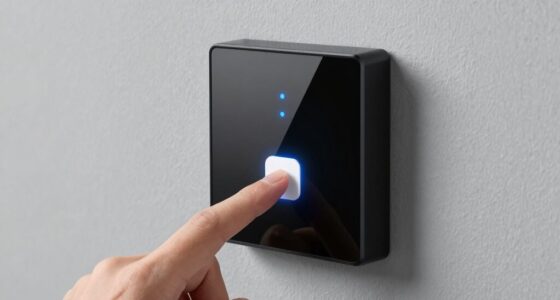
To detect presence without cameras and protect your privacy, you can use sensor fusion techniques that combine signals like Bluetooth, Wi-Fi, or ambient RF signals. These methods identify whether someone is nearby without revealing exact locations. Smart encryption protocols ensure data stays secure, and the system only confirms presence, not precise whereabouts. If you want to explore how these technologies work together to keep your privacy safe, there’s more to discover below.

Get privacy and security gear delivered free with Prime
- Fast, free delivery on millions of items
- Prime Video, Amazon Music and more included
- Member-only deals all year
Key Takeaways
- Combining Bluetooth, Wi-Fi, and RF sensors can detect proximity without revealing precise locations.
- Cryptographic protocols encrypt sensor data to ensure secure, privacy-preserving presence verification.
- Sensor fusion abstracts location details, confirming presence while safeguarding user anonymity.
- Such systems enable privacy-friendly access control, device pairing, and social interactions without cameras.
- These methods minimize privacy risks compared to traditional invasive surveillance or GPS-based detection.

In today’s digital world, knowing whether someone is nearby often requires sharing sensitive location data, raising privacy concerns. Traditional presence detection methods, like cameras or GPS, can compromise your privacy by revealing precise whereabouts. To address this, innovative solutions leverage techniques that detect presence without exposing personal location details. One such approach involves sensor fusion, where multiple sensors—such as Bluetooth, Wi-Fi signals, or ambient radio frequency detectors—work together to infer proximity. Instead of relying on a single data source that could pinpoint your exact location, sensor fusion combines signals to determine if someone is nearby without identifying where they are.
Sensor fusion detects proximity while preserving user privacy by avoiding precise location sharing.
This method offers a significant privacy advantage because it abstracts away precise location information, focusing solely on the fact of presence. But to guarantee that this process remains secure and resistant to malicious interference, cryptographic protocols come into play. These protocols encrypt the data exchanged between sensors and detection systems, preventing eavesdroppers from intercepting or deciphering sensitive information. By encrypting sensor data, cryptographic protocols ensure that only authorized devices can interpret the proximity signals, *thereby* maintaining user privacy.
Implementing privacy-preserving presence detection with sensor fusion and cryptography involves a careful balance. You need sensors sensitive enough to detect relevant signals but not so precise that they compromise your privacy. Additionally, the cryptographic protocols must be robust enough to withstand attacks, *guaranteeing* that the presence detection mechanism isn’t exploited to track individuals over time. Techniques like secure multi-party computation or zero-knowledge proofs can be employed, allowing systems to verify presence without revealing underlying data.
You benefit from this technology by maintaining your privacy while still enabling functionalities like access control, social interactions, or device pairing. For instance, your phone can detect when you’re near a smart home device and automatically *unlatch* the door without revealing your exact location to external entities. This way, the system confirms your proximity in a privacy-preserving manner, respecting your personal data. Furthermore, such methods are scalable and adaptable, suitable for various environments—whether in offices, public spaces, or private homes—without the need for invasive cameras or intrusive tracking.
Ultimately, integrating sensor fusion with cryptographic protocols offers a practical, privacy-focused solution for presence detection. It *guarantees* you stay connected and functional in the digital world without sacrificing your personal privacy. By focusing on secure, multi-sensor approaches, developers can create systems that are both effective and respectful of your right to privacy, redefining how proximity is verified in an increasingly connected society.
As an affiliate, we earn on qualifying purchases.
Frequently Asked Questions
How Does Presence Detection Work Without Using Cameras?
You can detect presence without cameras through sensor innovation, like motion sensors, infrared, or ultrasonic devices. These sensors track activity or movement, and the data is processed with data anonymization techniques to protect your privacy. Instead of capturing detailed images, they focus on detecting presence or absence, ensuring your location remains private while still providing accurate information for security, automation, or other applications.
What Are the Main Privacy Concerns With Traditional Presence Detection?
You might worry about your data being shared, tracked, or misused when traditional presence detection collects your information. Privacy concerns include unauthorized access, data leaks, and lack of transparency. To safeguard you, systems should prioritize data encryption and seek clear user consent. By doing so, they respect your privacy, ensure control over your information, and build trust—making your presence known without sacrificing your personal rights.
Can This Technology Detect Multiple People Simultaneously?
Yes, this technology can detect multiple people simultaneously through multi-user detection and simultaneous identification. You can rely on its ability to distinguish and track several individuals at once without infringing on privacy. It uses non-invasive signals, such as Wi-Fi or Bluetooth, to identify multiple users in real-time. This guarantees accurate presence detection while maintaining privacy, making it suitable for environments needing multi-user awareness without camera-based monitoring.
How Accurate Is Privacy-Preserving Presence Detection?
Think of privacy-preserving presence detection like a skilled detective, quietly gathering clues. Its sensor accuracy is impressive, often pinpointing presence with high precision. While no technology is infallible, detection reliability remains strong in controlled environments. You can trust this system to accurately sense multiple people without invading privacy, thanks to advanced algorithms and sensor calibration. Overall, it offers a reliable balance of privacy and detection performance, like a trustworthy friend keeping secrets.
What Are Potential Applications Beyond Security and Monitoring?
You can use privacy-preserving presence detection with sensor fusion and data anonymization in areas like smart homes, healthcare, and retail. It helps optimize energy usage, improve patient care, and personalize shopping experiences without compromising privacy. By combining multiple sensor inputs and anonymizing data, you make certain sensitive information stays protected while gaining valuable insights. This approach opens doors to innovative, privacy-conscious applications beyond security and monitoring.
As an affiliate, we earn on qualifying purchases.
Conclusion
By now, you see how privacy-preserving presence detection can keep your data safe without cameras. With over 80% of users concerned about privacy, these methods offer a promising solution. You can enjoy accurate detection while safeguarding your personal information. As technology advances, embracing such innovative approaches becomes essential. Ultimately, you get the benefits of presence detection without compromising your privacy—making your environment both smarter and safer.
As an affiliate, we earn on qualifying purchases.
privacy-preserving presence detection
As an affiliate, we earn on qualifying purchases.
As an affiliate, we earn on qualifying purchases.
Columbus Day / Indigenous Peoples' Day Picks
long weekend sales
As an affiliate, we earn on qualifying purchases.