For most families, I’d start with the Garmin inReach Messenger Plus with Power Bank Bundle: it pairs two-way satellite communication and SOS features with extra power for trips away from outlets. The Garmin inReach Mini 3 Plus bundle suits families who want a rugged touchscreen device, while the Motorola Defy Satellite Link is a phone-pairing option for people who prefer to message from a familiar handset. The main tradeoffs are ease of use, battery planning, device size, and whether everyone can use the communication features when a phone is unavailable. A bundle can add useful accessories, but it does not replace an active service plan or a family emergency plan. Read on for the full breakdown of how these ten options differ.

Get privacy and security gear delivered free with Prime
- Fast, free delivery on millions of items
- Prime Video, Amazon Music and more included
- Member-only deals all year
Key Takeaways
- The Messenger Plus with Power Bank Bundle leads for family readiness: its extra power source addresses a practical weak point on longer trips, alongside satellite messaging and SOS functions.
- The Mini 3 Plus bundle is the rugged touchscreen alternative: it favors a more self-contained device experience, while the Mini 3 Compact is the smaller choice for families prioritizing packability.
- Garmin’s lineup splits by communication needs: Messenger models focus on satellite messaging, while the Plus models add photo and voice messaging capabilities listed in their product names.
- The Motorola Defy Satellite Link depends on a compatible phone: that may feel familiar for everyday messaging, but it gives families another device and phone-connection step to manage.
- The ACR Bivy Stick options focus on compact satellite communication: the case-and-carabiner bundle adds carrying convenience, while the standard Bivy Stick listing keeps the emphasis on the communicator itself.
| Garmin inReach Messenger Plus Satellite Communicator with P-Bank Bundle |  | Best Overall for Family Check-Ins | Model: 010-02887-00 | Satellite network: Iridium | Connectivity: Iridium satellite, Bluetooth, Wi-Fi | VIEW ON AMAZON | See Our Full Breakdown |
| Garmin inReach Mini 3 Plus Rugged Global Satellite Communicator with Touchscreen, Messaging, Emergency SOS, and Power Bank Bundle |  | Best Compact Family Kit | Screen: 1.9-inch capacitive LCD touchscreen | Weight: 4.42 ounces | Dimensions: 3.85 × 1.05 × 2.16 inches | VIEW ON AMAZON | See Our Full Breakdown |
| Garmin inReach Mini 3 Compact SOS Satellite Communicator with Color Touchscreen Bundle |  | Best for Straightforward SOS and Location Sharing | Screen: 1.9-inch color touchscreen | Display type: LED | Connectivity: Bluetooth | VIEW ON AMAZON | See Our Full Breakdown |
| Garmin inReach Mini 2 Satellite Communicator with Accessories |  | Best for Navigation-Focused Families | Weight: 3.5 ounces | Dimensions: 4 × 2 inches | Battery life: Up to 14 days in default mode; up to 30 days in extended mode | VIEW ON AMAZON | See Our Full Breakdown |
| Garmin inReach Messenger Plus SOS Satellite Communicator with Photo, Text & Voice Messaging |  | Best for Rich Remote Updates | Connectivity: Wi-Fi listed; description also specifies cellular and satellite network switching | Control method: App | Water resistance: IPX7 | VIEW ON AMAZON | See Our Full Breakdown |
| Garmin inReach Messenger Satellite Communicator Bundle |  | Best for Long Family Trips | Compatible devices: Smartphones and Garmin devices | Battery life: Up to 28 days | Water resistance: IPX7 | VIEW ON AMAZON | See Our Full Breakdown |
| Garmin inReach Messenger Plus Satellite Communicator Bundle |  | Best for Richer Family Updates | Satellite network: Iridium | Messaging: Two-way text, photo, and voice messages | Text message length: Up to 1,600 characters | VIEW ON AMAZON | See Our Full Breakdown |
| Motorola Defy Satellite Link – Rugged Handheld GPS Communicator, Two-Way Global SMS Text Messenger, Emergency SOS Alerting, Android & iOS Compatible |  | Best for Basic Emergency Check-Ins | Screen size: 1.92 inches | Battery: 600 mAh Li-Po | Battery life: Up to 4 days standby | VIEW ON AMAZON | See Our Full Breakdown |
| ACR Bivy Stick 2-Way Satellite Communicator with Carrying Case and Carabiner Bundle |  | Best for Easy Carry and Check-Ins | Brand: ACR | Communication features: SOS, GPS sharing, and offline maps | Check-ins: Unlimited check-in messages | VIEW ON AMAZON | See Our Full Breakdown |
| ACR Bivy Stick Satellite Communicator – Two-Way Global SMS, GPS Tracker, Off-Grid Communication, SOS Emergency Beacon, Satellite Messenger & Location Sharing |  | Best for Tracking and Offline Navigation | Model number: 4621 | Connectivity: Bluetooth, Iridium satellites, LoRa, and wireless | Supported applications: iOS app and Android app | VIEW ON AMAZON | See Our Full Breakdown |
| satellite communicator bundle for family emergencie | Battery life | Connectivity | Water resistance |
|---|---|---|---|
| Garmin inReach Messenger Plus | Up to 25 days in 10-minute tracking mode | Iridium satellite, Bluetooth, Wi-Fi | IPX7 |
| Garmin inReach Mini 3 Plus Rug | 350 hours | Bluetooth | — |
| Garmin inReach Mini 3 Compact | 350 hours | Bluetooth | IP67 |
| Garmin inReach Mini 2 Satellit | Up to 14 days in default mode; up to 30 days in extended mode | Iridium satellite network | IPX7 |
| Garmin inReach Messenger Plus | Long-lasting; specific duration not provided | Wi-Fi listed; description also specifies cellular and satellite network switching | IPX7 |
| Garmin inReach Messenger Satel | Up to 28 days | Satellite, cellular, and Wi-Fi | IPX7 |
| Garmin inReach Messenger Plus | Up to 25 days in 10-minute tracking mode | — | IPX7 |
| Motorola Defy Satellite Link | Up to 4 days standby | Bluetooth | — |
| ACR Bivy Stick 2-Way Satellite | — | — | — |
| ACR Bivy Stick Satellite Commu | 120 hours | Bluetooth, Iridium satellites, LoRa, and wireless | — |
More Details on Our Top Picks
Garmin inReach Messenger Plus Satellite Communicator with P-Bank Bundle
For families who want more than a distress beacon, the inReach Messenger Plus pairs two-way text with photo and 30-second voice messages, giving people at home richer updates when a trip leaves cell coverage. Its Iridium satellite connection and interactive SOS make it a stronger fit for remote trips than relying on a phone alone, while the included P-Bank adds a practical charging option. Up to 25 days in 10-minute tracking mode also suits trips where charging access is uncertain. Compared with the inReach Mini 2, this bundle offers photo and voice messaging, but the Mini 2’s compass and TracBack tools may be more appealing to route-focused users. The main tradeoffs are a required satellite subscription and more messaging capability than families who only need basic check-ins may use.
Pros:- Supports two-way text, photo, and 30-second voice messages over satellite
- Up to 25 days of battery life in 10-minute tracking mode
- IPX7 water resistance suits wet outdoor conditions
- Bundle includes a P-Bank, USB-C cable, and charging adapters
Cons:- Satellite messaging requires an active subscription
- Some jurisdictions may restrict satellite device use
- Photo and voice messaging may be unnecessary for families seeking only basic emergency contact
Best for: Families taking extended off-grid trips who want to send text, photo, and voice updates and carry an extra battery bank.
Not ideal for: Occasional day hikers who only need basic SOS and location sharing, since the subscription and richer messaging features may be more than they need.
- Model:010-02887-00
- Satellite network:Iridium
- Connectivity:Iridium satellite, Bluetooth, Wi-Fi
- Battery life:Up to 25 days in 10-minute tracking mode
- Water resistance:IPX7
- Messaging:Text, photo, and 30-second voice messages
- App compatibility:Garmin Messenger and Garmin Explore
- Included accessories:P-Bank battery, USB-C cable, charging adapters, microfiber cleaning cloth
Our verdict“Choose this bundle for extended family trips where richer satellite check-ins and included backup power matter more than keeping the setup basic.”
Garmin inReach Mini 3 Plus Rugged Global Satellite Communicator with Touchscreen, Messaging, Emergency SOS, and Power Bank Bundle
The inReach Mini 3 Plus bundle puts a compact communicator and a 5,000mAh power bank in one kit, a useful combination when family members are splitting gear between packs. At 4.42 ounces, the device is easy to carry, and its touchscreen, voice and text messaging, photo sharing, and global SOS offer more direct interaction than a basic emergency beacon. The listed 350-hour battery life gives it a long-use profile, though real runtime depends on how it is used. Compared with the larger-feature emphasis of the inReach Messenger Plus, this pick prioritizes a small handheld form and includes a car charger and wall charger. That bundle can simplify preparation, but satellite service still needs a subscription, and some connected features depend on compatible Garmin devices or a smartphone.
Pros:- Compact 4.42-ounce handheld design
- Bundle includes a 5,000mAh power bank, car charger, and wall charger
- Supports global SOS, voice and text messaging, and photo sharing
- Touchscreen and Bluetooth support connected use with compatible devices
Cons:- Satellite services require an active subscription
- Some features may depend on compatible Garmin devices or smartphone pairing
- The provided data does not specify water resistance
Best for: Families who want a lightweight handheld communicator with a power bank and charging accessories for trips involving multiple pack users.
Not ideal for: Buyers who want the simplest possible emergency-only device or do not want to manage a satellite subscription and app or device compatibility.
- Screen:1.9-inch capacitive LCD touchscreen
- Weight:4.42 ounces
- Dimensions:3.85 × 1.05 × 2.16 inches
- Battery life:350 hours
- Connectivity:Bluetooth
- Navigation systems:GPS and GLONASS
- Messaging features:Voice and text messaging, photo sharing, LiveTrack, global SOS
- Included power and charging:5,000mAh power bank, USB-C cable, car charger, wall charger
Our verdict“Pick this bundle when portability and a ready-to-carry charging kit matter more than an emergency-only feature set.”
Garmin inReach Mini 3 Compact SOS Satellite Communicator with Color Touchscreen Bundle
Families who mainly want a compact device for emergency alerts and location updates may prefer the inReach Mini 3 over messaging-heavy picks. Its 1.9-inch color touchscreen gives users a more direct interface than a phone-dependent setup, while the listed 350-hour battery life suits longer outings where charging is limited. IP67 protection and operation in extreme temperatures support use in harsher conditions. Compared with the inReach Mini 3 Plus, this model is presented as an SOS communicator rather than a bundle centered on voice, photo sharing, and extra charging gear; that simpler role may be easier for a family to manage, but the supplied data lists fewer communication features. Satellite use requires an active subscription, and the compact handheld form may not suit everyone’s preferred way of carrying gear.
Pros:- IP67 water resistance and operation in extreme temperatures
- Listed 350-hour battery life for extended outings
- 1.9-inch color touchscreen provides a direct on-device interface
- Uses the Iridium satellite network for communication beyond cellular coverage
Cons:- Full satellite functionality requires an active subscription
- Handheld form may not suit users who want another mounting or carrying format
- The product data does not list photo or voice messaging
Best for: Families who want a compact, rugged handheld for SOS alerts and location sharing without prioritizing photo or voice messages.
Not ideal for: Families who want bundled backup power or richer voice and photo communication, since those advantages are listed for the Mini 3 Plus instead.
- Screen:1.9-inch color touchscreen
- Display type:LED
- Connectivity:Bluetooth
- Battery life:350 hours
- Water resistance:IP67
- Satellite network:Iridium
- Navigation system:GPS
- Map coverage:Worldwide
Our verdict“Choose the Mini 3 for a rugged, compact family SOS device when straightforward emergency communication matters more than richer messaging.”
Garmin inReach Mini 2 Satellite Communicator with Accessories
The inReach Mini 2 makes sense for families who want satellite contact alongside practical route tools. Two-way messaging and interactive SOS cover the emergency role, while TracBack routing can help users retrace a route if a group takes a wrong turn. A digital compass and weather updates add useful context beyond what the more messaging-focused inReach Messenger Plus emphasizes. Battery life is listed at up to 14 days in default mode or 30 days in extended mode, giving buyers a choice between routine use and longer tracking intervals. Its 3.5-ounce weight is easy to carry, but the small LCD can be less convenient to read than a touchscreen interface, and satellite service requires a subscription. Choose it for navigation support, not for photo or voice messaging.
Pros:- TracBack routing and digital compass support route recovery and orientation
- Weather updates add information for changing outdoor conditions
- Battery life reaches up to 30 days in extended mode
- Compact 3.5-ounce body with IPX7 water resistance
Cons:- Satellite services require a subscription plan
- Small LCD may be harder to read than the touchscreen on newer Mini models
- Does not offer the listed photo and voice messaging features of the Messenger Plus
Best for: Families who hike or travel on unfamiliar routes and want satellite messaging, weather information, and a way to retrace their path.
Not ideal for: Families who want photo and voice check-ins or a larger, more readable interface, since the Mini 2 has a small LCD and the supplied data lists no such messaging.
- Weight:3.5 ounces
- Dimensions:4 × 2 inches
- Battery life:Up to 14 days in default mode; up to 30 days in extended mode
- Water resistance:IPX7
- Connectivity:Iridium satellite network
- Display:480 × 272 LCD with capacitive touch
- Navigation features:TracBack routing and digital compass
- Additional feature:Weather updates
Our verdict“Choose the Mini 2 when route recovery and weather information are as important to your family as satellite SOS and messaging.”
Garmin inReach Messenger Plus SOS Satellite Communicator with Photo, Text & Voice Messaging
When relatives at home need more than a brief text, the inReach Messenger Plus supports photo, voice, and text messaging alongside SOS and live GPS tracking. That mix can help a family share more useful context from outside cellular coverage than the inReach Mini 2, whose listed strengths lean toward route tools and basic satellite communication. The device is described as switching between Wi-Fi, cellular, and satellite networks, which can help keep communication connected across changing coverage, though the supplied data does not spell out how each feature works. Its IPX7 rating adds water resistance. Unlike the bundle version of the Messenger Plus in this lineup, this listing does not specify a P-Bank or battery runtime, so buyers seeking included backup power should compare the bundle carefully. App compatibility and a subscription are also part of the setup.
Pros:- Supports photo, voice, and text messaging
- SOS feature includes 24/7 response coordination
- Live GPS tracking can share location with family
- IPX7 water resistance suits outdoor use
Cons:- Full satellite functionality requires an active subscription
- Some features depend on smartphone app compatibility
- Battery runtime and included backup power are not specified in the product data
Best for: Families who want photo, voice, and text updates plus live location tracking when traveling beyond cellular coverage.
Not ideal for: Buyers who need a clearly specified long battery runtime or included power bank, or who want to avoid smartphone-app dependence.
- Connectivity:Wi-Fi listed; description also specifies cellular and satellite network switching
- Control method:App
- Water resistance:IPX7
- Battery life:Long-lasting; specific duration not provided
- Messaging:Photo, text, and voice messaging
- Safety and tracking:SOS emergency feature and live GPS tracking
- Supported devices:Garmin watch or handheld device
- Supported apps:Garmin Messenger and Garmin Explore
Our verdict“Choose this listing for richer remote family updates and location sharing, but compare it with the bundled Messenger Plus if backup power is a priority.”
Garmin inReach Messenger Satellite Communicator Bundle
For families who may spend days beyond cell coverage, this Messenger bundle prioritizes staying connected over extra message formats. It supports two-way satellite messaging, group messages, and location sharing, so family members can receive check-ins and follow progress without relying on a cellular signal. Its stated battery life of up to 28 days is longer than the Messenger Plus bundle’s stated 25 days in 10-minute tracking mode, making this the stronger fit for longer outings, though those figures depend on use. The included portable battery adds another way to keep the communicator powered. Compared with the Motorola Defy Satellite Link, it has a much longer stated battery duration, but still requires an active satellite subscription and airtime plan. Buyers should also check local rules on satellite-device use before traveling.
Pros:- Supports two-way messaging and group check-ins beyond cellular coverage
- Location sharing helps family members follow a trip
- Up to 28 days of stated battery life
- Bundle includes a portable battery and charging adapters
Cons:- Messaging and satellite airtime require an active subscription plan
- Satellite-device use may be regulated in some jurisdictions
- Does not list photo or voice messaging among its features
Best for: Families planning multi-day trips outside cellular coverage who want group check-ins, location sharing, and a long stated battery life.
Not ideal for: Families who want photo or voice messaging, or who do not want recurring satellite service costs.
- Compatible devices:Smartphones and Garmin devices
- Battery life:Up to 28 days
- Water resistance:IPX7
- Connectivity:Satellite, cellular, and Wi-Fi
- Messaging:Two-way messaging and group messaging
- Location features:Location sharing
- Included accessories:USB cable, charging adapters, microfiber cloth, and portable battery
Our verdict“Choose this bundle for extended family trips where long battery life and group location sharing matter more than photo or voice messages.”
Garmin inReach Messenger Plus Satellite Communicator Bundle
This bundle makes the most sense when a family wants more than short text check-ins: the Messenger Plus supports text messages up to 1,600 characters, photo messages, and voice messages over the Iridium satellite network. That can make an off-grid update more useful to relatives who need a clearer account of a delay or situation. The tradeoff is its stated battery life: up to 25 days in 10-minute tracking mode, shorter than the standard inReach Messenger’s up to 28 days. It also needs an active satellite subscription, so the expanded messaging options bring ongoing service requirements. Compared with the Motorola Defy Satellite Link, this Garmin bundle specifies photo and voice messaging, while the Motorola’s compact, simple feature set is a better match for buyers focused on basic SOS and text communication.
Pros:- Supports text messages up to 1,600 characters, plus photo and voice messages
- Uses the Iridium satellite network for off-grid communication
- Includes a power bank in the bundle
- IPX7 water resistance and stated tolerance for extreme temperatures
Cons:- Requires an active subscription for satellite services
- Up to 25 days in 10-minute tracking mode is less than the standard Messenger’s stated 28 days
- Satellite use is restricted in some jurisdictions
Best for: Families who want to send more descriptive satellite updates, including photos or voice messages, during trips beyond cellular coverage.
Not ideal for: Buyers who only need basic emergency messaging or who prioritize the longest stated battery life over richer updates.
- Satellite network:Iridium
- Messaging:Two-way text, photo, and voice messages
- Text message length:Up to 1,600 characters
- Battery life:Up to 25 days in 10-minute tracking mode
- Water resistance:IPX7
- Temperature tolerance:Designed for extreme temperatures
- Bundle includes:Messenger Plus communicator, microfiber cleaning cloth, and P-Bank battery
Our verdict“Pick the Messenger Plus bundle if richer family updates matter more than maximizing the stated battery duration or keeping service needs simple.”
Motorola Defy Satellite Link – Rugged Handheld GPS Communicator, Two-Way Global SMS Text Messenger, Emergency SOS Alerting, Android & iOS Compatible
The Motorola Defy Satellite Link is the straightforward choice here for families who want a compact SOS and two-way messaging device without the richer message formats offered by the Garmin Messenger Plus. At 2.5 ounces, it is easy to attach or pack, and its push buttons and LED display provide physical controls rather than making the communicator itself the focus of a phone screen. It pairs with iOS 14 and Android 10 or later over Bluetooth. Its biggest limitation for family emergencies is power: up to four days of standby is far below the stated durations for either Garmin Messenger bundle, so it better suits shorter outings or trips with a charging plan. A service plan is also required, and satellite access is limited to coverage areas.
Pros:- Lightweight at 2.5 ounces and compact enough to carry easily
- Supports two-way satellite messaging and emergency SOS alerts
- Bluetooth compatibility with iOS 14 and Android 10 or later
- Includes a webbing strap with D-ring for attachment
Cons:- Stated battery standby is up to four days, much shorter than the Garmin Messenger bundles
- Requires a service plan and works only where satellite coverage is available
- Phone compatibility excludes older operating-system versions
Best for: Families on shorter outdoor outings who want a light, phone-compatible device for satellite texts and SOS alerts.
Not ideal for: Families on extended trips who need long standby duration or those whose phones do not run iOS 14 or Android 10 and later.
- Screen size:1.92 inches
- Battery:600 mAh Li-Po
- Battery life:Up to 4 days standby
- Dimensions:3.4 x 2.5 x 0.5 inches
- Weight:2.5 ounces
- Connectivity:Bluetooth
- Supported devices:iOS 14 and Android 10 or later
- Controls and attachment:GPS, LED display, push buttons, and webbing strap with D-ring
Our verdict“Choose the Defy for short trips where low carry weight and basic emergency communication count more than extended battery life.”
ACR Bivy Stick 2-Way Satellite Communicator with Carrying Case and Carabiner Bundle
This Bivy Stick bundle stands apart through its carry-focused accessories and check-in tools: the pouch has a belt attachment and carabiner, while the communicator supports unlimited check-in messages, GPS sharing, offline maps, and navigation. That combination suits a family that wants the device accessible rather than buried in a pack, with location information available when phones lose cellular service. Compared with the Garmin inReach Messenger bundle, the provided product details highlight offline maps and unlimited check-ins, but do not state a battery-life figure or water-resistance rating. Those missing details make it harder to judge for long or wet trips. Satellite communication also takes some familiarity, so this is less appealing to a family looking for a simple, ready-to-use emergency device.
Pros:- Pouch with belt attachment and carabiner supports accessible carry
- Unlimited check-in messages are listed
- Provides GPS location sharing and offline maps
- Designed for communication where cellular coverage is unavailable
Cons:- Requires familiarity with satellite communication
- Provided specifications do not state battery life or water resistance
- Smartphone compatibility is listed, so it is not presented as a standalone phone replacement
Best for: Families who want a satellite communicator kept close at hand, with a belt pouch, carabiner, GPS sharing, and offline navigation.
Not ideal for: First-time satellite users who want clearly stated battery and durability specifications or a particularly simple setup.
- Brand:ACR
- Communication features:SOS, GPS sharing, and offline maps
- Check-ins:Unlimited check-in messages
- Connectivity technology:RF
- Compatible devices:Smartphone
- Included carry accessories:Pouch case with belt attachment and carabiner
- Unit count:1
- Warranty:See product page for warranty details
Our verdict“Choose this bundle if accessible carry and check-in features are your priorities, but compare its unstated battery and durability details against the Garmin Messenger first.”
ACR Bivy Stick Satellite Communicator – Two-Way Global SMS, GPS Tracker, Off-Grid Communication, SOS Emergency Beacon, Satellite Messenger & Location Sharing
For families who want to follow a route as well as send emergency messages, this Bivy Stick pairs Iridium satellite communication with live tracking, offline maps, and location sharing. Its stated 120-hour battery life gives buyers a more concrete planning figure than the accessory-focused Bivy Stick bundle, whose supplied specifications do not list battery duration. The unit is also rated IPX7 and listed as MIL-STD-810 compliant, useful details for outdoor use, though neither removes the need to manage power and service. Compared with the Garmin inReach Messenger Plus, the Bivy Stick emphasizes GPS tracking and offline navigation, while Garmin specifies photo and voice messaging. This ACR model works with iOS and Android apps, but families should confirm their device compatibility and budget for a subscription to use its full functionality.
Pros:- Iridium satellite connectivity supports off-grid communication
- Includes live tracking, GPS location sharing, and offline maps
- Stated battery life of 120 hours
- IPX7 and MIL-STD-810 compliance are listed
Cons:- A subscription is required for full functionality
- At 3.95 ounces, it is heavier than the Motorola Defy Satellite Link
- Relies on compatible iOS or Android applications
Best for: Families who want route tracking, location sharing, and offline navigation alongside satellite SOS and two-way messaging.
Not ideal for: Buyers who want photo and voice messages or who need a communicator that operates without a compatible smartphone app and subscription.
- Model number:4621
- Connectivity:Bluetooth, Iridium satellites, LoRa, and wireless
- Supported applications:iOS app and Android app
- Battery life:120 hours
- Dimensions:4.51 x 1.86 x 0.83 inches
- Weight:3.95 ounces
- Enclosure:IPX7 and MIL-STD-810 compliant
- Listed uses:Outdoor activities, remote locations, hiking, camping, and skiing
Our verdict“Choose this Bivy Stick for family trips where route visibility and offline navigation matter more than photo or voice messaging.”
How We Picked
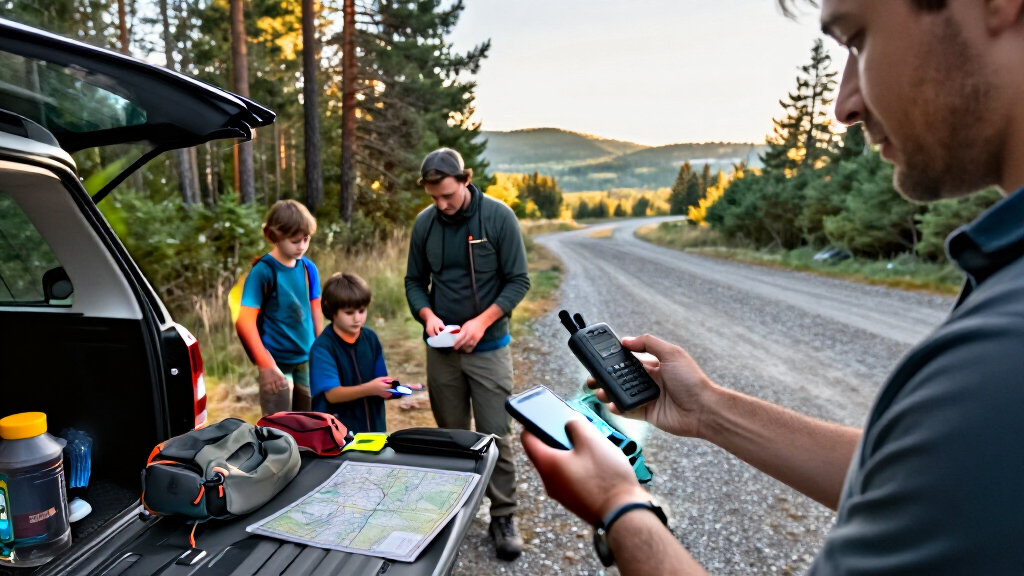
I compared these ten listings for the needs that matter when a family may have to communicate outside cellular coverage: two-way messaging and SOS capability, ease of access during stress, device independence, portability, and power planning. I also looked at what each bundle appears to add, since a power bank or carrying case can affect readiness even when the communicator itself is similar. I did not treat a bundle label as proof of an active satellite subscription; buyers should confirm current service requirements and coverage before relying on any device.
The ranking favors options that combine useful emergency communication with practical family readiness, then separates them by who benefits from their design. The Messenger Plus Power Bank Bundle ranks first for pairing communication features with a power accessory. Rugged touchscreen and compact Garmin models follow for different handling preferences, while phone-dependent or more accessory-focused choices rank lower for families who need the simplest backup path. Product names and supplied descriptions do not establish exact battery life, plan terms, coverage in every location, or included accessory contents, so those details should be verified before purchase.
| satellite communicator bundle for family emergencie | Connectivity | Water resistance |
|---|---|---|
| Garmin inReach Messenger Plus | Iridium satellite, Bluetooth, Wi-Fi | IPX7 |
| Garmin inReach Mini 3 Plus Rug | Bluetooth | — |
| Garmin inReach Mini 3 Compact | Bluetooth | IP67 |
| Garmin inReach Mini 2 Satellit | Iridium satellite network | IPX7 |
| Garmin inReach Messenger Plus | Wi-Fi listed; description also specifies cellular and satellite network switching | IPX7 |
| Garmin inReach Messenger Satel | Satellite, cellular, and Wi-Fi | IPX7 |
| Garmin inReach Messenger Plus | — | IPX7 |
| Motorola Defy Satellite Link | Bluetooth | — |
| ACR Bivy Stick 2-Way Satellite | — | — |
| ACR Bivy Stick Satellite Commu | Bluetooth, Iridium satellites, LoRa, and wireless | — |
Factors to Consider When Choosing Satellite Communicator Bundle For Family Emergencies
Choosing a family satellite communicator is less about collecting the most features and more about deciding how your household will use it under pressure. I’d settle the communication plan, power routine, and device handoff before comparing accessory bundles.
Decide Who Must Be Able to Send a Message
A family device is only useful if the person carrying it can operate it when plans change. Decide whether one designated adult will handle messages or whether older children and other caregivers need to use it too. A standalone communicator can reduce dependence on a phone, while a phone-paired unit may feel more familiar to someone who already messages from an app. Familiarity is not the same as readiness: practice sending a check-in and finding the SOS controls before a trip. Keep a short written contact list and agreed check-in schedule with the device so a handoff does not leave the next carrier guessing.
Check Service Plans and Coverage Before Choosing a Device
Satellite hardware alone does not tell you where messaging will work or what service is needed. Review the manufacturer’s current coverage map for the specific places your family visits, then check the plan requirements for SOS, routine messages, and location sharing. Do not assume that a bundle includes an active subscription just because it includes accessories. Also check whether a plan can be paused, changed, or shared across devices if your family has seasonal use. A lower-complexity device is a poor fit if its service terms do not match how often you travel off-grid.
Plan for Power as a Family System
Emergency communication needs power after the trip has already run longer than expected. Work out who will carry the communicator, who will carry a charging cable or power bank, and how the family will keep the kit dry and accessible. A bundle with a power bank can simplify packing, but it still needs to be charged and compatible with the device. Avoid treating an advertised battery figure as a guarantee; settings, message frequency, temperature, and tracking use can affect runtime. Make a habit of charging the full kit before departure and checking it again after each outing.
Choose Phone Independence Deliberately
A phone-linked satellite accessory can lower the learning curve for people who prefer a familiar screen and typing experience. Its tradeoff is that the phone becomes part of the communication chain, so battery loss, damage, or a pairing problem can complicate use. A communicator with its own screen and controls may be easier to rely on when a phone is unavailable, though the interface may take practice. Think through who holds each item and whether the family can still send a message if one device is lost. If the satellite unit is meant to be the emergency backup, test that backup without relying on cellular data.
Match the Device to the Trip, Not Just the Pack
Small, light equipment is easier to carry every day, while a larger screen or rugged design may be easier to handle with gloves or in poor conditions. Families taking short hikes close to roads may value a compact device and simple check-ins; remote, multi-day trips put more weight on power planning, SOS access, and communication routines. A carrying case or carabiner helps with storage and attachment, but it does not improve satellite coverage or replace a suitable service plan. Consider who will carry the unit during a split-up, since a communicator left in the car cannot help a separated group. Buy around the least predictable part of your normal use, not only the easiest outing.
Build a Family Response Plan Before an Emergency
Satellite SOS is a way to contact emergency response services, not a substitute for deciding what the family should do next. Agree on meeting points, who stays with children, and what information to share in a check-in if the group changes plans. Store emergency contacts and relevant medical details where the device or connected app can access them, if supported. Teach each likely carrier how to send a routine message and how SOS differs from a normal check-in. This preparation matters across every model in the roundup and can prevent confusion when one person is separated from the rest.
Frequently Asked Questions
Does a satellite communicator bundle include the service needed to send messages?
Do not assume it does. A bundle may include a communicator and accessories without including an active satellite service plan. Check the current product listing and manufacturer terms for subscription requirements, plan options, and any activation steps before relying on the device. Confirm that the plan supports the features your family expects, such as routine messaging, tracking, or SOS. Treat the hardware and service as separate parts of the purchase unless the seller clearly states otherwise.
Should I choose a communicator that works on its own or one that pairs with a phone?
Choose based on what your family can still use if a phone is lost, damaged, or out of power. A phone-linked unit may offer familiar typing and app controls, but it adds a dependency to the emergency communication chain. A communicator with its own screen or controls may be more self-contained, although family members should practice using it before a trip. If you choose a paired device, keep the phone charged and test the connection away from cellular coverage. For a household with several caregivers, the simplest operating routine may matter more than the interface with the most features.
Is a power bank bundle worth choosing for family emergencies?
It can be useful if your family takes longer outings or expects to use messaging and location features over multiple days. The accessory only helps if it is charged, compatible, and packed with the communicator, so build it into the same pre-trip check. A power bank adds weight and another item to maintain, which may be unnecessary for short outings with a reliable charging routine. Check what the bundle actually includes rather than relying on the word “bundle.” Also keep the device’s charging cable and any required adapters with the kit.
Can one satellite communicator cover a family if the group splits up?
One unit can only help the people who have it with them. If family members regularly travel in separate groups, decide in advance who carries the communicator and how the groups will reconnect if plans change. A single device may be adequate when everyone stays together with one responsible adult, but it leaves the other group without that communication link during a split. Consider the number of devices alongside service-plan costs and the likelihood of separation. At minimum, teach the person carrying the unit how to send a check-in and use SOS.
What should I verify before relying on SOS during a trip?
Check satellite coverage for your route, confirm the device is activated under the required service plan, and read the manufacturer’s instructions for starting an SOS. Make sure the device has charge and that the person carrying it can reach the controls without searching through a bag. Review what information the emergency response process may ask for and keep relevant contacts or medical details available. Do not trigger a live SOS just to test the feature; use the manufacturer’s approved test process instead. A household plan should also cover what to do while waiting for a response.
Conclusion
For most families, my best overall choice is the Garmin inReach Messenger Plus Satellite Communicator with P-Bank Bundle because it combines satellite communication features with an included power accessory. The best premium-style feature set goes to the Garmin inReach Mini 3 Plus Rugged Global Satellite Communicator bundle for buyers who want a rugged touchscreen device and added messaging capabilities. For best value in a simpler setup, compare the Garmin inReach Messenger Satellite Communicator Bundle and ACR Bivy Stick, then verify service requirements and included accessories before deciding. The best beginner fit may be the Motorola Defy Satellite Link for a family that prefers phone-based controls and is comfortable with the phone dependency. For compact carry, consider the Garmin Mini 3 Compact or ACR Bivy Stick; for extra carrying convenience, the Bivy Stick case-and-carabiner bundle is the more tailored pick. Whichever option you choose, confirm coverage and service, charge the full kit, and practice the family’s check-in and SOS routines before an emergency.
Fall Picks
fall essentials
As an affiliate, we earn on qualifying purchases.