A key cabinet lock box for office keys keeps shared keys organized and limits casual access, but the right choice depends on capacity and how staff need to retrieve or return keys. My best overall pick is the Durabox 200-Position Steel Key Cabinet for offices managing a large, clearly labeled key pool. For controlled returns, the 100 Keys Key Cabinet with Drop Slot stands out, while the Uniclife 20-Key Steel Cabinet with Combination Lock is a simpler fit for smaller teams. The main tradeoffs are storage capacity, access convenience, and how much key tracking the cabinet supports. Read on for the full breakdown and guidance on matching a cabinet to your office routine.

Get privacy and security gear delivered free with Prime
- Fast, free delivery on millions of items
- Prime Video, Amazon Music and more included
- Member-only deals all year
Key Takeaways
- Capacity varies widely: the lineup runs from 20-key cabinets to the 200-position Durabox, so sizing for future keys matters as much as counting today’s set.
- Drop slots serve a different purpose: the two 100-key drop-slot cabinets are aimed at controlled returns, not just orderly storage.
- Access methods change staff workflow: mechanical combinations avoid batteries and app setup, while the app-and-keypad and electronic models add digital access but may require more administration.
- Several models share similar footprints and capacities: the Uniclife 32-key options and the two 40-key KYODOLED cabinets make finish or rack style a more useful deciding factor than capacity alone.
- Hook count is not the whole system: numbered hooks, writable racks, tags, and return procedures determine how quickly staff can identify and replace keys.


| key cabinet lock box for office key | Material | Dimensions | Mounting | Capacity |
|---|---|---|---|---|
| Durabox 200-Position Steel Key | Alloy steel | 5.5" D x 15" W x 21.6" H | Wall mount | — |
| 100 Keys Key Cabinet with Drop | High-quality steel | 3.93 x 11.81 x 13.77 inches | Wall mount with pre-drilled holes | 100 keys |
| 100 Keys Key Lock Box with Dro | Alloy steel | 3.93 x 13.77 x 11.81 inches | Wall mount | — |
| Uniclife 32 Keys Key Lock Box | Steel | 9.8" L x 2.3" W x 15.7" H | Wall mount | 32 keys |
| Uniclife 20-Key Steel Key Cabi | Alloy steel | 3 x 6.5 x 8 inches | Wall mount | 20 keys |
| KYODOLED Key Box | Steel | 12.13 × 9.45 × 2.56 inches | Wall mount; mounting included | 40 keys |
| 60-Key Lock Box with Key Tags | Cold-rolled steel | 2.3 × 15.1 × 12.8 inches | Wall mount | 60 keys |
| 32-Key Lock Box with App & Key | Cold-roller steel | 14.2 × 11 × 2.3 inches | Wall mount | 32 keys |
| Uniclife 60-Position Steel Key | Alloy steel | 12.7 × 5.5 × 14.8 inches | Wall mount | 60 keys |
| 28-Key Lock Box Wall Mount | Cold-rolled steel | 2.4 × 8.19 × 11.81 inches | Wall mount; pre-drilled holes | 28 keys |
| Grimtron Electronic 40-Key Cab | Metal | 12.19 x 8.07 x 2.56 inches | Wall mount | 40 keys |
| Kyodoled Wall Mount Key Box | Alloy steel | 7.87 x 6.3 x 3.14 inches | Wall mount | 20 keys |
| KYODOLED Key Box | Steel | 12.13 x 9.45 x 2.56 inches | Wall mount | 40 keys |
| Uniclife 32-Position Wall Moun | Steel | 10.3 x 2 x 15 inches | Wall mount | 32 hooks |
| Amazon Basics Locking Steel Se | Steel | 2.8 x 7 x 9.8 inches | Wall mountable | 48 key hooks |
More Details on Our Top Picks
Durabox 200-Position Steel Key Cabinet – Organize and Secure Key Storage Lock Box with Numbered Hooks and Tags for Valets, Hotel, Office, Car Dealerships, and More (Light Grey)
For an office responsible for a large, changing set of keys, the Durabox 200-Position Steel Key Cabinet offers far more capacity than the 100-key drop-slot cabinets in this lineup. Its 200 numbered hooks, adjustable hook layout, and included tags and log sheet support a more structured system for assigning and tracking keys. The steel cabinet is designed for wall mounting, so the keys have a fixed, centralized home rather than being carried between locations. That capacity comes with a real space commitment: at 21.6 inches tall and 15 inches wide, it needs a suitable wall area. Unlike the 100 Keys Key Cabinet with Drop Slot, it has no described return slot, and its security is mechanical rather than electronic. I’d choose it for inventory scale, not for small offices or rapid key returns.
Pros:- Stores up to 200 keys, giving larger teams room to organize a broad inventory.
- Numbered adjustable hooks and 200 blank tags help connect each key to a tracking system.
- Steel construction and powder-coated finish suit permanent workplace installation.
- Mounting hardware, two keys, and a key log sheet are included.
Cons:- Its 21.6-inch height and 15-inch width require substantial wall space.
- Wall-mounted design is not suited to teams needing portable key storage.
- No drop slot or electronic access feature is specified.
Best for: Facilities teams, car dealerships, and larger offices managing dozens or hundreds of labeled keys in one fixed location.
Not ideal for: Small offices with only a few keys, or teams that need a drop slot, portable storage, or electronic access control.
- Material:Alloy steel
- Finish:Powder-coated steel
- Dimensions:5.5″ D x 15″ W x 21.6″ H
- Key positions:200
- Mounting:Wall mount
- Included components:2 keys, key log sheet, 200 blank key tags, adjustable numbered key hooks, mounting hardware
- Model number:K200
Our verdict“Choose the Durabox when your office needs a fixed cabinet for a large, numbered key inventory and has the wall space to accommodate it.”
100 Keys Key Cabinet with Drop Slot, Anti-Theft Lock Box with Key Tags
The standout here is the drop slot: staff can return keys without opening the cabinet, which helps offices keep a handoff process moving while limiting access to stored keys. The cabinet holds up to 100 keys, making it a practical middle ground between the 20-key Uniclife cabinet and the 200-position Durabox. Its steel body, anti-theft hinges, and pry-resistant door are aimed at more controlled storage than a simple key rack, while numbered hooks and adjustable shelves help keep assignments legible. The tradeoff is that the description does not specify a lock type, so buyers who need a combination or electronic access method should compare it with the Uniclife 32 Keys Key Lock Box. At 9.2 pounds, it also needs secure wall mounting; it is for keys, not larger valuables.
Pros:- Drop slot supports key returns without opening the main cabinet.
- Capacity for 100 keys suits a medium-sized office inventory.
- Anti-theft hinges and a pry-resistant door add physical protection.
- Numbered hooks and adjustable shelves support organized key assignment.
Cons:- The listed details do not identify the lock type or access method.
- At 9.2 pounds, it calls for a suitable, securely mounted wall surface.
- Designed for keys rather than larger items or valuables.
Best for: Office administrators and service teams that collect keys from staff or contractors throughout the day and want a return slot.
Not ideal for: Buyers who require a specified combination or electronic lock, or who need storage for items larger than keys.
- Material:High-quality steel
- Capacity:100 keys
- Dimensions:3.93 x 11.81 x 13.77 inches
- Weight:9.2 pounds
- Mounting:Wall mount with pre-drilled holes
- Organization:Numbered hooks and adjustable shelves
- Included:Key hooks and mounting bolts
Our verdict“Pick this cabinet if frequent key returns matter more to your office workflow than a clearly specified combination or electronic lock.”
100 Keys Key Lock Box with Drop Slot, Anti-Theft Key Cabinet with Key Tags
This model pairs 100 key positions with a side drop slot, giving offices both an organized storage layout and a route for returned keys. Compared with the similarly sized 100 Keys Key Cabinet with Drop Slot, its listed details are clearer about the one-shelf layout, black finish, and flat-panel door; the other cabinet instead calls out anti-theft hinges and a pry-resistant door. That makes the choice less about capacity and more about which construction details and layout match your installation. Alloy steel and wall mounting make it a fixed cabinet, and its 9.3-pound weight means the wall and fasteners need to support it properly. Key tags help with identification, but no digital access feature is described. I’d favor it when a straightforward 100-key system with a return slot is the priority.
Pros:- Combines 100 key positions with a side drop slot for returns.
- Numbered hooks and included key tags help staff identify keys.
- Wall-mount design creates a fixed, centralized storage point.
- Listed one-shelf layout and flat-panel door make the cabinet configuration clear.
Cons:- At 9.3 pounds, it requires a sturdy mounting surface and suitable fasteners.
- No electronic or digital security option is specified.
- The competing 100-key drop-slot cabinet explicitly lists anti-theft hinges and a pry-resistant door, details not given here.
Best for: Office coordinators and rental-property managers who need a labeled 100-key cabinet with a dedicated return slot.
Not ideal for: Teams seeking electronic access, a larger capacity than 100 keys, or a cabinet with explicitly listed anti-theft hinge and pry-resistant-door features.
- Material:Alloy steel
- Dimensions:3.93 x 13.77 x 11.81 inches
- Weight:9.3 pounds
- Key positions:100
- Mounting:Wall mount
- Shelves:1
- Color and door style:Black; flat panel
- Return feature:Side drop slot
Our verdict“Choose this version for a defined 100-key wall cabinet with a return slot, but compare its security details closely with the other 100-key option.”
Uniclife 32 Keys Key Lock Box, Wall Mount Key Cabinet with Writable Key Racks and Tags, Security Key Holder Storage for Office, Hotel & Company
The 3-digit combination lock gives this Uniclife cabinet a useful office distinction: staff can access the keys without needing a separate cabinet key, while the writable racks and tags help clarify where each key belongs. Its 32-key capacity sits between the compact 20-key Uniclife and the 100-key drop-slot models, making it a fit for a department or smaller workplace rather than a large facilities inventory. Four compartments add structure, and wide hooks are described as accommodating bulkier keys. The tradeoff is that a combination lock depends on staff sharing and managing the code; it is not the same as tracking individual electronic access. Compared with the Uniclife 20-Key Steel Key Cabinet, this offers more room and wider hooks, but takes more wall space and still lacks electronic controls.
Pros:- Resettable 3-digit combination lock avoids dependence on a separate cabinet key.
- 32 positions provide more capacity than the 20-key Uniclife cabinet.
- Four compartments, writable racks, and tags support clear key grouping.
- Wide hooks are suited to bulkier keys.
Cons:- Wall mounting is the only listed installation method.
- The combination lock does not provide electronic or biometric access control.
- Its 15.7-inch height may be more cabinet than a small team needs.
Best for: Small offices, hotel desks, and company teams that share up to 32 keys and prefer a combination code over managing a cabinet key.
Not ideal for: Large facilities needing 100 or more positions, or workplaces that require electronic access records or biometric controls.
- Material:Steel
- Dimensions:9.8″ L x 2.3″ W x 15.7″ H
- Capacity:32 keys
- Lock type:3-digit combination lock
- Mounting:Wall mount
- Compartments:4
- Color:Black
Our verdict“Choose this Uniclife when a shared combination code and organized storage for up to 32 office keys suit your team better than a keyed cabinet.”
Uniclife 20-Key Steel Key Cabinet with Combination Lock
For a small office with a modest key list, this Uniclife keeps storage simple: 20 key positions, a resettable combination lock, and colorful tags in a compact wall-mounted cabinet. It takes less space than the 32-key Uniclife, so it suits a reception area or staff room where a larger cabinet would be excessive. The smaller capacity also gives it a clear limit: offices managing multiple departments or frequent key additions may outgrow it and should look at the 32 Keys Key Lock Box or one of the 100-key cabinets. Its alloy-steel construction offers a fixed storage enclosure, but the product is described for indoor use and its basic build is not intended to withstand heavy impact. The listed weight is unusually low, so I would verify installation details before relying on it for a heavily used workplace.
Pros:- Compact dimensions suit tight office walls and staff areas.
- Resettable 3-digit combination lock avoids managing a separate cabinet key.
- Colorful tags and removable labels help distinguish keys quickly.
- 20 positions provide a defined solution for small collections.
Cons:- Capacity is limited to 20 keys, less than the 32-key Uniclife and larger cabinets.
- Specified for indoor use only.
- Basic construction may not withstand heavy impact, and the listed weight warrants checking mounting requirements.
Best for: Small offices, schools, and home-based businesses that need a combination-locked home for no more than 20 keys.
Not ideal for: Facilities teams with growing or shared inventories, or workplaces needing impact-resistant, outdoor, or electronically controlled storage.
- Material:Alloy steel
- Dimensions:3 x 6.5 x 8 inches
- Weight:3.04 ounces
- Capacity:20 keys
- Lock type:Resettable combination lock
- Mounting:Wall mount
- Color:Black
- Compartments:1
Our verdict“Choose this cabinet for a small indoor key collection when compact size and combination access matter more than room to grow.”
KYODOLED Key Box, 40-Key Lock Box with Combination Lock, Wall Mount, Black
For an office that needs a familiar, low-maintenance way to store a moderate number of keys, this 40-key steel cabinet pairs wall mounting with a resettable 3-digit combination. Staff can use a shared code rather than track a physical cabinet key, while writable labels and color-coded tags make it easier to identify sets quickly. Compared with the app-enabled DiDiHere 32-Key Lock Box, the KYODOLED avoids battery changes and app setup, but it cannot offer the same Bluetooth or remote-access options. Its capacity also sits below the 60-key Uniclife cabinet, so it suits a single department or small office better than a large property operation. The tradeoff is a basic access system and a cabinet intended for standard keys and car fobs, not bulky key bundles.
Pros:- Stores up to 40 standard keys and car key fobs.
- Resettable combination lock allows shared access without issuing a cabinet key.
- Writable labels and color-coded tags support faster key identification.
- Wall-mount design keeps keys together in a fixed, accessible location.
Cons:- A 3-digit combination provides fewer code options than the Uniclife cabinet’s 4-digit lock.
- Not designed for larger keys or bulky key bundles.
- No app, electronic access, or key-circulation tracking.
Best for: Small offices and facilities teams managing up to 40 standard keys who want shared combination access without batteries or an app.
Not ideal for: Offices with oversized fobs, more than 40 keys, or a need for remote access and user-level activity tracking.
- Capacity:40 keys
- Material:Steel
- Lock type:Resettable 3-digit combination lock
- Dimensions:12.13 × 9.45 × 2.56 inches
- Weight:3.5 pounds
- Mounting:Wall mount; mounting included
- Color:Black
- Organization:Writable labels and color-coded tags
Our verdict“Choose this cabinet for a small office that wants organized 40-key storage and simple shared combination access, not remote controls or tracking.”
60-Key Lock Box with Key Tags, Wall Mount Key Cabinet, Key Management System
This cabinet’s distinction is not just its 60-key capacity; it is the included app for tracking borrowing and returns. That makes it a stronger fit than the Uniclife 60-Position Steel Key Cabinet for offices where knowing who took a key matters as much as keeping keys sorted. The recessed cold-rolled steel door and magnetic closure provide a tidy, quiet cabinet, while wall mounting keeps it out of the way. There is a real tradeoff: the cabinet uses a mechanical key lock, and the app is needed for the full tracking feature, so it is not a fully electronic access-control system. Compared with the KYODOLED 40-Key Box, it offers more hooks and circulation records, but brings more setup and smartphone dependence.
Pros:- App-based tracking can help staff monitor key borrowing and returns.
- 60-key capacity exceeds the KYODOLED 40-Key Box.
- Recessed steel door with magnetic closure supports quiet, tidy operation.
- Cold-rolled steel construction is described as rust resistant.
Cons:- Full tracking features depend on using a smartphone app.
- Mechanical key lock does not provide app-based cabinet unlocking.
- Capacity is limited to 60 keys, which may not cover larger sites.
Best for: Office administrators, hotel staff, and property managers who need to record key borrowing and returns for a collection of up to 60 keys.
Not ideal for: Teams that avoid smartphone-based workflows, need electronic cabinet entry, or manage more than 60 keys.
- Capacity:60 keys
- Material:Cold-rolled steel
- Lock type:Mechanical key lock
- Dimensions:2.3 × 15.1 × 12.8 inches
- Mounting:Wall mount
- Color:Black
- Door:Recessed steel door with magnetic closure
- Additional feature:Mobile app management system
Our verdict“Pick this cabinet when key circulation records matter more than electronic entry or a setup that works without a smartphone.”
32-Key Lock Box with App & Keypad for Office and Home
The DiDiHere 32-Key Lock Box is the most access-flexible option in this group: it supports a keypad, Bluetooth, and app control, plus temporary, permanent, and time-limited passcodes. Those options suit offices that need to grant different people access without circulating one shared cabinet code. Compared with the KYODOLED 40-Key Box, it gives up eight key positions and adds battery upkeep; compared with the 60-key app-tracking cabinet, it offers electronic unlocking but holds fewer keys. Remote Wi-Fi access requires a separately purchased bridge, so the advertised range of access methods depends on the setup you choose. The steel cabinet is wall mounted, but its 32-key capacity and stated limit on oversized keys make it better for a small team than a busy, high-volume key desk.
Pros:- Keypad, Bluetooth, and app control offer more access methods than the mechanical cabinets.
- Temporary and time-limited passcodes can support controlled handoffs.
- Steel construction and a self-closing door suit wall-mounted office storage.
- Wall mounting provides a fixed location for a shared key collection.
Cons:- Wi-Fi remote access requires a separately purchased bridge.
- Two alkaline batteries are not included and are listed for replacement every 6–8 months.
- 32-key capacity and limited interior room may not suit bulky keys or larger collections.
Best for: Small offices that issue keys to different staff or visitors and want keypad, Bluetooth, and configurable passcode access.
Not ideal for: Large offices needing more than 32 key positions, teams that do not want battery-powered access, or buyers expecting remote Wi-Fi control without extra hardware.
- Brand and model:DiDiHere 2032
- Capacity:32 keys
- Material:Cold-roller steel
- Dimensions:14.2 × 11 × 2.3 inches
- Weight:2.7 kg
- Mounting:Wall mount
- Access:Keypad, app, and Bluetooth; Wi-Fi remote access with optional bridge
- Power:Two alkaline batteries, not included
- Maximum weight capacity:6.6 pounds
Our verdict“Choose the DiDiHere if flexible digital access matters more than capacity and you are prepared for batteries and possible bridge hardware.”
Uniclife 60-Position Steel Key Cabinet with Combination and Key Lock, Black
When an office needs space for many keys without app setup or battery management, this Uniclife cabinet brings 60 hooks, adjustable racks, and a resettable 4-digit combination lock together in one wall-mounted unit. The longer code gives it more combination options than the KYODOLED 40-Key Box, while its included backup keys provide another way to open the cabinet. It also comes with writable tags, a log sheet, and a pen, which can support a manual sign-out routine. Compared with the app-managed 60-key cabinet, this model makes circulation tracking a staff process rather than a digital feature. That simplicity is useful for teams with a paper log, but not for managers who need app-based borrowing records. It still needs wall space and cannot expand beyond 60 positions.
Pros:- 60 hooks and adjustable racks provide room to organize a sizeable key collection.
- Resettable 4-digit combination lock offers more code combinations than the KYODOLED 3-digit model.
- Backup keys provide an alternative means of opening the cabinet.
- Includes 60 key tags, a log sheet, a pen, screws, and wall anchors.
Cons:- No app or electronic tracking for key borrowing and returns.
- A paper log depends on staff recording key movements consistently.
- Wall mounting requires suitable space and installation.
Best for: Facilities teams and offices with up to 60 keys that prefer mechanical access and are willing to manage sign-outs on paper.
Not ideal for: Organizations that need automated circulation records, electronic access, or capacity beyond 60 keys.
- Capacity:60 keys
- Material:Alloy steel
- Lock type:Resettable 4-digit combination lock with backup keys
- Dimensions:12.7 × 5.5 × 14.8 inches
- Shelves:6
- Mounting:Wall mount
- Included organization items:60 key tags, log sheet, and pen
- Installation items:Screws and wall anchors
- Color:Black
Our verdict“Choose this Uniclife cabinet for a 60-key office that wants mechanical access, adjustable organization, and a manual log rather than app tracking.”
28-Key Lock Box Wall Mount, Steel Security Key Cabinet with Key Tags
For a small office with a short list of shared keys, this cabinet keeps the setup simple: 28 positions, a physical key lock, and included tags in a compact wall-mounted steel box. Its listed dimensions are smaller than the KYODOLED 40-Key Box, making it a better fit when wall space is tight and the collection is unlikely to grow much. The tradeoff is less capacity and less flexible access: unlike the KYODOLED, it does not use a combination lock, so authorized staff need access to the cabinet key. It also offers no electronic tracking, and the interior may be cramped for larger keys. The magnetic closure and pre-drilled holes help with everyday installation and closing, but this is a basic storage cabinet rather than a system for monitoring key handoffs.
Pros:- Compact listed dimensions suit offices with limited wall space.
- Cold-rolled steel cabinet provides a fixed, lockable storage point.
- Magnetic closure supports a neat, quiet door close.
- Includes key tags and pre-drilled holes for wall mounting.
Cons:- 28-key capacity is lower than the KYODOLED 40-Key Box and both 60-key cabinets.
- Physical-key access means staff must manage the cabinet key.
- Interior space may be too tight for oversized keys, and there is no electronic tracking.
Best for: Small offices, schools, or real estate teams with fewer than 28 standard keys and limited wall space.
Not ideal for: Teams that need a larger collection, shared access without a physical cabinet key, or app-based records of key handoffs.
- Capacity:28 keys
- Material:Cold-rolled steel
- Lock type:Key lock
- Dimensions:2.4 × 8.19 × 11.81 inches
- Weight:3.1 pounds
- Mounting:Wall mount; pre-drilled holes
- Color:Metallic black
- Door:One door with magnetic closure
- Included:Key tags
Our verdict“Pick this cabinet for a small, stable set of standard office keys when compact dimensions matter more than capacity or flexible access.”
Grimtron Electronic 40-Key Cabinet with Code Lock, Beige
I’d choose the Grimtron when several staff members need access but a single permanent code is not a good fit. Its three access modes include public access with a temporary PIN and password hiding, giving an office more control over handoffs than the mechanical combination on the KYODOLED 40-Key Box. The 40-key capacity and writable, color-coded tags suit a property team or workplace with regularly assigned keys, while its compact wall-mounted metal cabinet keeps them together rather than loose in a drawer.
The tradeoff is that electronic access depends on batteries, and the cabinet still requires a suitable mounting surface. At 40 keys, it also has no room to grow beyond its stated capacity; offices managing a larger collection should look to a higher-capacity cabinet such as the Amazon Basics 48-hook model. I’d pick this for shared access flexibility, not for maximum storage or a maintenance-free lock.
Pros:- Temporary-PIN and other access modes suit shared key handoffs.
- Stores and labels up to 40 keys in one wall-mounted cabinet.
- Color-coded writable tags help staff identify keys quickly.
- Compact metal construction keeps the cabinet relatively unobtrusive.
Cons:- Electronic lock may require battery replacement.
- Capacity is fixed at 40 keys, with no stated expansion option.
- Requires a wall-mount surface and installation.
Best for: Office administrators and property managers who need temporary access codes for staff, contractors, or changing key assignments.
Not ideal for: Teams with more than 40 keys, no suitable wall-mount location, or a preference for a mechanical lock without battery needs.
- Capacity:40 keys
- Lock type:Electronic code lock
- Access modes:Private, public with temporary PIN, and password hiding
- Material:Metal
- Mounting:Wall mount
- Dimensions:12.19 x 8.07 x 2.56 inches
- Weight:3.1 lbs
- Color:Beige
Our verdict“Choose the Grimtron if your office needs flexible code access for up to 40 labeled keys and can accommodate electronic-lock upkeep.”
Kyodoled Wall Mount Key Box, 20-Key Steel Cabinet with Combination Lock, Black
For a small office that needs a dedicated place for a limited set of keys, I’d favor this 20-hook Kyodoled over the larger KYODOLED 40-Key Box. Its smaller 7.87 x 6.3-inch footprint is easier to fit near a reception desk or inside a supply room, and the resettable 3-digit combination avoids managing a separate cabinet key. Numbered labels and color-coded tags make routine identification straightforward without adding electronic controls or battery upkeep.
The capacity limit is the main compromise: this is for a modest key roster, not a growing property portfolio. Its hooks may also be a poor fit for bulky fobs or thick key rings, which can crowd the cabinet before all 20 positions are used. Compared with the Grimtron’s electronic access modes, it offers simpler mechanical access but no temporary PIN function. I’d select it for compactness and uncomplicated shared storage, not for bulky keys or frequent access-code changes.
Pros:- Compact footprint fits tighter office spaces than a 40-key cabinet.
- Resettable 3-digit combination avoids carrying a cabinet key.
- Numbered labels and color-coded tags support quick identification.
- Alloy-steel cabinet is designed for wall mounting.
Cons:- Twenty positions may be too few for larger teams or expanding key collections.
- Bulky fobs and thick rings can take up space and reduce practical capacity.
- No electronic or temporary-code access mode is specified.
Best for: Small offices, studios, and rental managers storing a short list of standard keys in a compact wall-mounted cabinet.
Not ideal for: Teams with bulky fobs, thick key rings, or a collection that is likely to exceed 20 keys.
- Capacity:20 keys
- Lock type:Resettable 3-digit combination lock
- Material:Alloy steel
- Dimensions:7.87 x 6.3 x 3.14 inches
- Mounting:Wall mount
- Color:Black
- Included components:Installation kit and labels
Our verdict“Pick this Kyodoled when a small office needs an easy-to-place combination cabinet for standard keys, rather than room to scale.”
KYODOLED Key Box, 40-Key Lock Box with Combination Lock, Wall Mount, White
This 40-key steel cabinet is a sensible step up from the 20-key Kyodoled when an office has more departments or a larger set of assigned keys. Its listing specifically says it accommodates car key fobs, which gives it an advantage over the smaller Kyodoled for workplaces managing vehicle keys alongside office keys. A resettable 3-digit combination keeps access mechanical, while writable color-coded tags help staff distinguish similar-looking keys without relying on a separate inventory list.
That added capacity takes more wall space: at 12.13 x 9.45 inches, it is substantially larger than the 20-key model. It also does not offer the Grimtron’s temporary-PIN modes, so code-sharing is less tailored to short-term access. I’d choose this when a team wants 40 positions and fob compatibility in a straightforward combination cabinet. It is less appealing if the collection is small, the wall area is tight, or frequent access changes call for electronic controls.
Pros:- Forty positions provide more room than the 20-key Kyodoled.
- Product description includes car key fobs among compatible keys.
- Resettable combination lock avoids a separate cabinet key.
- Writable, color-coded tags support visual organization.
Cons:- Larger dimensions take more wall space than a compact cabinet.
- Fixed 40-key capacity may not suit larger collections.
- Combination access lacks the Grimtron’s temporary-PIN options.
Best for: Office and property teams managing up to 40 standard keys and car fobs who want a mechanical combination lock.
Not ideal for: Small offices with limited wall space or teams that need temporary access codes and electronic access modes.
- Capacity:40 keys
- Lock type:Resettable combination lock
- Material:Steel
- Dimensions:12.13 x 9.45 x 2.56 inches
- Weight:3.5 pounds
- Mounting:Wall mount
- Color:White
Our verdict“Choose this KYODOLED when you need 40 labeled positions, including space for fobs, and prefer a mechanical combination lock.”
Uniclife 32-Position Wall Mount Key Lock Box, Black
I’d put this 32-position Uniclife on the shortlist for offices where ordinary hooks feel crowded by vehicle fobs or larger key rings. Its wider hook spacing is the defining difference: it gives bulky keys more room than the compact 20-key Kyodoled, while offering more capacity than that smaller cabinet. Four shelves and compartments add structure for sorting a service team’s or hotel’s keys, and the included color-coded tags help staff spot the right group quickly.
The tradeoff is a taller 15-inch cabinet and wall-only placement, so it needs a suitable installation spot. Unlike the Grimtron, it has no electronic access options; the provided details describe a sturdy lock but do not specify its mechanism. Its 32 positions also sit between the 20-key and 40-key choices, which may be an awkward limit for a collection that is still growing. I’d choose it for key size and sorting space, not code flexibility or maximum capacity.
Pros:- Wider hook spacing is suited to bulky keys and car fobs.
- Thirty-two positions offer more room than a 20-key cabinet.
- Four shelves and compartments support grouped key organization.
- Color-coded tags make visual sorting easier.
Cons:- Wall mounting is required, which limits placement options.
- No electronic access option is specified.
- Thirty-two positions may be insufficient for larger or growing collections.
Best for: Office, hotel, and service-team managers storing a moderate number of fobs or bulky key rings that need wider hook spacing.
Not ideal for: Teams that require electronic access controls, cannot wall-mount a cabinet, or need capacity beyond 32 positions.
- Capacity:32 hooks
- Material:Steel
- Dimensions:10.3 x 2 x 15 inches
- Weight:2 pounds
- Mounting:Wall mount
- Color:Black
- Shelves:4
- Compartments:4
Our verdict“Choose this Uniclife if bulky keys need more breathing room than a compact cabinet offers and 32 positions cover your roster.”
Amazon Basics Locking Steel Security Cabinet Key Lock Box with 48 Key Hooks, Black
Among these five, the 48-hook Amazon Basics gives an office the most stated capacity, making it the better fit than the 40-key KYODOLED when a team needs extra positions without stepping up to a much larger cabinet system. Its steel construction, wall-mountable design, and included hooks, tags, and mounting hardware cover the basics for setting up a centralized key station. The physical key lock also avoids electronic battery needs and combination-code coordination.
That simplicity comes with a meaningful access tradeoff: anyone who needs to open the box must have the cabinet key, unlike the Grimtron’s code-based access or the combination Kyodoled models. The cabinet is also described as holding keys only, so it is not an option for teams seeking an electronic access workflow. I’d choose it for straightforward storage of a larger standard-key collection; offices needing temporary staff access or fewer physical keys to track should compare the code-lock alternatives.
Pros:- Forty-eight hooks offer the largest stated capacity in this batch.
- Steel cabinet is wall-mountable for a central key station.
- Mounting hardware and key tags are included.
- Physical key lock avoids electronic battery requirements.
Cons:- Opening the cabinet depends on access to its physical key.
- Designed for key storage only, with no electronic access modes specified.
- Requires wall mounting and installation.
Best for: Office and business administrators who need up to 48 hook positions for standard keys and can manage access through a physical cabinet key.
Not ideal for: Teams that need temporary PINs, shared code access, or a cabinet that avoids tracking a separate physical key.
- Capacity:48 key hooks
- Lock type:Key lock
- Material:Steel
- Dimensions:2.8 x 7 x 9.8 inches
- Weight:1.6 kg
- Mounting:Wall mountable
- Color:Black
- Included components:Key hooks, tags, and mounting hardware
Our verdict“Pick the Amazon Basics cabinet for a larger standard-key collection if your office is comfortable controlling access with a physical key.”
How We Picked
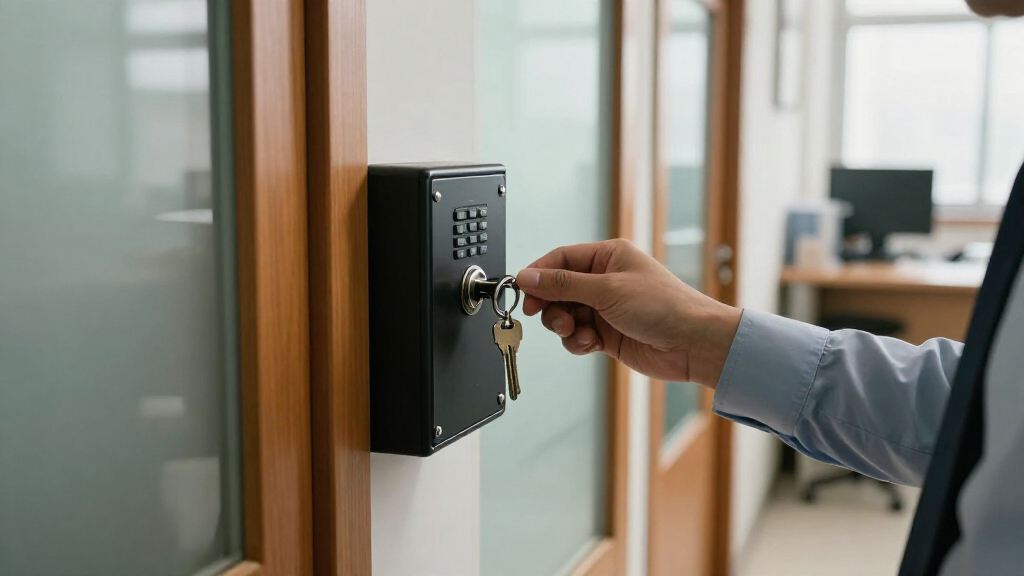
I compared these 15 cabinets around the needs of an office: keeping keys organized, limiting access, supporting reliable return routines, and fitting the number of keys a team manages. Capacity and labeling features mattered because an oversized cabinet wastes wall space, while a tight fit can make keys hard to distinguish. I also considered access style—keyed locks, mechanical combinations, electronic codes, app access, and drop slots—and what each asks of staff.
The ranking favors practical balance over the largest hook count or the most features. The Durabox leads for high-capacity organization; drop-slot models rank well for return control; compact cabinets make more sense for small offices. Electronic access can suit offices that need code-based entry, but it brings additional setup and upkeep questions. Similar-capacity products are separated by their stated organization and access features, not by assumed differences in security that the product details do not establish.
| key cabinet lock box for office key | Material | Mounting | Color |
|---|---|---|---|
| Durabox 200-Position Steel Key | Alloy steel | Wall mount | — |
| 100 Keys Key Cabinet with Drop | High-quality steel | Wall mount with pre-drilled holes | — |
| 100 Keys Key Lock Box with Dro | Alloy steel | Wall mount | — |
| Uniclife 32 Keys Key Lock Box | Steel | Wall mount | Black |
| Uniclife 20-Key Steel Key Cabi | Alloy steel | Wall mount | Black |
| KYODOLED Key Box | Steel | Wall mount; mounting included | Black |
| 60-Key Lock Box with Key Tags | Cold-rolled steel | Wall mount | Black |
| 32-Key Lock Box with App & Key | Cold-roller steel | Wall mount | — |
| Uniclife 60-Position Steel Key | Alloy steel | Wall mount | Black |
| 28-Key Lock Box Wall Mount | Cold-rolled steel | Wall mount; pre-drilled holes | Metallic black |
| Grimtron Electronic 40-Key Cab | Metal | Wall mount | Beige |
| Kyodoled Wall Mount Key Box | Alloy steel | Wall mount | Black |
| KYODOLED Key Box | Steel | Wall mount | White |
| Uniclife 32-Position Wall Moun | Steel | Wall mount | Black |
| Amazon Basics Locking Steel Se | Steel | Wall mountable | Black |
Factors to Consider When Choosing Key Cabinet Lock Box For Office Keys
Choosing a cabinet is as much a workflow decision as a storage decision. I would start with how keys move through the office, then match capacity, access, and mounting location to that routine.
Size for the working key pool, not just the current count
Count keys that need controlled storage, including spares and sets used by temporary staff, rather than counting only everyday keys. Leave room for labels and hands to move between hooks; a cabinet filled to every position can be harder to use than a slightly larger one. At the same time, choosing a very large cabinet for a small office can use wall space without improving control. Check whether the listed capacity refers to hooks or complete labeled sets, and account for bulky fobs that may occupy more room. A 20- or 32-key cabinet can suit a defined small pool, while larger counts fit sites with several departments or vehicles. If your inventory changes often, reserve capacity now rather than planning an immediate replacement later.
Match the lock and access routine to staff turnover
A mechanical combination avoids batteries and shared physical keys, but someone must manage the code and change it when access changes. A keyed cabinet is straightforward when a trusted manager controls the cabinet key, though that key becomes another item to safeguard. Electronic keypad or app access may make code changes easier for some teams, but check power requirements, reset procedures, and what happens if a phone or administrator is unavailable. Avoid selecting technology based on convenience alone: the cabinet still needs a clear rule for who can open it and when. Offices with frequent staff changes may value fast credential updates; a stable, small team may prefer a simpler lock. Compare the administration burden with the actual frequency of access changes.
Decide whether keys need a return slot
A drop slot can support after-hours returns and reduce the need for each user to reopen the cabinet. It is most useful when staff borrow keys temporarily and a supervisor retrieves or reconciles returned sets later. A slot does not by itself confirm which key was returned, who returned it, or whether a key is missing, so pair it with a sign-out log or another tracking process when accountability matters. Without a return routine, the slot can become a one-way collection point that is harder to audit. Standard cabinets are usually easier when users need to retrieve keys throughout the day. Choose the slot based on the handoff process, not simply because it sounds more secure.
Treat labels and key tags as part of the security system
Numbered hooks, writable racks, and tags can cut search time and reduce mix-ups, especially when keys look alike. Make labels useful to staff without exposing sensitive details: a room number or internal code may be safer than writing an alarm location or access instructions on a tag. Establish one naming convention before filling the cabinet, and keep a matching inventory somewhere controlled. Tags need to remain attached and legible, so leave enough space for them to hang without tangling. A cabinet with many hooks but inconsistent labeling can create more confusion than a smaller, well-maintained system. Plan who updates labels when a lock or key assignment changes.
Check mounting location and everyday access
Measure the wall area and check the mounting surface before choosing a cabinet; a secure cabinet is only as practical as its installation. Place it where authorized staff can reach it without making keys visible to visitors or people passing through shared areas. Consider whether the door can open fully and whether the cabinet remains accessible when the office is busy. The heaviest or largest models may need more careful placement than a compact box, and the product details should be checked for mounting hardware and installation requirements. Avoid hiding the cabinet so thoroughly that staff create informal key caches elsewhere. A consistent, controlled location supports both security and routine.
Separate organized storage from full key control
A lock box can restrict access to stored keys, but it does not automatically record borrowing, identify a user, or show whether a key was returned. Offices responsible for vehicles, restricted rooms, or valuable equipment may need a sign-out log, named custody, or a separate electronic tracking process. Decide what evidence your workplace needs before paying for app or keypad features that may not provide a complete audit trail. Also set a process for lost keys, code changes, and staff departures. A basic cabinet can work well when paired with disciplined procedures; a more advanced lock cannot compensate for missing ownership rules. Think of the cabinet as one part of key management rather than the whole system.
Frequently Asked Questions
How much extra capacity should I leave in an office key cabinet?
I would leave enough open positions for the keys likely to be added during the cabinet’s service life, plus space for tags to hang without crowding. There is no useful universal percentage because a small office may add keys slowly while a facilities team may expand its inventory often. Count spare and temporary-use keys, not just the sets currently assigned to staff. If the cabinet is already close to full, moving to the next capacity tier can be easier than reorganizing later. Avoid paying for a much larger cabinet if the extra capacity would take up needed wall space and remain unused.
Is a drop-slot cabinet a better choice than a standard key cabinet?
It is a better fit when users need to return keys without opening the cabinet, such as after-hours staff or shared vehicle users. A standard cabinet is often simpler when authorized employees need to retrieve and replace keys throughout the day. The slot does not identify the person returning a key or verify what was dropped in, so it should not replace a sign-out process where accountability matters. Think through who empties or checks the return area and how often. If no one owns that task, a drop slot may add friction rather than control.
Should I choose a mechanical combination or an electronic key cabinet?
A mechanical combination is a straightforward choice when access changes infrequently and the office can manage a shared code carefully. An electronic keypad or app-based model may suit teams that need code changes or a different access routine, but check power, recovery, and administrator requirements before choosing one. Neither access style automatically provides a complete record of which employee took a key. For frequent staff changes, focus on how quickly credentials can be updated and who has permission to do so. For a small, stable team, simpler mechanics may be easier to maintain.
Can a wall-mounted key cabinet provide enough security for sensitive office keys?
A cabinet can add a controlled barrier and keep keys out of casual reach, but the product category alone does not establish a specific security rating or resistance to forced entry. Consider the sensitivity of the keys, the cabinet’s mounting surface, who controls access, and whether the keys themselves reveal what they open. For high-consequence keys, limit access further with named custody or a documented sign-out process. Place the cabinet away from public view and secure it according to the manufacturer’s mounting instructions. If your workplace has formal security requirements, verify that the chosen model meets them rather than assuming any lock box will.
What should I do if several office keys look alike?
Use a consistent numbering or naming scheme and make the cabinet hook, tag, and inventory record agree. Writable racks and supplied tags can help, but avoid putting sensitive room or alarm details on a tag that may be seen by an unauthorized person. Keep the key identification system separate from access instructions, and update every record when a key is reassigned. For frequently borrowed keys, add a sign-out method so the cabinet’s labels are not the only source of control. A clear return routine also helps staff notice a missing key before the next person needs it.
Conclusion
For a large office key pool, I would choose the Durabox 200-Position Steel Key Cabinet as the best overall fit because its high stated capacity and numbered organization address the core storage problem directly. The 100 Keys Key Cabinet with Drop Slot is the better specific-use pick when controlled returns matter, while the Uniclife 20-Key Steel Cabinet with Combination Lock suits beginners and smaller teams seeking a simpler setup. For digital access, compare the app-and-keypad cabinet with the Grimtron Electronic 40-Key Cabinet against your office’s ability to manage codes and power needs. I would treat the Amazon Basics 48-hook cabinet as a practical mid-capacity option to compare for value, while the largest cabinet is the premium-capacity choice for workplaces that need room to grow. Choose by matching the key count and return process first, then select the access method your staff can maintain consistently.