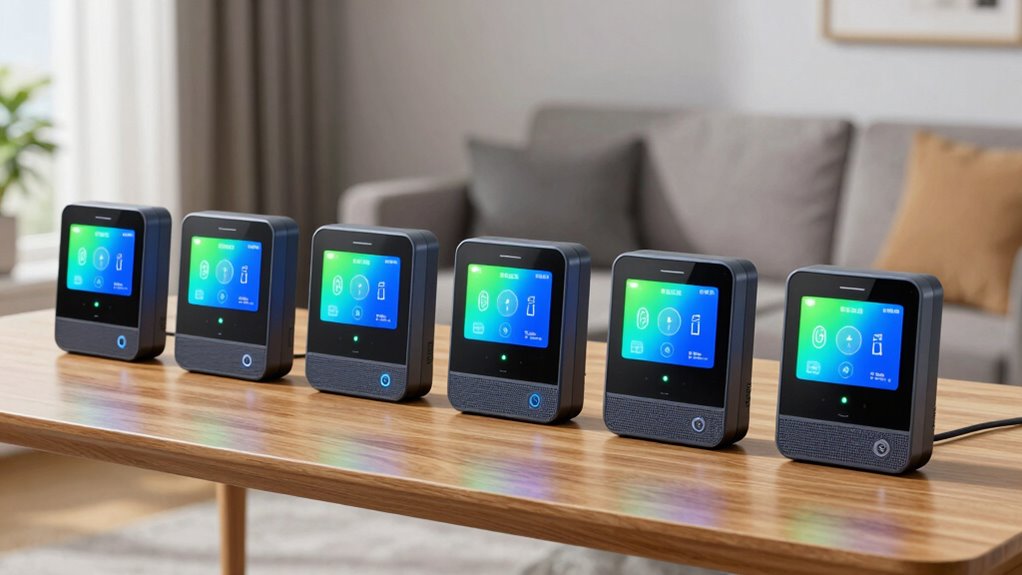

Choosing the right indoor air quality monitor for VOCs and CO2 requires balancing sensor accuracy with ease of use. My top recommendation is the Airthings Wave Plus for its superior data visualization and long battery life, making it ideal for health-conscious households. For those needing extensive data logging, the 16-in-1 Indoor Air Quality Monitor offers unparalleled metric density, though it lacks smart home integration. The primary tradeoff in this category is between simple, single-purpose devices and complex, multi-parameter stations that require more maintenance. This guide breaks down which monitor fits your specific living environment and technical comfort level.

Get privacy and security gear delivered free with Prime
- Fast, free delivery on millions of items
- Prime Video, Amazon Music and more included
- Member-only deals all year
Key Takeaways
- Monitors with dedicated NDIR CO2 sensors provide significantly more accurate data than those estimating CO2 from VOC levels.
- Smart integration (Wi-Fi/Zigbee) adds value for automation but often reduces battery life compared to standalone units.
- 16-in-1 monitors often suffer from ‘sensor clutter,’ where less critical metrics distract from the primary VOC and CO2 readings.
- Calibration frequency varies widely; premium units often auto-calibrate, while budget options require manual reset intervals.
- Display clarity is a hidden differentiator; smaller screens make it difficult to spot trends in VOC fluctuations over time.
| 16-in-1 Indoor Air Quality Monitor with CO2 Detection and AQI Alerts |  | Best Budget Portable Option | Brand: HSCLPM | Model: AK23 | Measurements: CO2, PM1.0, PM2.5, PM10, HCHO, TVOC, temp, humidity, AQI | VIEW ON AMAZON | See Our Full Breakdown |
| bonoch AirSentry 16-in-1 Indoor Air Quality Monitor with 7-Inch Display |  | Best for Home Office Visibility | Measurements: CO2, PM2.5, PM1.0, PM10, HCHO, TVOC, temp, humidity, AQI, time | Display: 7-inch HD LED | Alert modes: 7 | VIEW ON AMAZON | See Our Full Breakdown |
| AprilAire ZAWTHCPV Smart Wi-Fi Indoor Air Quality Monitor |  | Best for Ecosystem Integration | Brand: AprilAire | Model: ZAWTHCPV | Measurements: PM2.5, VOCs, CO₂, humidity, temperature | VIEW ON AMAZON | See Our Full Breakdown |
| LifeBasis 11-in-1 Indoor Air Quality Monitor |  | Best Balanced Portable Monitor | Brand: LifeBasis | Model: 11-in-1 Air Quality Monitor | Dimensions: 0.95 x 2.92 x 6.3 inches | VIEW ON AMAZON | See Our Full Breakdown |
| YNAK AK22A 16-in-1 Indoor Air Quality Monitor with 7-Inch Display |  | Best Value Large Display | Brand: YNAK | Model: AK22A | Display: 7-inch LED | VIEW ON AMAZON | See Our Full Breakdown |
| AirKnight AT1000 Indoor Air Quality Monitor |  | Best for Formaldehyde Detection | Model: AT1000 | Sensors: CO2, PM2.5, PM10, TVOC, Formaldehyde (HCHO) | Display: Large LCD screen | VIEW ON AMAZON | See Our Full Breakdown |
| Airthings Wave Plus Smart Radon and Indoor Air Quality Monitor |  | Best for Radon and Long-Term Monitoring | Brand: Airthings | Model: 2930 (Wave Plus) | Sensors: Radon, VOCs, Humidity, Temperature, Air Pressure | VIEW ON AMAZON | See Our Full Breakdown |
| AQItech 16-in-1 Indoor Air Quality Monitor with Color Display |  | Best for Rapid Real-Time Updates | Manufacturer: AQItech | Model: AK16C | Update Interval: 1.5 seconds | VIEW ON AMAZON | See Our Full Breakdown |
| Amazon Smart Air Quality Monitor |  | Best for Alexa Ecosystem Integration | Sensors: Temperature, Humidity, CO, PM2.5, VOCs | Connectivity: 2.4 GHz Wi-Fi, Bluetooth LE 4.2 | Power: 5 W Adapter (Indoor Use Only) | VIEW ON AMAZON | See Our Full Breakdown |
| YNAK 16-in-1 Indoor Air Quality Monitor with HD Display | 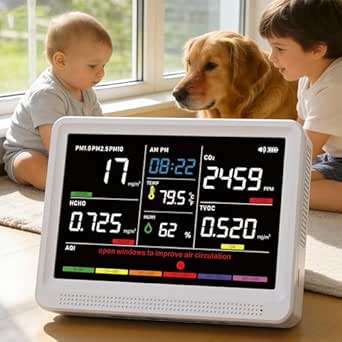 | Best Overall for Versatility and Battery Life | Brand: YNAK | Display Size: 5.5 inches | Battery Life: Up to 10 hours | VIEW ON AMAZON | See Our Full Breakdown |
| ZEMEOLLO Portable Indoor Air Quality Monitor | 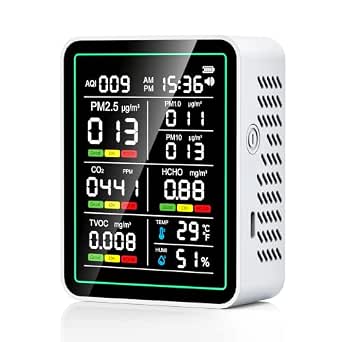 | Best for Multi-Gas Screening | Measurements: CO₂, HCHO, TVOC, benzene, PM1.0, PM2.5, PM10, temperature, AQI | Battery Capacity: 2000mAh rechargeable lithium battery | Battery Life: Up to 20 hours | VIEW ON AMAZON | See Our Full Breakdown |
| BREATHE Airmonitor Plus Gen 2 Indoor Air Quality Monitor |  | Best Connected Monitor | Sensors: CO2, PM1, PM2.5, PM10, TVOC, Formaldehyde (HCHO), Temperature, Humidity | Connectivity: 2.4 GHz Wi-Fi | Battery Life: Up to 6 hours | VIEW ON AMAZON | See Our Full Breakdown |
| Lecoolife 16-in-1 Indoor Air Quality Monitor with 7-Inch Display |  | Best for Home Calibration | Monitored Measurements: CO₂, PM1.0, PM2.5, PM10, HCHO, TVOC, temperature, humidity, and AQI | Display: 7-inch screen with adjustable brightness | Alerts: Audible buzzer with mute function | VIEW ON AMAZON | See Our Full Breakdown |
| AirWhisper 16-in-1 Indoor Air Quality Monitor | 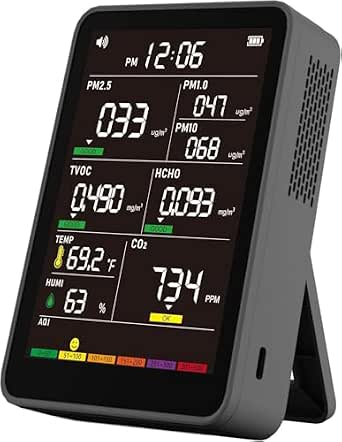 | Best for Vehicle Use | Measurements: PM1.0, PM2.5, PM10, CO2, TVOC, HCHO, temperature, humidity | Display: HD color screen with color-coded readings | Sampling Interval: 1.5 seconds | VIEW ON AMAZON | See Our Full Breakdown |
| Fil-Fresh 16-in-1 Indoor Air Quality Monitor with 7″ Display |  | Best Plug-and-Play Display | Display Size: 7.2 inches | Battery Capacity: 2500mAh | Battery Life: 8 hours | VIEW ON AMAZON | See Our Full Breakdown |
| indoor air quality monitor for vocs and co2 | Display |
|---|---|
| 16-in-1 Indoor Air Quality Mon | Large screen |
| bonoch AirSentry 16-in-1 Indoo | 7-inch HD LED |
| AprilAire ZAWTHCPV Smart Wi-Fi | — |
| LifeBasis 11-in-1 Indoor Air Q | LCD with adjustable brightness |
| YNAK AK22A 16-in-1 Indoor Air | 7-inch LED |
| AirKnight AT1000 Indoor Air Qu | Large LCD screen |
| Airthings Wave Plus Smart Rado | — |
| AQItech 16-in-1 Indoor Air Qua | HD Color Screen |
| Amazon Smart Air Quality Monit | — |
| YNAK 16-in-1 Indoor Air Qualit | — |
| ZEMEOLLO Portable Indoor Air Q | Color LED screen |
| BREATHE Airmonitor Plus Gen 2 | — |
| Lecoolife 16-in-1 Indoor Air Q | 7-inch screen with adjustable brightness |
| AirWhisper 16-in-1 Indoor Air | HD color screen with color-coded readings |
| Fil-Fresh 16-in-1 Indoor Air Q | — |
More Details on Our Top Picks
16-in-1 Indoor Air Quality Monitor with CO2 Detection and AQI Alerts
This unit offers an impressive breadth of metrics for its compact form factor, tracking everything from CO2 to TVOCs. I find it particularly useful for spot-checking air quality in small, enclosed spaces like nurseries or cars, where its seven-color alert system provides immediate visual feedback without needing to interpret raw numbers. Compared to the bonoch AirSentry, this monitor is significantly more portable and less obtrusive, though it lacks the detailed trend analysis of smart-connected devices. The primary tradeoff here is thermal interference; the internal battery and charging circuitry generate heat that can skew temperature readings, making it unreliable for precise climate control monitoring. It is a solid entry-level tool for anyone who wants a quick snapshot of air health without a steep learning curve.Pros:- Tracks 16 distinct metrics including CO2, PM, and VOCs
- Intuitive seven-color AQI alerts for instant interpretation
- Highly portable with a built-in rechargeable battery
- Large display makes readings easy to see from a distance
Cons:- Battery and charging heat can distort temperature readings
- Lacks app connectivity for historical data logging
- Plastic casing feels less durable than premium metal options
Best for: Travelers and parents who need a compact, battery-powered device for quick spot-checks in small rooms or vehicles
Not ideal for: Users requiring accurate ambient temperature data or those who want detailed historical trends via an app
- Brand:HSCLPM
- Model:AK23
- Measurements:CO2, PM1.0, PM2.5, PM10, HCHO, TVOC, temp, humidity, AQI
- AQI Alerts:7 color levels
- Power Source:Rechargeable battery
- Battery Life:Up to 12 hours
- Display:Large screen
Our verdict“Choose this if you need a simple, portable way to check air quality on the go, but skip it if you need precise temperature accuracy.”
bonoch AirSentry 16-in-1 Indoor Air Quality Monitor with 7-Inch Display
The 7-inch HD LED display is the standout feature here, allowing you to glance at complex air quality data from across the room without squinting. This makes it superior to the compact HSCLPM AK23 for users who want constant visibility in a workspace or living area. The device offers seven distinct alert modes and adjustable brightness, which helps mitigate eye strain during nighttime use. However, the 8-hour runtime is shorter than some competitors, meaning you will likely need to keep it plugged in for continuous monitoring. While the USB-C charging is convenient, the device itself is heavier and bulkier, making it less suitable for travel. It is best viewed as a stationary desktop companion rather than a mobile tool.Pros:- Large 7-inch HD display allows easy reading from a distance
- Seven adjustable alert modes with mute functionality
- USB-C charging and three brightness settings for flexibility
- 12-month warranty provides peace of mind
Cons:- Battery life is limited to roughly 8 hours
- Bulkier form factor makes it less portable
- Sensors require protection from perfumes and strong odors
Best for: Remote workers and home office users who want large, at-a-glance air quality data on their desks
Not ideal for: Travelers or those with limited desk space who prefer a compact, pocket-sized device
- Measurements:CO2, PM2.5, PM1.0, PM10, HCHO, TVOC, temp, humidity, AQI, time
- Display:7-inch HD LED
- Alert modes:7
- Runtime:Up to 8 hours
- Charging:USB-C
- Weight:1.46 pounds
- Warranty:12 months
Our verdict“This is the ideal choice for stationary setups where large, readable displays are a priority over portability.”
AprilAire ZAWTHCPV Smart Wi-Fi Indoor Air Quality Monitor
Unlike the standalone units in this roundup, this monitor is designed to be the brain of a larger air quality system. It measures five key factors and pushes data to the AprilAire Healthy Air app, offering trend analysis and guidance that simple LCD screens cannot match. This connectivity makes it far more powerful than the LifeBasis 11-in-1 for users who want to understand long-term patterns rather than just current readings. However, the full potential of its “Healthy Air Mode” requires a compatible AprilAire Wi-Fi thermostat, which is sold separately. This dependency creates a barrier to entry for those not already invested in the AprilAire ecosystem. It is a specialized tool for homeowners seeking automated air purification management rather than a general-purpose monitor.Pros:- Wi-Fi connectivity enables remote monitoring and trend analysis
- Integrates directly with compatible AprilAire air systems
- Provides actionable guidance and alerts via the app
- Three-year warranty reflects manufacturer confidence
Cons:- Requires the AprilAire Healthy Air app for full functionality
- Healthy Air Mode needs a separate compatible thermostat
- Monitors fewer parameters than 16-in-1 competitors
Best for: AprilAire system owners who want to automate their air purification and track long-term air quality trends
Not ideal for: Users without a compatible AprilAire thermostat or those who prefer simple, standalone hardware without app dependencies
- Brand:AprilAire
- Model:ZAWTHCPV
- Measurements:PM2.5, VOCs, CO₂, humidity, temperature
- Connectivity:Wi-Fi
- App:AprilAire Healthy Air
- Warranty:3 years
- Included:Healthy Air Monitor and power supply
Our verdict“Select this if you are already in the AprilAire ecosystem and want automated air control, otherwise look elsewhere.”
LifeBasis 11-in-1 Indoor Air Quality Monitor
This device strikes a compelling balance between portability and sensor accuracy. It utilizes an NDIR CO2 sensor, which is generally more reliable for carbon dioxide detection than the cheaper electrochemical sensors found in some budget competitors like the HSCLPM AK23. The inclusion of audible alerts alongside color-coded visuals ensures you are notified of poor air quality even if you aren’t looking at the screen. With an 11-12 hour battery life, it outlasts the 8-hour runtime of the bonoch AirSentry, making it more viable for all-day portable use. The tradeoff is a smaller display that requires closer inspection for detailed data. It is a strong contender for users who want better sensor precision without committing to a large, stationary unit.Pros:- High-precision NDIR sensor for accurate CO2 readings
- Audible and visual alerts ensure you don’t miss air quality changes
- USB-C charging with decent 11-12 hour battery life
- Lightweight and compact for easy transport
Cons:- Smaller LCD screen is harder to read from a distance
- Requires daily charging for continuous long-term use
- Plastic build may feel less premium than metal-cased rivals
Best for: Health-conscious individuals who want portable monitoring with higher-precision NDIR CO2 sensors and audible alarms
Not ideal for: Users who need to read data from across the room, as the LCD display is smaller than 7-inch models
- Brand:LifeBasis
- Model:11-in-1 Air Quality Monitor
- Dimensions:0.95 x 2.92 x 6.3 inches
- Weight:6.1 ounces
- Battery:2500mAh Lithium Polymer
- Sensors:NDIR CO2, Laser Particle, Semiconductor
- Display:LCD with adjustable brightness
- Alerts:Visual (Color-coded) and Audible
Our verdict“A great choice for those prioritizing sensor accuracy and portability over large display visibility.”
YNAK AK22A 16-in-1 Indoor Air Quality Monitor with 7-Inch Display
If you want the visibility of a large screen without paying a premium, this model delivers. It shares a similar 7-inch display and feature set with the bonoch AirSentry, including USB-C charging and seven AQI alert types. The inclusion of a charging adapter in the box is a practical touch that saves the hassle of sourcing your own cable and block. While the runtime is capped at 8 hours, matching its competitor, the overall package feels slightly more complete for immediate use. The main drawback is that, like many large-display monitors, it is susceptible to sensor interference from strong odors like perfumes. It is a straightforward, no-nonsense option for families who want clear, shared visibility into their home’s air quality.Pros:- Large 7-inch display with three brightness settings
- Includes charging adapter and cable in the box
- Seven AQI alert buzzer types with mute option
- USB-C charging for modern convenience
Cons:- Battery runtime is limited to 8 hours
- Sensors are sensitive to strong odors and perfumes
- Lacks smart connectivity or app integration
Best for: Families who want a large, easy-to-read display for shared spaces without buying extra charging accessories
Not ideal for: Users in environments with frequent strong odors or perfumes, which can disrupt sensor accuracy
- Brand:YNAK
- Model:AK22A
- Display:7-inch LED
- Monitored parameters:CO2, PM, HCHO, TVOC, temp, humidity, AQI, time
- Alert functions:7 AQI alert buzzer types
- Battery runtime:Up to 8 hours
- Included accessories:Charging adapter, USB-C cable, user manual
- Warranty:12 months
Our verdict“This is the practical pick for households wanting a large-screen monitor with all necessary accessories included.”
AirKnight AT1000 Indoor Air Quality Monitor
The AirKnight AT1000 distinguishes itself in this lineup by including a dedicated formaldehyde (HCHO) sensor, a critical feature for new furniture or renovated homes that many competitors omit. While the Airthings Wave Plus focuses on radon and the Amazon Smart Monitor lacks CO2 tracking, the AirKnight covers CO2, PM2.5, PM10, TVOC, and HCHO in a single handheld unit. Its large LCD screen offers clear readability without needing a smartphone app, making it ideal for users who dislike pairing processes. However, the lack of specified accuracy data and missing battery runtime information are significant drawbacks. Unlike the YNAK 16-in-1, which boasts a 10-hour battery life, the AirKnight’s endurance is unknown, potentially limiting its utility for all-day spot checks in large spaces.
Pros:- Dedicated formaldehyde (HCHO) sensor for detecting off-gassing
- Monitors CO2 and TVOC alongside particulate matter
- Large, easy-to-read LCD screen requires no app
- Includes US-based customer phone support
Cons:- No published battery runtime or charging time details
- Measurement accuracy specifications are not disclosed
- Lacks smart connectivity or app integration
Best for: Homeowners concerned about off-gassing from new furniture or recent renovations who need specific formaldehyde readings.
Not ideal for: Tech-savvy users seeking smart home integration or Wi-Fi connectivity, as this device offers no app pairing.
- Model:AT1000
- Sensors:CO2, PM2.5, PM10, TVOC, Formaldehyde (HCHO)
- Display:Large LCD screen
- Battery:3000 mAh rechargeable lithium-polymer
- Dimensions:7.55 x 2.09 x 3.16 inches
- Weight:12 ounces
- Connectivity:None (Standalone)
Our verdict“Choose the AirKnight if you specifically need to monitor formaldehyde levels and prefer a simple, standalone device over a smart app.”
Airthings Wave Plus Smart Radon and Indoor Air Quality Monitor
The Airthings Wave Plus is the only device in this batch that monitors radon, a colorless, radioactive gas often overlooked by standard air quality monitors. While the AQItech 16-in-1 offers a wider range of pollutants like PM1.0 and CO2, the Wave Plus excels in long-term placement with a 16-month battery life and a five-year warranty option. It uses Bluetooth to send data to the Airthings app, providing historical trends rather than just real-time snapshots. This makes it superior for establishing baselines in basements or bedrooms. However, it lacks CO2 monitoring, which is a key metric for ventilation in offices, forcing users who need CO2 data to pair it with a separate device like the YNAK.
Pros:- Only monitor in this list with radon detection
- Extensive 16-month battery life on two AA batteries
- Detailed historical data and trends via Airthings app
- 5-year extended warranty available upon registration
Cons:- No CO2 sensor, limiting ventilation feedback
- Requires a 7-day settling period for accurate radon readings
- Bluetooth-only connectivity limits remote viewing range
Best for: Homeowners needing to monitor radon levels alongside VOCs and humidity in living spaces without frequent recharging.
Not ideal for: Users who require CO2 monitoring or Wi-Fi connectivity for remote access, as it relies on Bluetooth and lacks a CO2 sensor.
- Brand:Airthings
- Model:2930 (Wave Plus)
- Sensors:Radon, VOCs, Humidity, Temperature, Air Pressure
- Power:2 AA Batteries
- Battery Life:Up to 16 months
- Connectivity:Bluetooth LE
- Warranty:5-year extended (with registration)
Our verdict“The Wave Plus is the definitive choice for radon safety and long-term air quality trends, provided you don’t need CO2 data.”
AQItech 16-in-1 Indoor Air Quality Monitor with Color Display
For users who need immediate feedback on air quality changes, the AQItech 16-in-1 stands out with its 1.5-second update interval. This is significantly faster than the AirKnight AT1000 or the app-dependent Amazon Smart Monitor, allowing you to see the instant impact of opening a window or running a purifier. The HD color screen makes data interpretation intuitive, using color codes to signal danger levels. It tracks a broad spectrum of pollutants including PM1.0, CO2, and TVOC. The main tradeoff is its 4–5 hour battery life, which is shorter than the YNAK‘s 10 hours, making it better suited for spot-checking specific rooms rather than all-day portable monitoring.
Pros:- Extremely fast 1.5-second data refresh rate
- Vivid color display simplifies data interpretation
- Tracks PM1.0, a finer particulate than many competitors
- Includes both USB-C cable and AC adapter
Cons:- Short 4–5 hour battery runtime
- No smart app integration or remote alerts
- Heavier than some compact alternatives at 14.8 ounces
Best for: Users who want to test the immediate effectiveness of air purifiers or ventilation changes in real time.
Not ideal for: Those needing long-duration portable monitoring, as the short battery life requires frequent recharging.
- Manufacturer:AQItech
- Model:AK16C
- Update Interval:1.5 seconds
- Sensors:PM1.0, PM2.5, PM10, CO2, TVOC, HCHO, Temp, Humidity
- Battery Runtime:4–5 hours
- Charging:USB-C
- Display:HD Color Screen
Our verdict“Pick the AQItech if you value instant visual feedback for quick troubleshooting over long battery life or smart features.”
Amazon Smart Air Quality Monitor
The Amazon Smart Air Quality Monitor is designed exclusively for users already committed to the Alexa ecosystem. Unlike the standalone AQItech or AirKnight, this device pushes data to the Alexa app and can trigger routines, such as turning on a smart plug for an air purifier when VOCs spike. It monitors temperature, humidity, CO, PM2.5, and VOCs but notably lacks a CO2 sensor, which is a major limitation for those focused on ventilation and cognitive performance. It is also strictly indoor and wired, lacking the portability of the YNAK. This is not a general-purpose monitor; it is a smart home accessory that happens to track air quality.
Pros:- Seamless integration with Alexa app and Echo devices
- Can automate smart home routines based on air quality
- Sends push notifications for poor air quality events
- Compact, minimalist design fits any room
Cons:- No CO2 sensor, limiting ventilation insights
- Requires constant power via adapter (not battery-powered)
- Useless without an Alexa account and compatible devices
Best for: Alexa users who want automated alerts and smart home triggers based on air quality changes.
Not ideal for: Users who need CO2 monitoring, portability, or do not use Alexa-enabled devices.
- Sensors:Temperature, Humidity, CO, PM2.5, VOCs
- Connectivity:2.4 GHz Wi-Fi, Bluetooth LE 4.2
- Power:5 W Adapter (Indoor Use Only)
- Dimensions:65 × 65 × 45 mm
- Weight:120 g
- Compatibility:Alexa App & Echo Devices
- Warranty:1-Year Limited
Our verdict“Buy this only if you are deep in the Alexa ecosystem and prioritize automation over comprehensive sensor coverage like CO2.”
YNAK 16-in-1 Indoor Air Quality Monitor with HD Display
The YNAK 16-in-1 offers the most balanced package in this roundup, combining a 5.5-inch HD display with a substantial 10-hour battery life. This endurance allows for all-day portable monitoring, outperforming the AQItech‘s 4–5 hours and the AirKnight‘s unspecified runtime. It tracks nine key parameters, including CO2 and HCHO, using external sensors for better accuracy. While the Amazon Smart Monitor relies on Wi-Fi and the Airthings lacks CO2, the YNAK provides a comprehensive, standalone view of your environment. The tradeoff is its bulkier size compared to the compact AirKnight, and the temperature/humidity accuracy ranges (±1-3°F) are less precise than dedicated professional-grade sensors, but it remains the strongest general-purpose choice.
Pros:- Long 10-hour battery life for extended portability
- Large 5.5-inch HD display with adjustable brightness
- Monitors 9 parameters including CO2, HCHO, and TVOC
- High-precision external sensors with 0.001 resolution
Cons:- Temperature and humidity accuracy ranges are relatively wide
- External sensors require careful handling to avoid contamination
- No Wi-Fi or app connectivity for remote monitoring
Best for: Users who need a versatile, portable monitor for homes, offices, or cars with long battery life and a large display.
Not ideal for: Those seeking ultra-precise environmental data or smart home automation, as it lacks app connectivity.
- Brand:YNAK
- Display Size:5.5 inches
- Battery Life:Up to 10 hours
- Charging:USB-C
- Sensors:CO2, PM2.5, PM1.0, PM10, HCHO, TVOC, Temp, Humidity, AQI
- Sensor Accuracy:0.001 units
- Temp Accuracy:±1 to ±3 °F
Our verdict“The YNAK is the best all-around choice for most buyers, offering the best mix of sensor variety, screen size, and battery endurance.”
ZEMEOLLO Portable Indoor Air Quality Monitor
The ZEMEOLLO Portable Indoor Air Quality Monitor distinguishes itself by targeting a specific niche: multi-gas detection. While many competitors in this roundup focus heavily on particulate matter and CO2, the ZEMEOLLO adds benzene detection to its suite of sensors alongside TVOC and formaldehyde. This makes it a stronger choice for those concerned with off-gassing from new furniture or paints, areas where the BREATHE Airmonitor Plus Gen 2 might be less specialized in its marketing. The 2000mAh battery provides up to 20 hours of runtime, significantly outlasting the 4-6 hour batteries found in the AirWhisper or BREATHE models, allowing for longer portable sessions without needing a power outlet.
However, this extended battery life and sensor breadth come with a trade-off in connectivity. Unlike the app-connected options, the ZEMEOLLO is a standalone device with no Wi-Fi or Bluetooth. You cannot view historical data or receive remote alerts on your phone. It is strictly a visual, on-the-spot tool. If you need to track trends over months, this is the wrong pick; if you need to quickly check air quality in a specific room or car for benzene and CO2, it offers valuable versatility that simpler monitors lack.
Pros:- Includes benzene detection, a rare feature in this price bracket
- 20-hour battery life is double that of many portable competitors
- Color LED screen clearly highlights readings above safety thresholds
- Simple one-button operation requires no technical setup
Cons:- No wireless connectivity means no data logging or remote monitoring
- Accuracy claims are not independently verified by third-party labs
Best for: Homeowners moving into newly renovated spaces who want to check for benzene and formaldehyde alongside CO2 without relying on an app.
Not ideal for: Users who want to track long-term air quality trends or receive remote alerts on their smartphone.
- Measurements:CO₂, HCHO, TVOC, benzene, PM1.0, PM2.5, PM10, temperature, AQI
- Battery Capacity:2000mAh rechargeable lithium battery
- Battery Life:Up to 20 hours
- Display:Color LED screen
- Charging:USB charging cable included
- Temperature Units:Celsius and Fahrenheit
Our verdict“This monitor is the go-to choice for portable, multi-gas screening where long battery life and immediate visual feedback matter more than digital history.”
BREATHE Airmonitor Plus Gen 2 Indoor Air Quality Monitor
The BREATHE Airmonitor Plus Gen 2 stands apart as the only option in this batch that offers robust app integration with data export capabilities. While the Fil-Fresh and Lecoolife models offer large screens for immediate viewing, they remain isolated devices. The BREATHE connects via 2.4 GHz Wi-Fi to provide 90-day historical data and CSV export, making it the superior tool for users who want to correlate air quality with HVAC usage or outdoor conditions. The ability to set configurable alerts means you can be notified when CO2 levels spike, even if you are not in the room.
The trade-off for this connectivity is a shorter battery life of just 6 hours compared to the 20-hour runtime of the ZEMEOLLO. This limits its utility as a truly portable, all-day device; it is better suited for stationary use near a power source or short-term portable checks. Additionally, the requirement for a 2.4 GHz Wi-Fi network can be a hurdle for modern homes that default to 5 GHz bands. If you prioritize data analysis and remote monitoring over raw battery endurance, this is the most capable option here.
Pros:- 90-day data history with CSV export for professional-grade analysis
- Smart app integration allows for remote monitoring and configurable alerts
- Compact design with 2-year warranty offers peace of mind
- Measures 8 parameters including humidity, which many basic monitors omit
Cons:- Requires a specific 2.4 GHz Wi-Fi connection for smart features
- Battery life is limited to 6 hours, restricting extended portable use
Best for: Tech-savvy users who want to track long-term air quality trends and export data for detailed analysis.
Not ideal for: Users who need a portable monitor for all-day use away from power outlets, due to the 6-hour battery limit.
- Sensors:CO2, PM1, PM2.5, PM10, TVOC, Formaldehyde (HCHO), Temperature, Humidity
- Connectivity:2.4 GHz Wi-Fi
- Battery Life:Up to 6 hours
- Power Source:USB-C rechargeable
- App Features:Remote readings, alerts, historical graphs, CSV export
- Warranty:2 Year Manufacturer
Our verdict“This is the definitive choice for data-driven users who need historical logs and remote alerts, provided they have a compatible Wi-Fi network.”
Lecoolife 16-in-1 Indoor Air Quality Monitor with 7-Inch Display
The Lecoolife 16-in-1 earns its place by offering built-in calibration support, a feature often reserved for industrial equipment. For budget-conscious buyers, this is a significant advantage over the AirWhisper or Fil-Fresh, which offer no user-adjustable calibration. This allows the device to maintain better accuracy over time by comparing readings against a known standard, a critical factor for long-term CO2 monitoring where sensor drift is common. The 7-inch display is large enough to be read from across a room, making it an effective wall-mount or desk centerpiece for quick status checks.
However, the reliance on user calibration introduces a layer of complexity. Unlike the plug-and-play simplicity of the ZEMEOLLO, the Lecoolife requires some technical understanding to calibrate correctly. If you skip this step or perform it incorrectly, the readings may be less reliable than a factory-calibrated unit. Furthermore, the description lacks specific accuracy tolerances, meaning you are trusting the hardware’s baseline performance. It is a powerful tool for those willing to tinker, but potentially frustrating for users who want a ‘set it and forget it’ experience without maintenance.
Pros:- Built-in calibration support helps maintain accuracy over time
- Large 7-inch display provides high visibility for room-wide monitoring
- Adjustable brightness and mute options for audible alerts offer flexibility
- Tracks 9 parameters including PM1.0, which is useful for fine dust detection
Cons:- Requires user intervention for calibration to ensure accuracy
- Sensor accuracy specifications are not detailed in the product description
Best for: DIY enthusiasts and tech-savvy users willing to manually calibrate sensors for improved long-term accuracy.
Not ideal for: Users who prefer a maintenance-free, plug-and-play experience without worrying about sensor adjustment.
- Monitored Measurements:CO₂, PM1.0, PM2.5, PM10, HCHO, TVOC, temperature, humidity, and AQI
- Display:7-inch screen with adjustable brightness
- Alerts:Audible buzzer with mute function
- Calibration:Built-in calibration support
- Temperature Units:°F or °C
- Weight:1.47 pounds
Our verdict“This monitor is best for users who value the ability to fine-tune their device’s accuracy over time rather than relying solely on factory settings.”
AirWhisper 16-in-1 Indoor Air Quality Monitor
The AirWhisper 16-in-1 is explicitly designed for versatility between indoor and vehicle environments. Its compact, lightweight form factor (12.3 ounces) and included AC adapter make it easier to move between a car dashboard and a home desk than the bulkier Lecoolife or Fil-Fresh models. The 1.5-second sampling interval is notably fast, providing nearly real-time feedback when you open a car door or enter a room. This speed is crucial for checking air quality in enclosed spaces like a hot car, where VOCs can spike rapidly.
The primary drawback is its 4-5 hour battery life, which is the shortest in this group. While sufficient for a commute or a short work session, it falls short of the ZEMEOLLO’s 20-hour endurance for all-day portability. Additionally, like many in this segment, it lacks app connectivity, meaning you cannot log your car’s air quality history. It is a specialized tool for spot-checking, not for monitoring. If your primary concern is the air you breathe while driving or in small, enclosed spaces, its portability and speed win out over the larger, stationary competitors.
Pros:- Compact, lightweight design is ideal for vehicle dashboards and travel
- Fast 1.5-second update rate provides immediate feedback on air changes
- Includes both USB-C cable and AC adapter for flexible power options
- Color-coded display allows for quick visual assessment of air status
Cons:- Short 4-5 hour battery life limits extended portable use
- No app connectivity prevents historical data tracking
Best for: Commuters and drivers who want to monitor air quality in their vehicle as well as at home.
Not ideal for: Users who need all-day battery life or long-term data logging capabilities.
- Measurements:PM1.0, PM2.5, PM10, CO2, TVOC, HCHO, temperature, humidity
- Display:HD color screen with color-coded readings
- Sampling Interval:1.5 seconds
- Battery Runtime:4–5 hours
- Charging:USB-C
- Weight:12.3 ounces
Our verdict“This is the best portable option for drivers who need quick, accurate spot-checks of air quality in their car and home.”
Fil-Fresh 16-in-1 Indoor Air Quality Monitor with 7″ Display
The Fil-Fresh 16-in-1 excels in simplicity and visibility. It features a 7.2-inch high-contrast LED display that is larger and arguably more readable than the screens on the AirWhisper or ZEMEOLLO. For users who want to glance at air quality from across a living room without squinting, this is the standout. It requires no app, no Wi-Fi, and no account setup, making it the most accessible option for non-technical users or households with mixed comfort levels with technology. The 2500mAh battery offers 8 hours of wireless use, a middle ground that beats the BREATHE and AirWhisper while falling short of the ZEMEOLLO.
However, this simplicity comes at the cost of smart features. Unlike the BREATHE Airmonitor Plus, you cannot access historical data or receive notifications when you are away from the device. It is a purely local monitoring tool. While the Lecoolife offers calibration, the Fil-Fresh relies on factory settings, which may drift over time. It is the best choice for those who want a prominent, easy-to-read dashboard for their home air quality without any digital complexity or maintenance requirements.
Pros:- 7.2-inch display offers excellent readability from a distance
- Zero setup required with no app or Wi-Fi connection needed
- 8-hour battery life supports full workday use without charging
- Smart visual alerts provide immediate feedback without noise
Cons:- Lacks any smart home integration or remote data logging
- No user calibration option means accuracy depends entirely on factory settings
Best for: Users who want a large, easy-to-read display and zero setup complexity for their living space.
Not ideal for: Data enthusiasts who need historical logs, remote alerts, or sensor calibration options.
- Display Size:7.2 inches
- Battery Capacity:2500mAh
- Battery Life:8 hours
- Charging Port:USB-C
- Monitored Parameters:CO2, PM2.5, PM1.0, PM10, HCHO, TVOC, Temperature, Humidity, Time
- Connectivity:None (Standalone)
Our verdict“This is the ideal choice for households wanting a prominent, hassle-free air quality dashboard without any technical setup.”

How We Picked
I evaluated these monitors based on sensor technology, specifically prioritizing those using NDIR for CO2 and metal-oxide or photoionization for VOCs. Data accuracy was weighed against ease of interpretation, as raw numbers are less useful than actionable trends. I also considered connectivity options, distinguishing between devices that offer app history versus those that only provide real-time local display.
The ranking logic favors devices that strike a balance between scientific precision and daily usability. Units that required frequent manual calibration or had confusing interface layouts were ranked lower, even if their raw sensor specs were high. Value was determined by the longevity of the sensor and the quality of the accompanying software or app ecosystem.
Factors to Consider When Choosing Indoor Air Quality Monitor For Vocs And Co2
Selecting a monitor involves more than just checking a spec sheet. These factors help you avoid common pitfalls and choose a device that actually improves your indoor environment.Sensor Technology and Accuracy
The most critical factor is the type of sensor used for CO2 and VOCs. NDIR (Non-Dispersive Infrared) sensors are the gold standard for CO2, offering stability and accuracy over time. Cheaper monitors often use VOC sensors to estimate CO2, which is inaccurate if you have high VOC sources like candles or cleaning products. For VOCs, Photoionization Detectors (PID) are more sensitive than standard metal-oxide sensors, though they are pricier. If you have asthma or allergies, prioritize monitors that can distinguish between different pollutant types rather than giving a generic ‘air quality index.’ Do not assume that a higher number of sensors equals better accuracy; often, dedicated sensors outperform multi-sensor arrays that share processing power.Connectivity and Data History
Decide whether you need real-time local display or historical data logging. Wi-Fi enabled monitors allow you to track trends over weeks or months via an app, which is essential for identifying patterns like poor ventilation during sleep. Standalone units with LCD screens are better for immediate feedback but offer no long-term insight. Some devices use Bluetooth, which is secure but limits range, while Zigbee integrates well with smart home hubs for automation. If you plan to link your monitor to a ventilation system or air purifier, ensure it supports open protocols like Matter or HomeKit. Without data history, you are merely observing the air, not understanding its behavior.Calibration Requirements
All sensors drift over time, requiring calibration. Auto-calibration features use algorithms to adjust readings based on typical outdoor baseline levels, which is convenient but can be flawed in highly polluted urban areas or sealed environments. Manual calibration requires exposing the device to fresh outdoor air periodically, a step many users forget. Premium monitors often have longer drift intervals, meaning they stay accurate for years without intervention. Budget monitors may need quarterly resets to remain useful. If you dislike maintenance, look for units with explicit ‘auto-calibration’ claims and check user feedback on whether these features actually work as intended.Display and User Interface
The physical interface determines how often you will actually check your air quality. Large, color displays make it easy to see trends at a glance, while small monochrome screens require squinting and interpretation. Some monitors use LED rings or color-coded lights, which provide immediate visual cues but lack detailed numerical data. An intuitive app interface is equally important; poorly designed apps can bury critical alerts in menus. If you intend to place the monitor in a bedroom, consider backlight brightness and noise levels, as some devices have audible alarms or bright displays that disrupt sleep. A monitor that is hard to read is a monitor you will ignore.Power Source and Placement Flexibility
Power constraints dictate where you can place the device. Battery-powered units offer flexibility for testing different rooms but require charging cycles that can interrupt data logging if the battery dies. Wired units guarantee continuous operation but limit placement to outlets. Some monitors offer dual power options, providing the best of both worlds. Consider the cable length and whether the unit requires a specific orientation for accurate readings. If you move frequently or rent, a portable battery model is more practical than a bulky wired station. Check if the battery is replaceable; sealed lithium batteries will render the device obsolete once they degrade.Frequently Asked Questions
Do I need a separate monitor for VOCs and CO2?
Not necessarily, but dedicated devices often perform better. Combined units like the Airthings Wave Plus are convenient and space-saving, but they sometimes compromise on the sensitivity of one sensor to power the other. If you have specific health concerns related to chemical off-gassing (VOCs) or ventilation (CO2), a specialized sensor might offer higher precision. However, for general home monitoring, a well-calibrated combined unit is usually sufficient and more cost-effective. Consider your primary health trigger: if it’s asthma, prioritize VOC sensitivity; if it’s drowsiness or headaches, prioritize CO2 accuracy.How accurate are cheap 16-in-1 monitors?
Cheap 16-in-1 monitors often sacrifice accuracy for quantity. Many use low-cost metal-oxide sensors that react broadly to many gases, leading to false positives for VOCs from things like cooking or perfume. The CO2 readings in these budget units are frequently estimated rather than measured directly via NDIR. While they provide a general sense of whether the air is ‘good’ or ‘bad,’ they lack the precision needed for medical or industrial decisions. If you need reliable data for health management, investing in a mid-range monitor with verified sensor technology is a better choice than buying multiple cheap units.Can indoor plants improve the readings on my monitor?
Indoor plants have a negligible impact on VOC and CO2 levels in a typical home. To significantly alter the readings on a high-sensitivity monitor, you would need a commercial-scale greenhouse effect within your room. Plants primarily affect humidity and provide psychological benefits, not substantial air purification. Relying on plants to lower your CO2 readings is a misconception; ventilation is the only effective method for reducing CO2 buildup. Use your monitor to track the effectiveness of your HVAC system or opening windows, not your potted ferns.Why do my VOC readings spike when I clean?
Cleaning products release volatile organic compounds immediately, causing sharp spikes in VOC readings. This is normal behavior for a sensitive monitor and indicates it is working correctly. High-quality monitors will show these transient peaks and then return to baseline as the air is ventilated. If your monitor stays elevated for hours, it may indicate poor ventilation or a low-quality sensor with slow recovery times. Use these spikes as a signal to open windows or run exhaust fans during and after cleaning tasks to reduce exposure.Is a smart home integration worth it for air quality?
Smart integration is valuable if you want to automate ventilation. For example, linking a CO2 monitor to a smart exhaust fan can automatically boost airflow when levels rise, preventing drowsiness. Without integration, you must manually check the app and take action. However, if you do not have smart ventilation controls, the integration feature adds little practical value beyond remote viewing. Weigh the cost of the smart monitor against your ability to act on the data; if you cannot automate the response, a simple standalone unit may be more straightforward.Conclusion
For most households, the Airthings Wave Plus remains the best overall choice due to its balance of design, accuracy, and smart features. If you need detailed data logging and don’t mind a bulkier device, the 16-in-1 Indoor Air Quality Monitor is the best value for tech enthusiasts. Beginners should start with the Amazon Smart Air Quality Monitor for its simplicity and voice assistant compatibility. For those in radon-prone areas, the Airthings Wave Plus again stands out by combining radon detection with VOC and CO2 monitoring. Ultimately, choose the monitor that matches your ability to act on the data—whether that’s adjusting a smart vent or simply opening a window.
As an affiliate, we earn on qualifying purchases.Evergreen bestsellers Picks

Samsung 48 4K OLED Smart TV (2026) with WireLogic 8ft Ultra High Speed HDMI Cable

Ninja Crispi Microwave & Air Fryer with FusionCrisp Technology, 14-in-1, Black (MW101BK1)

KitchenAid Artisan 5-Qt Tilt Head Stand Mixer, Milkshake