A home security system without monthly fees can keep ongoing costs down, but the right choice depends on whether you need door-and-window alarms, outdoor video, or both. My best overall pick is the eufy Security Essential Alarm System for a straightforward sensor-based setup without a required subscription. For wider property coverage, the Hiseeu 8-camera kit stands out for its local HDD recording, while the PGST 12-piece kit adds GSM/4G communication alongside WiFi. The main tradeoff is that subscription-free systems often put more responsibility on you for monitoring, storage, connectivity, and response. Read on for the full comparison and help matching a system to your home.

Get privacy and security gear delivered free with Prime
- Fast, free delivery on millions of items
- Prime Video, Amazon Music and more included
- Member-only deals all year
Key Takeaways
- Alarm kits and camera systems solve different problems: the eufy, PGST, and other sensor kits focus on detecting entry, while the solar-camera options focus on watching outdoor areas.
- Local recording is a major point of separation: the Hiseeu system includes a 1TB HDD, and another listed camera kit includes a 500GB HDD; these offer a different storage approach from kits that depend on app alerts.
- Connectivity backup varies: the PGST and 24-piece alarm kits list WiFi plus GSM/4G, which may help when WiFi is unavailable, subject to cellular service and setup requirements.
- Solar power reduces routine charging, not all upkeep: outdoor camera kits can reduce battery maintenance, but placement, sunlight, weather, and network coverage still affect reliability.
- More sensors or cameras are not automatically a better fit: the 7-piece eufy kit is simpler to plan around, while larger alarm and camera bundles suit homes with more entry points or outdoor zones.





| home security system without monthly fee | Connectivity |
|---|---|
| 15-Piece WiFi Home Security Sy | Wireless 2.4GHz WiFi |
| PGST Home Security Systems 12- | WiFi and GSM/4G |
| No Monthly Fee Solar Security | 2.4GHz and 5GHz WiFi |
| Aosu D1 Classic 4-Cam Kit Wire | WiFi |
| eufy Security Essential Alarm | Wireless |
| Alarm System for Home Security | Wireless Wi-Fi and 4G |
| Home Security System Wireless | Wireless Wi-Fi and 433MHz signals |
| ANSQUE Home Security Cameras W | — |
| WiFi Alarm System for Home Sec | Wi-Fi |
| Hiseeu Solar Security Cameras | — |
| No Monthly Fee Solar Security | — |
More Details on Our Top Picks
15-Piece WiFi Home Security System, DIY Wireless Alarm Kit, No Subscription
This kit is a strong fit for buyers who want a traditional sensor-and-siren alarm without a recurring plan. Its 120dB siren, app alerts, keypad, and remotes provide several ways to react to an alarm, while support for up to 20 sensors leaves room to cover more doors and windows later. Compared with the eufy Security Essential Alarm System, this one emphasizes expansion capacity and multiple control methods; eufy instead lists 64GB of local storage and a five-year average sensor battery life. The tradeoff here is network flexibility: the base system supports 2.4GHz WiFi only, and its sensors use alkaline batteries. It is an alarm system, not a camera recorder, so buyers wanting video evidence should look at the camera kits in this roundup.
Pros:- DIY installation avoids the need for professional setup
- 120dB siren provides a forceful audible alert
- Supports expansion up to 20 sensors and multiple remotes
- App alerts help users respond when away from home
Cons:- Connects through 2.4GHz WiFi only
- Sensors require alkaline battery replacements
- Does not include camera recording or video storage
Best for: DIY homeowners who want loud local alarm response, app alerts, and room to add sensors as their coverage needs grow
Not ideal for: Homes relying on 5GHz-only WiFi or buyers who want recorded camera footage included in the security setup
- Connectivity:Wireless 2.4GHz WiFi
- Audible alarm:120dB
- Maximum sensor expansion:Up to 20 sensors
- Control methods:App, remote, and voice
- Voice compatibility:Alexa
- Maximum range:100 feet
- Power source:Battery powered
- Sensor battery type:Alkaline
Our verdict“Choose this kit if you want an expandable, siren-led alarm with app control and can work within its 2.4GHz WiFi requirement.”
PGST Home Security Systems 12-Piece Kit, WiFi + GSM/4G, Mobile App Control, Alexa Compatible
The PGST kit stands apart from WiFi-only alarms by combining WiFi with GSM/4G connectivity, giving it a potential communication path beyond the home network. That makes it a more relevant choice for buyers concerned about a router outage than the 15-Piece WiFi Home Security System, which lists WiFi connectivity alone. The 12-piece set is aimed at homes with three to five bedrooms and pairs app control through Smart Life or Tuya with Alexa compatibility. Its 110dB audible alert is substantial, though below the 120dB siren listed for the 15-piece kit. The no-subscription positioning suits self-managed security, but full control depends on a smartphone app, and added cameras or sensors are separate purchases. Confirm what cellular service and setup the 4G function requires before relying on it as backup.
Pros:- Supports both WiFi and GSM/4G connectivity
- Wireless installation avoids running sensor cables
- Alexa compatibility allows voice commands
- No monthly subscription is listed
Cons:- Smartphone app is needed for full control
- Additional cameras and sensors must be purchased separately
- The available details do not specify expansion limits or cellular service requirements
Best for: Households seeking an app-managed alarm with WiFi and 4G connectivity options, particularly in a multi-bedroom home
Not ideal for: Buyers who want a ready-made camera system, avoid smartphone-based controls, or need clearly specified included expansion beyond the 12-piece kit
- Connectivity:WiFi and GSM/4G
- Kit size:12 pieces
- Audible alarm:110dB
- Control method:Smart Life or Tuya app
- Voice compatibility:Alexa
- Maximum range:100 meters
- Motion sensing:PIR motion detection
- Power source:Battery powered with alkaline cells
Our verdict“Pick PGST over a WiFi-only alarm if 4G connectivity is a priority and app-based operation suits your household.”
No Monthly Fee Solar Security Camera System with Home Hub, 4 Pack 4MP 360° PTZ Wireless Outdoor Cameras, Local Storage, Color Night Vision, 5GHz & 2.4GHz WiFi for Home Exterior, IP66
This camera kit is the strongest fit here for buyers who want several outdoor viewpoints without paying for a cloud plan. Its four cameras, app-controlled pan and tilt, and local SD-card storage bring video monitoring into a no-monthly-fee setup; unlike the PGST 12-Piece Kit, it focuses on recorded outdoor footage rather than door and motion sensors with a siren. Dual-band WiFi gives it more network flexibility than the 2.4GHz-only alarm kit, and solar panels can reduce routine charging. There are limits: the SD card is not included, WiFi is required, and the hub supports no more than four cameras. The product description also calls the video 4K while the listed specification says 4MP, so buyers should treat 4MP as the stated resolution.
Pros:- Local SD-card storage supports recording without a monthly plan
- Four cameras offer coverage across multiple exterior areas
- Dual-band WiFi supports both 2.4GHz and 5GHz networks
- Solar panels, two-way audio, and AI human detection add practical monitoring tools
Cons:- SD card must be purchased separately
- Requires WiFi and offers no cellular connectivity
- One hub supports a maximum of four cameras
Best for: Homeowners who want app-viewable outdoor video from four camera positions and prefer local storage over a subscription
Not ideal for: People without reliable WiFi, buyers who need cellular camera access, or properties that require more than four cameras on one hub
- Camera count:4
- Listed resolution:4MP
- Night vision:Color night vision up to 65 feet
- Storage:Supports SD cards up to 128GB; card not included
- Power:8000mAh rechargeable battery with solar panel
- Connectivity:2.4GHz and 5GHz WiFi
- Camera controls:App-controlled pan and tilt, auto-tracking, and two-way audio
Our verdict“Choose this kit for four-camera outdoor video with local storage, provided WiFi coverage and a separate SD card are acceptable.”
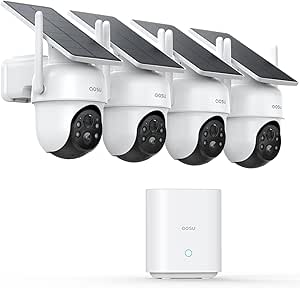
Aosu D1 Classic 4-Cam Kit Wireless Outdoor Security Cameras with Solar Power
The Aosu D1 makes a clear case for buyers who want outdoor cameras with local storage included: its 32GB capacity means footage can be stored without first buying the SD card required by the No Monthly Fee Solar Security Camera System with Home Hub. Four cameras, solar power, auto-tracking, and multi-camera live view suit a property where users want to check several outdoor areas from one system. The listed 2K video and full-color night vision are useful for identifying activity, while the competing hub kit offers dual-band WiFi and a stated 4MP resolution. Aosu’s tradeoffs are its WiFi dependence, outdoor-only positioning, and solar performance that relies on adequate sunlight. Its IP65 rating is also lower than the IP66 rating listed for the other solar camera kit.
Pros:- 32GB local storage is included
- Integrated solar panels reduce routine charging needs
- Full-color and infrared night vision offer two low-light modes
- Multi-camera live view and auto-tracking support broader outdoor monitoring
Cons:- Optimal solar charging depends on direct sunlight
- Designed for outdoor use and listed with an IP65 rating
- Does not provide HDMI or TV output for live viewing
Best for: Homeowners who want four outdoor cameras with included local storage and solar charging, especially where camera sites receive direct sun
Not ideal for: Buyers needing indoor cameras, a non-WiFi connection, stronger stated weather protection, or dependable solar charging in shaded locations
- Camera count:4
- Resolution:3MP (2K)
- Local storage:32GB
- Night vision:Full-color and infrared
- Coverage:360° pan and tilt
- Connectivity:WiFi
- Power:Solar-powered with integrated panel
- Field of view:105°
Our verdict“Select the Aosu D1 if included local storage matters more than dual-band WiFi or the higher IP66 rating of the other four-camera kit.”
eufy Security Essential Alarm System, 7-Piece, No Monthly Fee
The eufy Essential is the simpler alarm choice for buyers who value a compact, app-guided setup and local storage through its 64GB HomeBase Mini. Its keypad, entry sensors, and motion sensor cover the basics without a monthly fee, while the listed five-year average battery life may mean fewer sensor changes than the alkaline-powered 15-Piece WiFi Home Security System. That larger kit has the advantage for households planning to add many sensors and wanting a louder, specified 120dB siren. Eufy’s appeal is a more restrained setup with expandable options, but its details do not specify a siren volume or professional monitoring, and app control requires a smartphone. Choose it for straightforward entry and motion alerts, not as a camera-focused system or a substitute for monitored emergency response.
Pros:- No monthly fee is listed for ongoing security
- Includes a HomeBase Mini with 64GB storage
- In-app guidance supports DIY setup
- Expandable options allow additional sensors
Cons:- Sensors are battery powered and will eventually need replacements
- Professional monitoring options are not specified
- App control requires a smartphone
Best for: Smartphone-owning households seeking a straightforward entry-and-motion alarm with local HomeBase storage and fewer included components
Not ideal for: Buyers who need a specified high-volume siren, professional monitoring, or a security setup centered on outdoor video cameras
- Kit size:7 pieces
- Included hub:HomeBase Mini
- Local storage:64GB
- Included sensors:Entry sensors and motion sensor
- Control methods:App and push button
- Connectivity:Wireless
- Average battery life:5 years
- Power source:Battery powered
Our verdict“Choose eufy for a compact, expandable alarm with local HomeBase storage, but select the larger 15-piece kit if a specified loud siren and wider sensor expansion matter more.”
Alarm System for Home Security, 24-Piece WiFi + GSM/4G Home Alarm System with Alexa and Google Assistant Compatibility
I rank this kit for households that want a connection option beyond home Wi-Fi without paying for a monitoring plan. Its Wi-Fi and 4G connectivity can help keep notifications available if broadband drops, while the included portable SOS device adds a personal alert option that the sensor-focused WiFi Alarm System (B0H73WGPZB) does not list. Alexa and Google Assistant compatibility also gives it more voice-control flexibility than that app-focused alternative. The tradeoff is that the product data does not specify whether 4G service has any separate conditions, so buyers should verify how that connectivity works before relying on it. It also lacks in-app SMS or phone alarms and needs a smartphone for full control. This is a broader connectivity package, not a substitute for professional emergency response.
Pros:- Offers both Wi-Fi and 4G connectivity for an alternative notification path when Wi-Fi is unavailable.
- Works with Alexa and Google Assistant for voice control.
- Includes a portable emergency SOS device.
- Full functionality is described as requiring no monthly fee.
Cons:- In-app SMS and phone-call alarms are not supported.
- Full control depends on a smartphone app.
- Does not support 5G networks, and the 4G service conditions are not specified.
Best for: Households that want a DIY alarm with Wi-Fi plus 4G connectivity, voice-assistant control, and a portable SOS device, without a monthly monitoring fee.
Not ideal for: Buyers who want automated text or phone-call alerts, do not want app-based control, or need a system explicitly compatible with 5G networks.
- Included units:24
- Connectivity:Wireless Wi-Fi and 4G
- Power source:Battery powered
- Controls:App, push button, remote, and voice
- Compatible devices:Smartphone
- Alert type:Audio and motion
- Maximum range:100 meters
- Audible alarm:120 dB
Our verdict“Choose this 24-piece kit if you value Wi-Fi-plus-4G connectivity and an SOS device more than phone-call alerts or app-free operation.”
Home Security System Wireless, Smart WiFi Alarm Kit with 120dB Siren, Door & Window Sensors, Remote Control, App Alerts, Compatible with Alexa & Google Home, No Monthly Fee
This kit is a good fit for people who want to start with basic entry-point protection and add devices over time. Its stated capacity of up to 100 accessories gives it more room to grow than the WiFi Alarm System (B0H73WGPZB), which is listed for up to 20 sensors. Self-adhesive installation and a remote control make setup and everyday arming less involved, while Alexa and Google Home compatibility add convenient voice control. The central limitation is the network: it requires 2.4GHz Wi-Fi and uses 433MHz wireless signals, so placement and distance may affect how well accessories communicate. The basic kit also has no built-in motion detector. Compared with the 24-piece WiFi + GSM/4G alarm (B0H6FBSVD7), this is more expandable on paper but lacks its listed 4G connection option.
Pros:- Expandable to as many as 100 accessories.
- Self-adhesive, wireless installation avoids wiring.
- Supports Alexa and Google Home voice control.
- Includes a rechargeable backup battery.
Cons:- Requires 2.4GHz Wi-Fi and does not support 5GHz networks.
- The basic kit does not include built-in motion detectors.
- 433MHz accessory signals and the stated 10-meter range may constrain placement.
Best for: Renters or homeowners who want a self-installed, voice-compatible entry alarm that can grow with additional sensors and accessories.
Not ideal for: Buyers who need motion detection in the base kit, rely on 5GHz Wi-Fi, or want a cellular backup connection.
- Connectivity:Wireless Wi-Fi and 433MHz signals
- Wi-Fi requirement:2.4GHz
- Maximum accessory capacity:Up to 100 accessories
- Audible alarm:120 dB
- Installation:Self-adhesive
- Compatible devices:Alexa and Google Home
- Maximum range:10 meters
- Weight:136 g
Our verdict“Pick this kit if you want a scalable Wi-Fi entry alarm and can work within its 2.4GHz network and accessory-range limits.”
ANSQUE Home Security Cameras Wireless Outdoor, Solar Powered, 4-Cam System
Unlike the alarm kits in this roundup, this ANSQUE set is built around outdoor video coverage, not door and window sirens. Four solar-powered cameras with 360° PTZ coverage and AI motion tracking can follow activity across a yard, while local storage avoids making a paid cloud plan the default for recording. That makes it a more suitable match for exterior monitoring than the 24-piece WiFi + GSM/4G alarm (B0H6FBSVD7), which is an alarm system rather than a camera set. The tradeoffs are its dependence on adequate sunlight and its outdoor-only IP65 design; it does not replace entry sensors or provide a listed central alarm hub. Buyers should also distinguish the advertised 365-day battery life from guaranteed performance, since charging depends on conditions. It suits focused camera coverage, not whole-home alarm protection by itself.
Pros:- Solar-powered design is specified with up to 365-day battery life.
- 360° PTZ coverage and AI motion tracking help follow activity.
- Built-in 32GB storage is expandable up to 512GB.
- Dual-band Wi-Fi supports 2.4GHz and 5GHz networks.
Cons:- Solar charging works best with sufficient sunlight.
- IP65 design is for outdoor use and does not add indoor alarm sensors.
- Advanced camera features come with a higher-cost positioning than basic alarm kits.
Best for: Homeowners who want four solar-powered outdoor cameras with local recording and broad yard coverage without relying on a monthly cloud plan.
Not ideal for: Buyers seeking door and window sensors, a central siren-based alarm system, or reliable solar charging in persistently shaded locations.
- Camera count:4
- Camera type:PTZ dome
- Field of view:360° panoramic
- Video and night vision:2K HD color night vision with 8× digital zoom
- Storage:32GB built-in, expandable up to 512GB
- Power:Solar-powered; stated battery life up to 365 days
- Wi-Fi:Dual-band 2.4GHz and 5GHz
- Water resistance:IP65
Our verdict“Choose ANSQUE for local-recording outdoor camera coverage, but pair it with an alarm kit if you also need entry sensors and a siren.”
WiFi Alarm System for Home Security, DIY, No Monthly Fee, App Alerts
This is the more straightforward choice for buyers who want a basic DIY alarm with app notifications and no monthly fee. Its 120dB siren, door sensor technology, and support for up to 20 sensors cover the core job of alerting you when an entry point is opened. The smaller expansion limit is a clear step down from the 100-accessory capacity listed for the WiFi alarm kit (B0H3YS7RNF), but it may be plenty for an apartment or modest home. An eight-hour battery backup can keep the system running through a short outage. The compromises are 2.4GHz-only Wi-Fi, indoor-only use, and reports of connectivity issues in the supplied product data. Compared with the Wi-Fi + GSM/4G system (B0H6FBSVD7), it is less resilient if the home network fails.
Pros:- DIY wireless installation does not require wiring.
- Supports expansion up to 20 sensors.
- Provides app alerts without a monthly fee.
- Includes an eight-hour battery backup.
Cons:- Works only with 2.4GHz Wi-Fi.
- Designed for indoor use.
- Product data notes connectivity issues, which may affect remote alerts.
Best for: Apartment dwellers and owners of smaller homes who need a simple, app-managed door alarm with room for a limited number of extra sensors.
Not ideal for: People who need cellular backup, outdoor protection, 5GHz Wi-Fi support, or broad expansion beyond 20 sensors.
- Connectivity:Wi-Fi
- Wi-Fi requirement:2.4GHz
- Sensor type:Door sensor
- Maximum sensor capacity:Up to 20 sensors
- Audible alarm:120 dB
- Maximum range:100 feet
- Battery backup:8 hours
- Control method:App
Our verdict“Choose this system for basic, budget-minded entry monitoring in a smaller home where 2.4GHz Wi-Fi is dependable.”
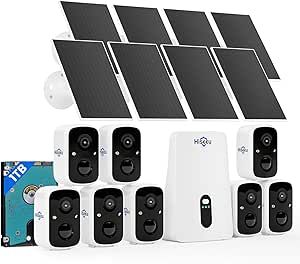
Hiseeu Solar Security Cameras Wireless Outdoor System, 8 Camera Kit, Expandable to 10CH, No Monthly Fee, Solar-Powered, 4MP Color Night Vision, Dual-Band WiFi, 1TB HDD
For a large property, Hiseeu offers a more coverage-focused camera setup than the four-camera ANSQUE system (B0D7Z97Q48): this kit includes eight cameras and can expand to ten channels. Its 1TB HDD keeps recordings local, a useful distinction for buyers who want to avoid ongoing cloud storage fees, while 4MP color night vision and PIR/AI detection help identify activity after dark. Solar power can reduce routine charging, but direct sunlight matters, and the product data notes that some upgraded AI detection features may carry extra cloud-plan costs. That caveat keeps “no monthly fee” from meaning every advanced feature is free. This is a substantial outdoor surveillance setup, not a simple alarm kit; unlike the WiFi Alarm System (B0H73WGPZB), it does not list door sensors or a 120dB siren.
Pros:- Includes eight cameras and supports expansion to ten channels.
- 1TB HDD provides substantial local video storage.
- 4MP video and color night vision support clearer low-light footage.
- PIR and AI detection can distinguish people, vehicles, and pets.
Cons:- Solar charging performs best with direct sunlight.
- Some upgraded AI detection features may incur cloud-plan fees.
- A multi-camera outdoor system does not replace an entry-sensor alarm.
Best for: Owners of large homes, outbuildings, or rural properties who need multiple outdoor camera views and substantial local recording capacity.
Not ideal for: Apartment residents, buyers who need door and window alarm sensors, or anyone unwilling to check which AI features require a paid cloud plan.
- Included cameras:8
- Expandable capacity:Up to 10 channels
- Storage:1TB HDD
- Resolution:4MP
- Night vision:Color night vision
- Power source:Solar powered and battery powered
- Wi-Fi:Dual-band 2.4GHz and 5GHz
- Motion detection:PIR and AI human, vehicle, and pet detection
- App compatibility:EseeCloud, Alexa, and SmartThings
Our verdict“Choose Hiseeu for wide outdoor coverage and local recording across a large property, provided its solar and paid-feature limits fit your setup.”
No Monthly Fee Solar Security Cameras Wireless Outdoor with 4MP HD Video, Color Night Vision, 360° View, 2-Way Audio, and 500GB HDD NVR System
I’d choose this system for outdoor coverage that records locally without a required monthly plan. Its 500GB HDD gives it an advantage over camera kits that rely mainly on removable-card storage, while 4MP video and color night vision can help make activity easier to identify after dark. The 360-degree pan-and-tilt view also lets each camera cover more ground than a fixed-angle unit, though it doesn’t mean one camera can watch every area at once.
Compared with the Hiseeu 8-camera system, this listing specifies less built-in storage, so it suits a smaller setup better than someone planning broad, long-term recording. Solar power can reduce charging chores, but performance depends on usable sunlight, and the product data notes that some features may require an app subscription. I’d check which functions remain free before buying.
Pros:- 500GB HDD provides local recording capacity without relying only on a memory card.
- 4MP resolution and color night vision support clearer identification in low-light conditions.
- 360° horizontal and 90° vertical PTZ coverage can reduce blind spots compared with fixed-view cameras.
- Solar panel and 8000mAh battery reduce routine charging when the cameras receive adequate sunlight.
Cons:- Solar charging may be inadequate in shaded areas or during stretches of limited sunlight.
- The 500GB drive may not provide enough retention for extended recordings or a larger camera setup.
- Some features may require an app subscription, so the no-monthly-fee promise may not cover every function.
Best for: Homeowners seeking solar-powered outdoor cameras with a built-in hard drive and adjustable views, especially where regular charging would be inconvenient.
Not ideal for: Buyers in shaded locations or those who need guaranteed continuous recording, extensive long-term storage, or every app feature without a subscription.
- Resolution:4MP
- Night vision:Color, up to 65 feet
- View:360° horizontal, 90° vertical
- Storage:500GB HDD; supports up to 128GB TF card
- Power:Solar panel with 8000mAh battery
- Wi-Fi:Dual-band 2.4GHz and 5GHz
- Audio:Two-way communication
- Weather resistance and mounting:Waterproof; wall mount
- Material:Aluminum
Our verdict“Choose this system for solar-powered outdoor monitoring with local HDD storage, but check sunlight conditions and subscription-dependent features before relying on it as a fully fee-free setup.”

How We Picked
I ranked these options by how well their listed features support a genuinely subscription-free setup: what is included for local monitoring or recording, how the system communicates alerts, and how much of the home it can cover. I separated sensor-based alarm kits from outdoor camera systems rather than treating them as interchangeable. A siren and contact sensors can warn occupants about entry, while cameras provide visual evidence and perimeter visibility; neither automatically replaces the other.
Within each group, I weighed practical setup and maintenance, the usefulness of the included hardware, and the tradeoffs buyers take on by avoiding a recurring service. Products with local storage or an additional listed communication path earned attention because they can reduce reliance on a cloud plan or a single connection. I did not treat broad claims such as “no monthly fee” as proof that every feature is free: app access, storage terms, cellular service, and optional services can vary, so buyers should verify current terms before ordering.
Factors to Consider When Choosing Home Security System Without Monthly Fees
Before choosing a kit, decide what you expect the system to do when something happens. A no-fee system can shift costs and responsibility away from a monitoring provider and onto the owner: you may need to check alerts, maintain equipment, and decide how recordings are stored. These points can help you avoid paying for coverage that does not match your home.
Choose Between Entry Alerts and Outdoor Video
Start by listing the problems you want to detect. Door and window sensors are built to flag entry points, while cameras help you check driveways, yards, and exterior doors. A camera-only setup may show what happened outside but leave interior entry points unmonitored; a sensor-only kit may alert you without showing who is there. For a home with several exterior approaches, camera placement may matter more than adding indoor sensors. If you want both kinds of coverage, check whether you can combine systems or whether you will need separate apps and hubs.
Check What “No Monthly Fee” Actually Covers
The phrase can refer to basic app alerts, local recording, or the absence of a required professional monitoring plan, and those are not the same thing. Before buying, check whether viewing clips remotely, keeping recordings, or using advanced detection features requires a subscription. Confirm whether the system includes storage hardware or if you must supply a card or drive. Also check the terms for account access and whether key functions continue if a trial or optional plan ends. This small piece of research can prevent a low-maintenance expectation from turning into a storage or service surprise.
Treat Local Storage and Alerts as Separate Needs
Local storage can preserve footage without relying on a cloud subscription, but it does not guarantee that recordings will remain available if the recorder is stolen, damaged, or disconnected. App alerts tell you that an event may have occurred; they do not provide a person to investigate or contact emergency services. Consider whether you need continuous recording, event clips, or simply a live view, since those needs affect storage capacity and upkeep. If keeping evidence matters, check how long the included storage can retain footage at your chosen settings. A second copy stored somewhere else may reduce the risk of losing the only recording.
Plan for Connectivity Failures
WiFi-based systems depend on a working router and a reliable signal where sensors or cameras are installed. A kit listing GSM/4G offers another communication route, but cellular alerts depend on compatible service, coverage, and any activation requirements. Solar-powered cameras also need a usable WiFi connection even when their batteries receive sunlight. Map weak-signal areas before installation, especially at detached garages, gates, or the far side of a large property. If internet outages are common where you live, prioritize a clearly explained backup path rather than assuming every wireless system can report an alarm offline.
Budget for Maintenance and Placement
Subscription-free does not mean maintenance-free. Contact sensors need batteries, cameras may need cleaning or repositioning, and solar panels need enough suitable sunlight to support their intended use. A camera placed for a clear view can still miss faces or activity if glare, trees, or a wide distance interfere. Think through ladder access and seasonal changes before choosing high-mounted equipment. A smaller system installed in useful locations can serve you better than a larger bundle whose devices are difficult to maintain.
Match System Size to the Home, Not the Bundle
Count doors, accessible windows, and outdoor zones before deciding how many devices you need. A large sensor kit can leave unused pieces if your home has few entry points, while a four-camera bundle may not cover a long driveway and several sides of a house. Expansion claims are useful only if added devices are compatible and can be managed by the included hub or recorder. Check the system’s supported device limits and whether extra units require separate equipment. Buying for the layout first makes it easier to compare a compact starter kit with a larger package on practical coverage rather than device count alone.
Frequently Asked Questions
Can a home security system without monthly fees contact emergency services for me?
Do not assume that an app alert or loud siren includes professional emergency dispatch. Many no-fee kits leave monitoring and response decisions to the homeowner, and features can vary by model and service plan. Check the product’s current terms for any dispatch option, required plan, or cellular service charge. If you want emergency services contacted automatically, confirm who receives the alarm and how verification works before buying. If you choose self-monitoring, decide who will check alerts when you are away or unable to respond.
Should I choose a camera system with a hard drive or an alarm kit with sensors?
Choose based on the information you need during an incident. A sensor kit can report that a door or window opened and may sound a siren, while a camera system can show activity in the areas its cameras cover. A hard drive provides a local place to record video, but it does not add entry sensors or guarantee an alert if the network or recorder fails. If you need both entry detection and video evidence, plan for a combined setup rather than expecting one device type to do both jobs. Verify that the storage method and alert features work without a paid plan.
Does a solar-powered outdoor camera need direct sunlight all day?
Solar performance depends on the camera’s power use, panel placement, weather, and the amount of usable light it receives. A shaded eave or a location with frequent overcast conditions may not keep a camera charged as expected, even if the model is sold as solar-powered. Check whether the panel can be mounted separately and positioned toward better light without compromising the camera view. Review the manufacturer’s charging and battery guidance for the specific kit. Plan to check power status after installation and through seasonal changes rather than treating solar power as maintenance-free.
Will a WiFi security system still send alerts during an internet outage?
A system that relies only on WiFi may lose app communication when the internet connection drops, even if local sensors or a siren continue to work. Kits listing GSM/4G may offer another route, but you should confirm whether cellular service needs activation, has coverage at your home, or carries a separate charge. Local recording can preserve footage during an outage, but it does not necessarily send an alert to your phone. Ask which functions remain available without internet: siren, local recording, sensor-to-hub communication, and remote notifications. That distinction matters if outages are frequent in your area.
Can I start with a small kit and add more cameras or sensors later?
Expansion depends on the hub, recorder, and device compatibility, not only on whether the listing says a system is expandable. Check the maximum number of supported devices and confirm that additional models work with the same app and recording setup. Adding equipment later may also require stronger WiFi coverage, more storage, or a new power plan. If you expect to grow the system, map the likely future locations before choosing a starter bundle. This helps you avoid a setup where added devices need a separate hub or a different account.
Conclusion
For most buyers who want a clear starting point, I recommend the eufy Security Essential Alarm System as the best overall sensor-based option in this lineup. The best value in coverage comes from the Hiseeu 8-camera kit for buyers who want multiple outdoor views and included local HDD storage, while the best premium-style choice is also Hiseeu for homes that can use its larger camera capacity and expandable setup. Beginners should lean toward the 7-piece eufy kit for a more approachable alarm setup; buyers who want another communication route should compare the PGST 12-piece kit and the 24-piece WiFi plus GSM/4G alarm system. For solar outdoor coverage, consider the Aosu, ANSQUE, or other solar camera kits based on storage, camera count, and placement needs. Choose sensors for entry alerts, cameras for visual coverage, and verify which features work without a paid plan before you commit.