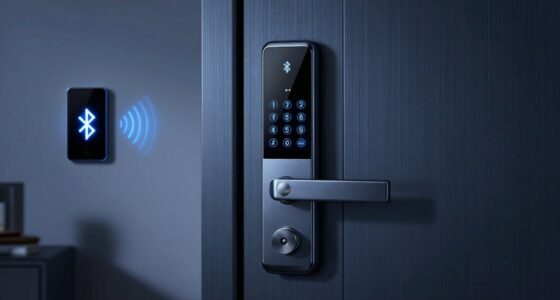
Bluetooth jamming attacks on smart locks are a real concern, exploiting the wireless protocol’s vulnerabilities and environmental factors to disrupt signals and block access. Attackers can use signal interference or spoofed signals to disable lock communication, causing inconvenience or security risks. While effective jamming requires powerful devices and favorable conditions, awareness of these threats is essential. If you want to understand how to protect your smart lock from such attacks, keep exploring these security challenges.
Key Takeaways
- Bluetooth jamming attacks are technically feasible but require powerful transmitters and environmental conditions to overcome security protocols.
- Modern Bluetooth protocols include anti-interference features, making successful jamming more difficult than often assumed.
- Real-world incidents confirm that attackers can disrupt Bluetooth signals, but consistent, large-scale jamming remains challenging.
- Effectiveness depends on attacker resources, device resilience, and environmental factors like walls and electronics.
- Implementing encryption, regular updates, and detection systems significantly reduces the risk of successful Bluetooth jamming attacks.

Philips Wi-Fi Door Lock, WiFi Smart Lock Keyless Entry Deadbolt for Front Door, Compatible with Alexa & Google Assistant, Remote Control, Built-in WiFi, APP Fingerprint Passcode Unlock, Auto Locking
𝐅𝐥𝐞𝐱𝐢𝐛𝐥𝐞 𝐖𝐚𝐲𝐬 𝐭𝐨 𝐔𝐧𝐥𝐨𝐜𝐤: Unlock the way you want: app, passcode, fingerprint, physical key, or voice via Alexa/Google…
As an affiliate, we earn on qualifying purchases.
As an affiliate, we earn on qualifying purchases.
Understanding Bluetooth Technology in Smart Locks
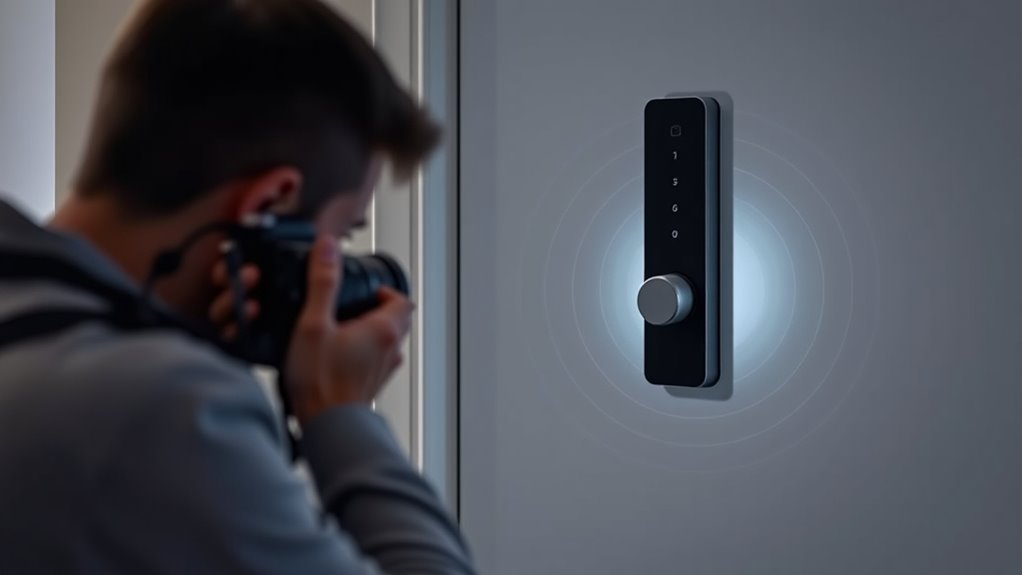
Bluetooth technology is the foundation that enables many smart locks to communicate wirelessly with your smartphone or other devices. While it offers convenience, it also comes with Bluetooth vulnerabilities that can be exploited by malicious actors. These vulnerabilities may include weak pairing protocols or outdated firmware, making your lock susceptible to hacking attempts. Additionally, encryption challenges pose a significant concern; many devices struggle to implement robust encryption, which can leave transmitted data exposed. Understanding how Bluetooth works helps you recognize potential risks and the importance of keeping your smart lock’s software updated. Being aware of these vulnerabilities allows you to take proactive steps, like enabling security features, to protect your smart lock from unauthorized access through Bluetooth-based attacks. Environmental considerations in device manufacturing and usage further influence the overall security landscape.

Ubertooth One Bluetooth Protocol Analyzer Detector 2.4 GHz with Metal Shell, Wireless Development BT Sniffer USB2.0 with Antenna, Bluetooth Compatible Analysis BLE Tool for BT Sniffer Experimentation
Advanced communication technology: Equipped with a 2.4GHz antenna, it has a transmission power and reception sensitivity comparable to…
As an affiliate, we earn on qualifying purchases.
As an affiliate, we earn on qualifying purchases.
How Do Bluetooth Jamming Attacks Work?
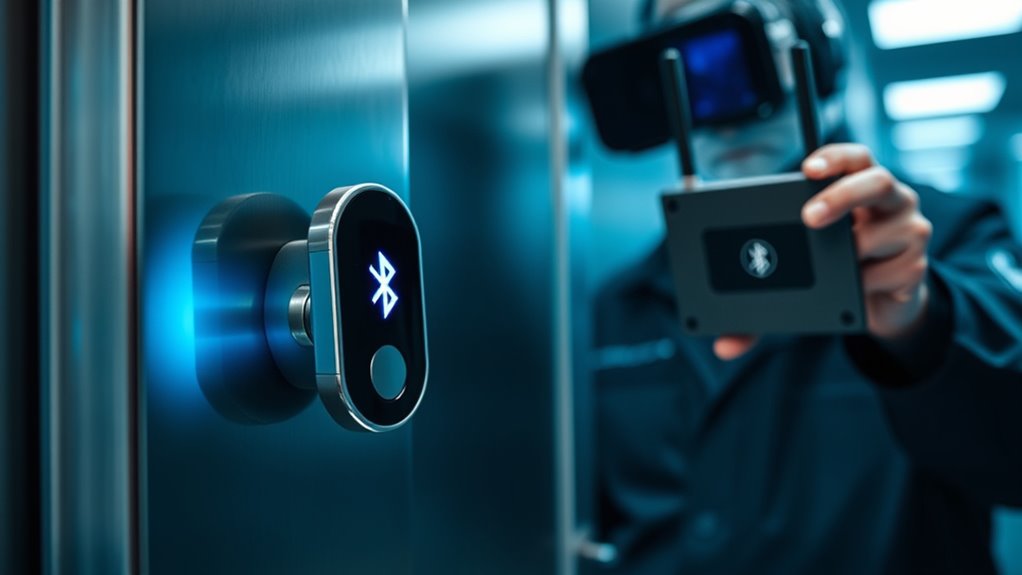
Bluetooth jamming attacks work by disrupting the signals your smart lock relies on to communicate. Attackers use signal interference techniques to overpower or block these signals, preventing your lock from functioning properly. As a result, the lock may become unresponsive, leaving your property vulnerable. Understanding the technology behind Bluetooth communication can help in assessing the risks and implementing effective security measures.
Disrupting Bluetooth Signals
Jamming attacks work by overwhelming the wireless signals used for communication, effectively blocking devices from connecting or exchanging data. When you attempt to use a smart lock via Bluetooth, a jammer floods the airwaves with noise, disrupting the signal. This exploits wireless vulnerabilities, making devices unable to communicate with the lock. Attackers can also use signal spoofing, tricking your device into thinking the connection is still active or redirecting signals, further complicating the attack. By constantly transmitting on the same frequency, jammers prevent your device from sending or receiving commands. As a result, your smart lock becomes unresponsive, and the attacker maintains control over the connection environment. This method highlights how Bluetooth signals can be disrupted through targeted interference, threatening the security of wireless devices. Additionally, understanding how Bluetooth Jamming works can help in developing more secure wireless protocols to defend against such attacks.
Signal Interference Techniques
Signal interference techniques disrupt wireless communication by intentionally injecting noise or false signals into the frequency spectrum. Attackers often exploit Bluetooth’s frequency hopping, which rapidly switches channels to avoid interference, making jamming more challenging. They may also use signal spoofing, mimicking legitimate signals to confuse the lock. These methods flood the communication channel, preventing the lock and app from establishing a stable connection. Additionally, understanding Home Improvement concepts can help in designing more resilient wireless systems. Below is a table illustrating common interference tactics:
| Technique | Method | Effect |
|---|---|---|
| Frequency Jamming | Overpower signals on multiple channels | Disrupts communication |
| Signal Spoofing | Fake signals mimic legitimate ones | Confuses device pairing |
| Noise Injection | Injects random noise into spectrum | Blocks data transmission |
| Channel Flooding | Sends excessive signals on channels | Overloads the receiver |
| Replay Attacks | Repeats captured signals | Causes false responses |
These techniques make Bluetooth jamming attacks effective in disrupting smart lock operations.
Impact on Lock Function
When malicious actors deploy interference techniques, they effectively disrupt the communication between your smart lock and its controlling device. Bluetooth interference causes signal disruption, preventing commands from reaching the lock. As a result, the lock may fail to open or lock when you need it most. This disruption can render your smart lock temporarily useless, leaving your property vulnerable. In some cases, the lock might remain stuck in a locked or unlocked state, compromising security. The attack doesn’t damage the hardware but halts its normal function by blocking the Bluetooth signals. Continuous interference can also cause the lock to repeatedly attempt to reconnect, draining its battery faster. Overall, Bluetooth interference directly impacts the lock’s ability to respond, undermining its core security features. Additionally, Kia Tuning modifications like ECU remapping or suspension upgrades demonstrate how electronic and mechanical systems can be optimized or disrupted, highlighting the importance of secure communications for modern devices.

Yale Security Wi-Fi and Bluetooth Upgrade Kit for First Gen Assure Locks and Levers, Not Compatible with Yale Assure Lock 2 (YRD4XX), AYR202-CBA-KIT
Upgrade your first generation Yale Assure Lock or Lever to work with the Yale Access App so you…
As an affiliate, we earn on qualifying purchases.
As an affiliate, we earn on qualifying purchases.
Real-World Incidents of Bluetooth Jamming Attacks
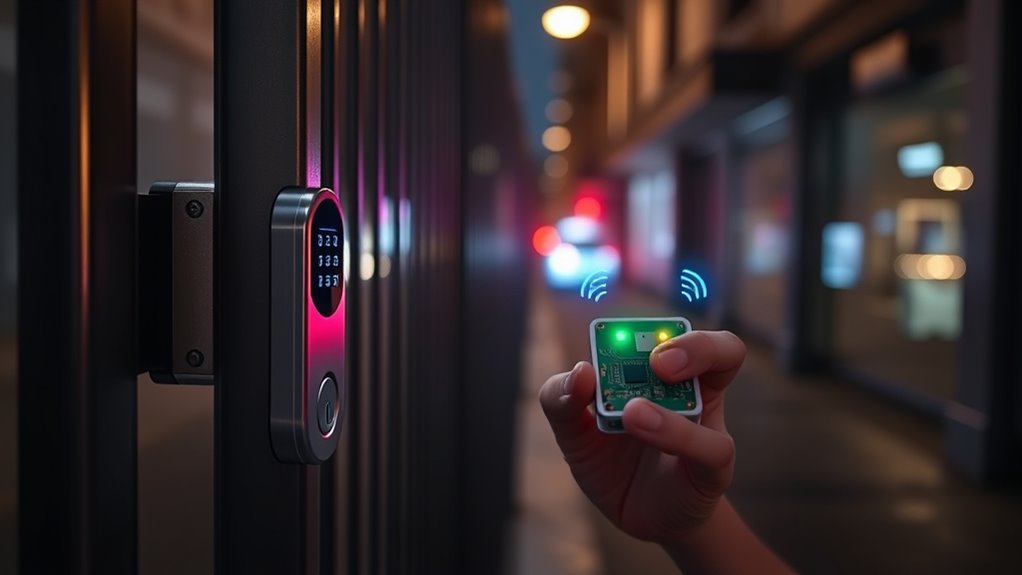
Despite the increasing adoption of smart locks, real-world incidents of Bluetooth jamming attacks have highlighted their vulnerability. In several smart home setups, hackers successfully disrupted Bluetooth signals, preventing you from accessing doors remotely. These incidents reveal significant wireless vulnerabilities that attackers exploit using inexpensive jamming devices. For example, in one case, a homeowner couldn’t gain entry to their smart lock during a break-in attempt, exposing how easily signals can be blocked. Such attacks aren’t just theoretical—they’ve happened in real life, emphasizing that Bluetooth-based smart locks aren’t invulnerable. While these incidents are relatively rare, they serve as a warning that your smart home security depends on more than just the device’s features. Being aware of these vulnerabilities helps you better protect your property. Additionally, understanding wireless security risks can guide you in adopting more comprehensive protective measures.

7-in-1 Hidden Camera Detectors, AI Chip Anti-Spy Camera Finder & 6 Modes
【Built-in AI-Driven Detection】This camera detector is equipped with an upgraded AI chip for improved anti-interference performance and faster…
As an affiliate, we earn on qualifying purchases.
As an affiliate, we earn on qualifying purchases.
Technical Challenges in Executing Jamming Attacks

Executing Bluetooth jamming attacks involves overcoming several technical hurdles that can limit their effectiveness. One major challenge is managing radio frequency interference, which can vary unpredictably. Signal degradation occurs as the jammer struggles to overpower legitimate signals without causing unintended disruptions. Precise timing and power control are essential to avoid detection and reduce collateral damage. The table below highlights key obstacles:
| Challenge | Explanation | Impact |
|---|---|---|
| Radio Frequency | Competing signals reduce jamming power | Limits attack range |
| Signal Degradation | Weakens the jammer’s effectiveness | Reduces success probability |
| Power Management | Maintaining high power levels safely | Risk of detection |
| Device Sensitivity | Variability affects jamming stability | Inconsistent results |
| Environmental Factors | Physical obstacles and interference | Signal attenuation |
These hurdles demand precise execution, making effective jamming difficult. Additionally, AI vulnerabilities such as bias and unpredictable behavior can further complicate efforts to develop resilient countermeasures against detection.
The Likelihood of Successful Bluetooth Jamming

The likelihood of successfully jamming Bluetooth signals on smart locks hinges on several critical factors. One key aspect is interference mitigation; smart locks often use adaptive techniques to counteract interference, making jamming more difficult. Signal resilience also plays an essential role, as modern Bluetooth protocols include features that improve robustness against disruptions. Additionally, your jamming device must be powerful enough to overpower legitimate signals without being detected or blocked by other wireless traffic. Environmental factors, such as walls or electronic devices, can further reduce jamming effectiveness. While technically feasible, the success of a Bluetooth jamming attack depends heavily on these variables. Moreover, Bluetooth protocol features have been developed to enhance security and reduce susceptibility to interference, further complicating such attacks. Overall, the combination of interference mitigation strategies and signal resilience reduces the likelihood of a successful, sustained jamming attempt.
Potential Consequences of Jamming Attacks on Smart Locks
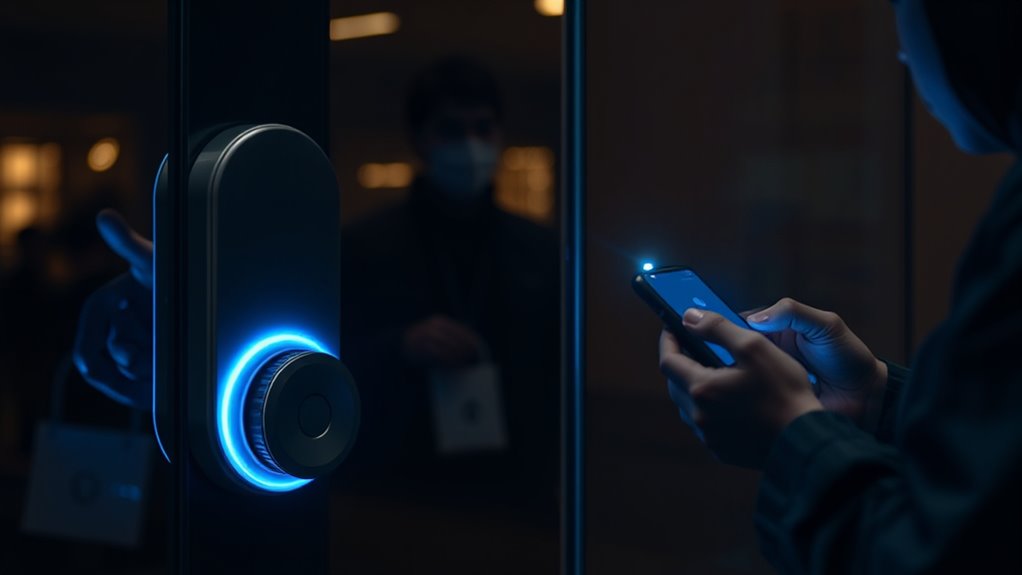
When a Bluetooth jamming attack occurs, you risk losing control over your smart lock, making it easier for intruders to gain unauthorized access. This disruption can also disable your security system, leaving your property vulnerable. Understanding these potential consequences highlights the importance of protecting your smart lock from such threats. Trust issues with devices can also arise, leading to further vulnerabilities if not properly addressed.
Unauthorized Lock Access
Jamming attacks on smart locks can lead to unauthorized access, putting your security at significant risk. These attacks exploit smart lock vulnerabilities by blocking Bluetooth signals, preventing legitimate users from unlocking their doors. Bluetooth protocol limitations make it easier for attackers to disrupt communication, especially if the lock lacks robust anti-jamming features. When signals are jammed, the lock may default to insecure modes or become unresponsive, allowing intruders to bypass security altogether. In some cases, attackers can manipulate the lock’s firmware or exploit weak encryption, gaining control without needing to disable Bluetooth entirely. This unauthorized access compromises your safety and privacy, highlighting the importance of understanding both smart lock vulnerabilities and Bluetooth protocol limitations to better protect your property. Additionally, implementing security measures such as encrypted communication protocols and anti-jamming technologies can help mitigate these risks.
Security System Disruption
By disrupting Bluetooth signals, jamming attacks can do more than just block access; they can compromise your entire security system. When communication is interrupted, malicious actors might exploit cryptography vulnerabilities to manipulate or disable security protocols. This disruption can lead to false alarms or disablement of alerts, reducing your safety. Additionally, attackers could engage in hardware tampering, physically altering or bypassing components to weaken security defenses. Jamming can also prevent updates or patches from reaching your smart lock, leaving it vulnerable to exploitation. The combined effects threaten not only access control but the overall integrity of your security system. Ultimately, jamming attacks can create a window for further attacks, making your entire safety infrastructure susceptible to compromise.
Methods to Detect and Prevent Bluetooth Interference
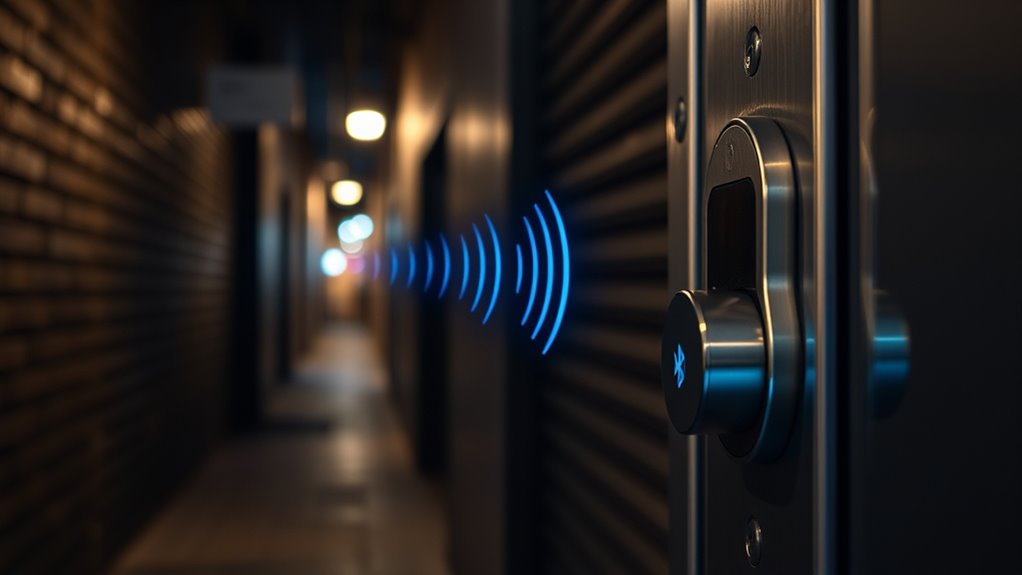
Detecting and preventing Bluetooth interference requires a proactive approach that involves both technological solutions and vigilant monitoring. You should implement robust cryptographic protocols to secure communications, making it harder for attackers to disrupt signals. Regularly updating firmware can also address hardware vulnerabilities that could be exploited to cause interference. Using spectrum analyzers helps identify unusual activity or jamming signals, alerting you to potential threats. Additionally, deploying interference detection systems that monitor Bluetooth channels enables rapid response to jamming attempts. Combining encryption, hardware security measures, and continuous monitoring forms a thorough defense. These methods help you spot interference early and mitigate risks, ensuring your smart lock remains reliable despite potential Bluetooth jamming threats.
Best Practices for Enhancing Smart Lock Security
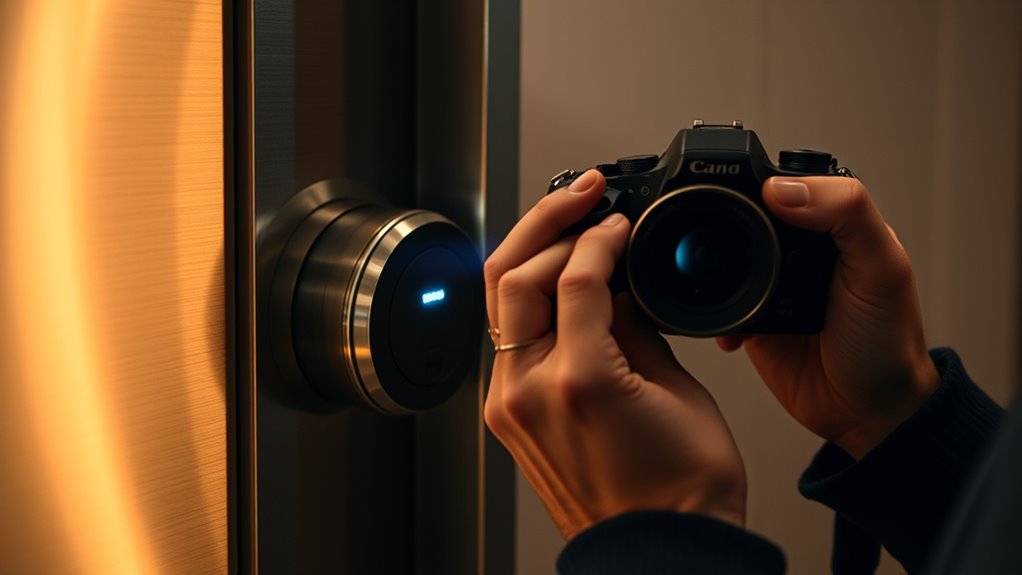
Implementing strong security practices is essential to safeguarding your smart lock against Bluetooth threats. Start by choosing devices that utilize robust cryptography protocols, ensuring data encryption during communication. Regularly update your lock’s firmware to patch hardware vulnerabilities that hackers might exploit. Use multi-factor authentication when available, adding an extra layer of protection beyond Bluetooth pairing. Avoid default passwords and customize settings to prevent unauthorized access. Additionally, limit Bluetooth visibility when not in use, reducing exposure to potential jamming or interception. Be cautious of physical hardware vulnerabilities; secure your smart lock and related components to prevent tampering. Combining these practices helps defend against attacks, keeping your smart lock secure and resilient against evolving Bluetooth threats.
Future Outlook: Evolving Threats and Protections

As technology advances, smart lock manufacturers and security experts must stay vigilant against increasingly sophisticated Bluetooth threats. Future protections will likely rely on innovations like quantum encryption, which can safeguard data against even the most advanced attacks. Additionally, biometric authentication—such as fingerprint or facial recognition—will enhance access security, making unauthorized jamming or hacking more difficult. Smart locks may also incorporate adaptive security protocols that detect unusual activity in real-time, prompting immediate countermeasures. As threats evolve, combining these advanced technologies ensures a layered defense, reducing vulnerabilities. Staying ahead requires ongoing research and rapid implementation of emerging solutions to protect your smart lock from persistent and future Bluetooth threats.
Frequently Asked Questions
Can Bluetooth Jamming Attacks Be Automated by Hackers?
You might wonder if Bluetooth jamming attacks can be automated by hackers. The answer is yes; automated exploits can be used to identify vulnerable devices through device detection and then jam signals efficiently. Hackers can deploy tools that scan for smart locks and launch jamming attacks automatically, making it easier to target multiple devices quickly. Staying alert and employing robust security measures helps protect your smart lock from such automated threats.
Are There Specific Brands More Vulnerable to Bluetooth Jamming?
Think of smart locks like fragile glassware—some brands are more susceptible to damage. Certain brands have known device vulnerabilities, making them more vulnerable to Bluetooth jamming. For instance, less established brands often lack robust security features, increasing susceptibility to attacks. You should research brand susceptibility and choose reputable smart lock providers, as these tend to have stronger security measures that reduce your risk of falling victim to Bluetooth jamming or other attacks.
How Long Does a Typical Bluetooth Jamming Attack Last?
The attack duration of a Bluetooth jamming attack varies depending on the attacker’s intent and method. It can last from a few seconds to several minutes, causing interference effects that disrupt communication between your device and the lock. During this time, you may experience a loss of connection, preventing access. Longer attacks increase the risk of unauthorized entry, highlighting the importance of strong security measures to mitigate such threats.
What Legal Risks Are Associated With Bluetooth Jamming?
Imagine maneuvering a landscape with strict rules—you should be aware of potential legal repercussions from Bluetooth jamming. Engaging in such activities can lead to serious penalties, including fines and regulatory sanctions. You must prioritize regulatory compliance, as jamming disrupts legitimate communications and can violate laws governing wireless spectrum use. Staying informed helps you avoid inadvertent legal issues and ensures you’re acting within the bounds of the law.
Do Bluetooth Jamming Attacks Affect Other Wireless Devices Nearby?
Bluetooth jamming attacks can cause interference impact on nearby wireless devices, disrupting their signals. When a jammer targets your smart lock, it may also affect other Bluetooth or Wi-Fi devices in the vicinity, reducing their device resilience. You might notice connectivity issues or degraded performance. The extent depends on the jammer’s power and the devices’ resilience, but nearby devices are often affected due to shared frequency interference.
Conclusion
While the idea of Bluetooth jamming attacks might seem like a sneaky villain lurking in the shadows, the reality is more complex—like chasing a ghost in a foggy night. Most attackers face tough hurdles, making successful jamming a rare storm rather than a daily tempest. Stay vigilant, keep your smart lock updated, and don’t let fear lock you out. With smart defenses, you’re the lighthouse guiding your home safely through any digital fog.