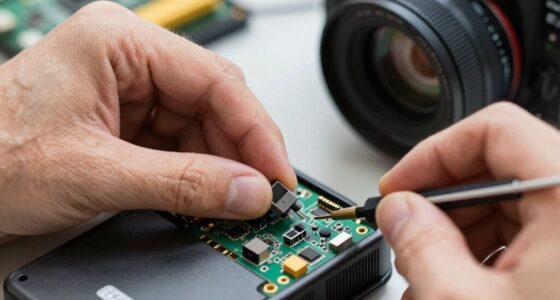
Upgrading your legacy lighting system to smart protocols lets you control your lights wirelessly, making management easier and more efficient. It reduces wiring costs, supports real-time adjustments, and offers greater flexibility for future upgrades. Smart systems also help save energy by automating schedules and using sensors. Plus, they improve safety with features like emergency lighting. To discover how these upgrades can transform your space and maximize benefits, continue exploring the options available.

Get privacy and security gear delivered free with Prime
- Fast, free delivery on millions of items
- Prime Video, Amazon Music and more included
- Member-only deals all year
Key Takeaways
- Transitioning to smart protocols simplifies wiring and enables wireless control for existing lighting fixtures.
- Upgrading enhances energy efficiency through automation, sensors, and remote monitoring.
- Smart protocols support scalability for future expansion without extensive rewiring.
- Integration with IoT platforms improves safety, reliability, and emergency response capabilities.
- The upgrade process reduces maintenance costs and allows real-time system optimization.

Upgrading legacy lighting systems is essential for improving energy efficiency, reducing maintenance costs, and enhancing safety. As technology advances, traditional lighting setups become outdated, limiting your ability to control and optimize your lighting environment effectively. Modern smart protocols enable seamless wireless integration, allowing you to connect lighting fixtures to centralized systems or IoT platforms. This connectivity simplifies management, giving you real-time control over lighting scenarios and enabling you to adapt lighting levels based on occupancy, daylight, or time of day. By adopting wireless integration, you eliminate the need for extensive wiring and manual adjustments, making upgrades more flexible and cost-effective.
Upgrade to smart protocols for seamless, flexible, and cost-effective lighting control and energy efficiency.
With smart lighting protocols, energy optimization becomes more attainable than ever. You can automate lighting schedules to turn off or dim fixtures when spaces are unoccupied, substantially reducing unnecessary energy consumption. Sensors and motion detectors integrated into these systems detect activity and adjust lighting accordingly, ensuring lights are only on when needed. This not only cuts down on energy bills but also contributes to a greener footprint. The ability to monitor energy usage remotely helps you identify patterns and inefficiencies, empowering you to make data-driven decisions to further optimize your lighting setup. Additionally, understanding Juice Cleanse and Detox principles can inspire environmentally conscious choices in energy management.
Upgrading to smart protocols also means you can implement scalable solutions that grow with your needs. Wireless integration makes it easy to add new fixtures or upgrade existing ones without extensive rewiring. You can also synchronize lighting across multiple zones, creating cohesive lighting environments that enhance safety and ambiance. Plus, these systems often support advanced features like scene setting, color tuning, and adaptive lighting, which enhance user experience and operational flexibility. Whether managing a commercial space or a public facility, integrating smart lighting protocols ensures your system remains adaptable and future-proof.
Furthermore, these upgrades improve safety by providing better illumination control in critical areas. Emergency lighting can be integrated with the system to ensure instant response during outages or emergencies. Combining wireless integration with energy optimization not only makes your lighting smarter but also more reliable and safer. You’ll spend less time maintaining fixtures, as remote diagnostics and automated alerts notify you of issues before they become serious problems.
As an affiliate, we earn on qualifying purchases.
Frequently Asked Questions
What Are the Initial Costs of Upgrading to Smart Lighting?
The initial costs of upgrading to smart lighting vary, but you can expect to invest in new fixtures, control systems, and installation. While upfront expenses might seem high, you’ll benefit from energy savings over time and greater user customization. These improvements can reduce your energy bills and enhance your space’s ambiance, making the investment worthwhile. Plus, smart systems often offer scalable options to fit your budget and needs.
How Long Does a Typical Upgrade Process Take?
The installation timeline for upgrading to smart lighting varies, but you can typically expect it to take anywhere from a few days to a few weeks. Your pace depends on the complexity of your system and how quickly you select a vendor. By choosing the right vendor early, you streamline the process, ensuring a smoother upgrade with minimal disruption. Proper planning helps you stay on schedule and meet your desired completion date.
What Are the Main Compatibility Issues With Existing Systems?
You might face compatibility issues like protocol interoperability and hardware integration hurdles. Your existing system could use outdated protocols incompatible with new smart standards, causing communication failures. Hardware components might not support modern protocols, requiring replacements or adapters. These challenges demand careful planning to guarantee smooth integration. Addressing protocol interoperability early and selecting compatible hardware can save you time and money, making your upgrade more seamless and future-proof.
Are There Security Concerns With Smart Lighting Protocols?
Yes, security is a key concern with smart lighting protocols. You need to guarantee lighting encryption is robust to prevent unauthorized access, and implement strict access control measures. Without proper security, hackers could manipulate lighting systems or access sensitive data. Regular updates and strong authentication help protect your network. Staying vigilant about these security aspects ensures your smart lighting system remains safe and reliable.
How Can I Ensure Minimal Disruption During Installation?
Did you know that proper installation planning can reduce setup time by up to 30%? To guarantee minimal disruption during installation, you should create a detailed plan that includes clear timelines and communication. Train your staff beforehand, so they’re familiar with the new protocols. Scheduling the upgrade during off-peak hours also helps minimize impact. With these steps, your upgrade will be smooth and efficient.
As an affiliate, we earn on qualifying purchases.
Conclusion
Think of upgrading your legacy lighting system as planting a seed in a garden. With care and the right tools, it grows into a vibrant, intelligent network that adapts and thrives. By embracing smart protocols, you’re nurturing a future where your lighting system blossoms into something more efficient and responsive. Don’t wait for storms to damage your garden—start today and watch your smart lighting landscape flourish, transforming your space into a beacon of innovation.
As an affiliate, we earn on qualifying purchases.
As an affiliate, we earn on qualifying purchases.
Halloween Picks
halloween
As an affiliate, we earn on qualifying purchases.