
📊 Full opportunity report: How Federal Judge's Ruling Impacts Trade, Supply Chains, And Voter ID Policies on IdeaNavigator AI — validation score, market gap, and execution plan.
TL;DR
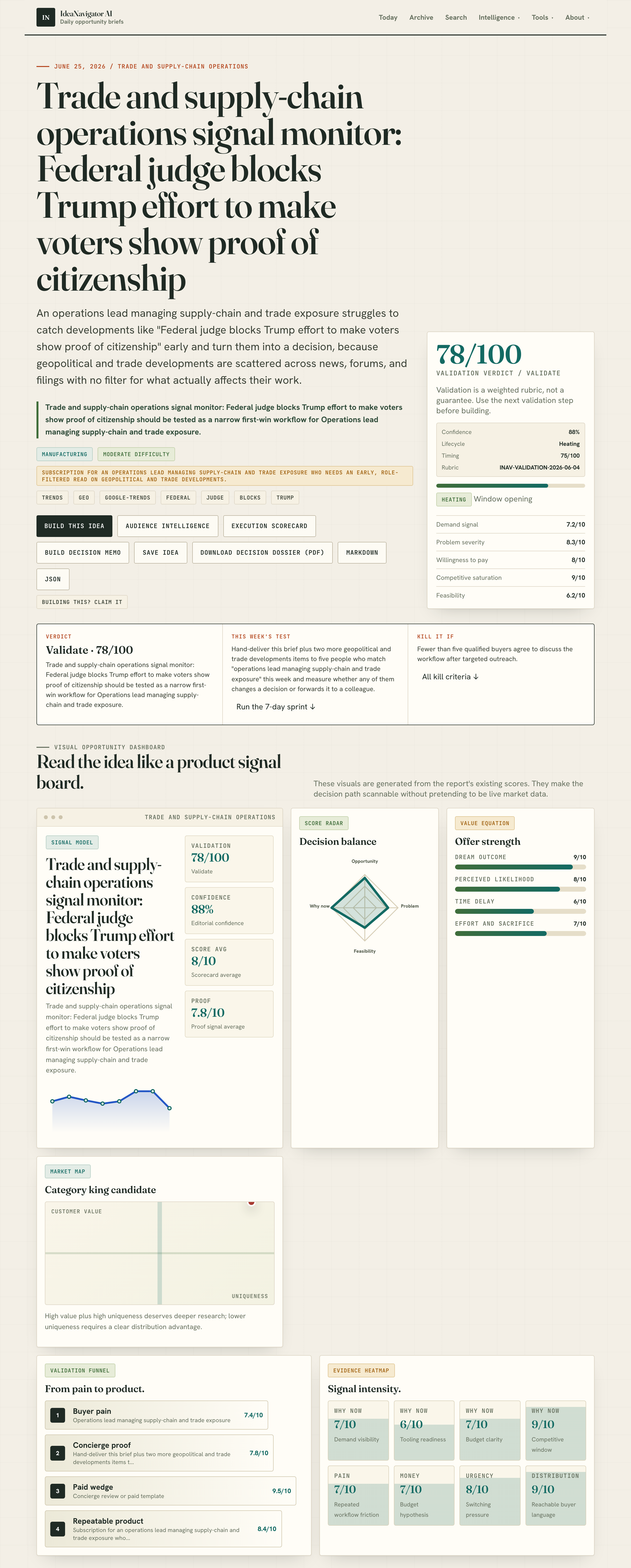
A federal judge has blocked an effort by former President Trump to require voters to show proof of citizenship. This legal decision influences election policies and may have ripple effects on trade and supply chains, especially in how legal and political developments are monitored and acted upon.
A federal judge has blocked former President Donald Trump’s effort to require voters to present proof of citizenship, a move that could have significant repercussions for election policies, legal battles, and the broader political landscape. This ruling marks a key legal setback for Trump’s voting restrictions and underscores the importance of legal decisions in shaping both electoral and trade-related policies.
The court ruling, issued by a federal judge in Washington, D.C., prevents the implementation of Trump’s proposed requirement that voters show proof of citizenship when registering or voting. The judge cited legal concerns about the potential disenfranchisement of eligible voters and questioned the alignment of the effort with existing federal laws.
This decision is confirmed to have halted the enforcement of the policy, which was part of Trump’s broader efforts to tighten voting restrictions. The ruling was based on legal arguments presented in a lawsuit challenging the rule, and it is considered a significant legal victory for voting rights advocates.
While the ruling directly impacts voting procedures, experts suggest it could influence related legal and political strategies, especially as election laws remain a contentious issue across states. The decision may also ripple into trade and supply chain considerations, as legal stability and regulatory clarity are crucial for international and domestic commerce.
Legal Victory Shapes Electoral and Trade Policies
This ruling matters because it reinforces legal protections for voters against restrictive requirements, potentially setting a precedent that influences future election laws. Additionally, legal stability in voting policies can impact trade negotiations and supply chain operations, which rely on predictable regulatory environments. The decision underscores how judicial actions in politically sensitive cases can have broad implications beyond the courtroom, affecting economic and geopolitical stability.
personal data encryption software 2026
As an affiliate, we earn on qualifying purchases.
As an affiliate, we earn on qualifying purchases.
Legal Battles Over Voting Laws and Political Impact
The effort to require proof of citizenship for voters has been a contentious issue, with proponents arguing it secures election integrity and opponents claiming it suppresses voter turnout. The legal challenge against Trump’s proposed rule was part of a broader pattern of court interventions in voting rights cases. Historically, similar policies have faced legal hurdles, and this recent ruling continues that trend.
The legal landscape is highly dynamic, with multiple courts examining different aspects of voting laws. The decision aligns with a series of judicial decisions that have struck down or limited restrictive voting measures, emphasizing the judiciary’s role in balancing election security and voter access.
From a trade perspective, legal stability in election policies is critical, as it influences international relations, trade negotiations, and compliance with global standards. Uncertainty in domestic election laws can lead to diplomatic tensions or disruptions in trade agreements, especially if legal disputes spill over into international forums.
“Legal stability in election laws can indirectly impact trade and supply chains by fostering a predictable regulatory environment.”
— Trade expert
As an affiliate, we earn on qualifying purchases.
Unclear Long-Term Effects on Election and Trade Laws
It is not yet clear how this ruling will influence future legal challenges to voting laws or whether similar policies will be reinstated in other states. The broader impact on international trade and supply chains remains uncertain, as these depend on subsequent legal and political developments that are still unfolding. Additionally, there is ongoing debate about how courts will interpret similar restrictions in different jurisdictions, which could alter the legal landscape further.
As an affiliate, we earn on qualifying purchases.
Next Legal Challenges and Policy Developments to Watch
Legal battles over voting laws are expected to continue, with possible appeals or new lawsuits challenging other restrictive measures. Policy makers may also revisit the issue, either to reinforce or modify existing voting requirements. From a trade perspective, businesses and supply chain managers will need to monitor legal stability and regulatory changes, as these can influence compliance and operational planning. International actors may also observe how domestic legal decisions affect geopolitical relations and trade agreements.
data encryption tools for cybersecurity
As an affiliate, we earn on qualifying purchases.
As an affiliate, we earn on qualifying purchases.
Key Questions
How does this ruling affect future voting laws?
The ruling sets a legal precedent that may hinder efforts to implement similar voter ID requirements, but future laws could still be challenged or modified depending on subsequent court decisions.
Could this impact international trade or supply chains?
Indirectly, yes. Stable and predictable election laws support a secure legal environment, which is crucial for international trade and supply chain operations. Uncertainty or legal disputes can create disruptions or delays.
What are the next legal steps for the Trump voter proof requirement?
Legal parties may appeal the decision, or lawmakers could attempt to revise the policy to address court concerns. The outcome depends on ongoing litigation and legislative actions.
Will this ruling influence other states’ voting policies?
Potentially. The decision may serve as a legal reference or deterrent for similar voter ID laws in other jurisdictions, but each state’s legal environment remains distinct.
How might this affect upcoming elections?
While the ruling prevents the immediate enforcement of the proof of citizenship requirement, ongoing legal debates mean election laws could still change, affecting voter access and ballot procedures.
Source: IdeaNavigator AI