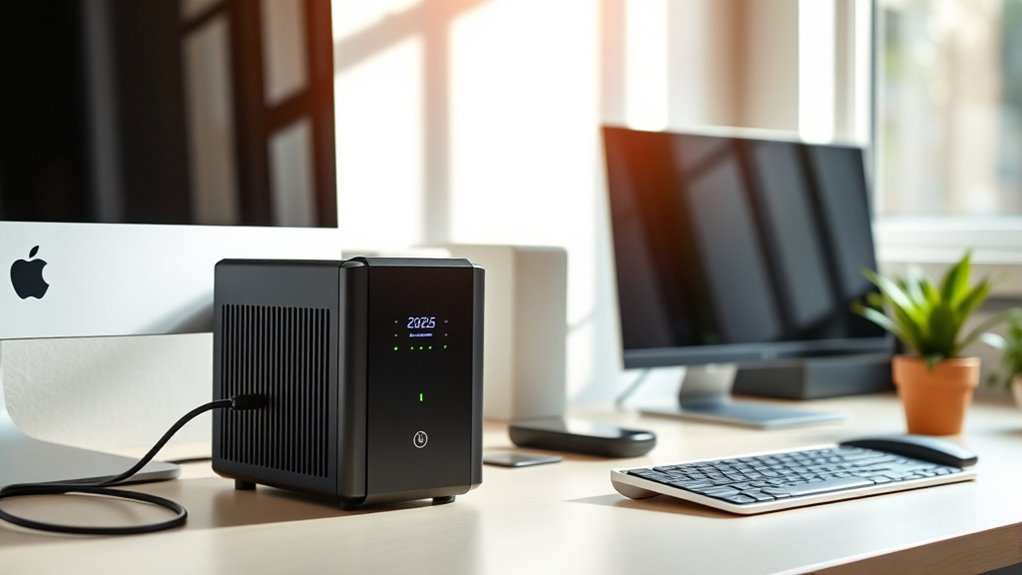

For a small-home uninterruptible power supply, I’d start with the CyberPower CP1500AVRLCD3 as the best overall choice for households that need more capacity and a clear status display. The CyberPower ST425 is a simpler fit for a router and a few small devices, while the GOLDENMATE 1000VA/600W lithium model stands out for buyers weighing battery longevity against upfront simplicity. The main tradeoff is between compact, lower-capacity units for essential electronics and larger models that can support a computer setup for longer or handle more equipment. Outlet layout, battery chemistry, and the power draw of your devices can matter as much as the VA rating. Read on for how all 13 options compare and which one suits your home.

Get privacy and security gear delivered free with Prime
- Fast, free delivery on millions of items
- Prime Video, Amazon Music and more included
- Member-only deals all year
Key Takeaways
- The CyberPower CP1500AVRLCD3 is the roundup’s broadest all-around fit: its 1500VA capacity and LCD make it better suited to a mixed home-office setup than the small standby units.
- Small loads do not need a large UPS: the CyberPower ST425, APC BE425M, and Tripp Lite BC350 are aimed at basic electronics, but their limited capacity leaves little room for adding higher-draw devices.
- Lithium models make a different ownership tradeoff: the GOLDENMATE 1000VA/600W and 1000VA/800W units pair lithium batteries with higher capacity, but buyers should compare their power needs and product specifications rather than assume the higher VA figure alone means longer runtime.
- Power quality separates computer-focused picks: the CP1500PFCLCD and APC BX1000M offer AVR, while the CP1500PFCLCD adds PFC sinewave output for equipment that benefits from that compatibility.
- Convenience varies beyond capacity: the SKE VL425 adds USB-C charging and an RJ45 port, while the CyberPower EC850LCD adds an LCD and energy-saving features, making their feature sets more distinctive than basic outlet counts.
| CyberPower ST425 Standby UPS Battery Backup and Surge Protector |  | Best Compact Pick | Maximum output: 260W | Outlets: 8 | Listed runtime: 1 minute | VIEW ON AMAZON | See Our Full Breakdown |
| APC 500VA/300W Backup Battery Power Supply for Home Office, Wi-Fi, BE500G3 |  | Best for Wi-Fi and Small Home Offices | Capacity: 500VA / 300W | Outlets: 6 total; 4 battery-backed | Runtime: Up to 17 minutes at 100W load | VIEW ON AMAZON | See Our Full Breakdown |
| CyberPower CP1500AVRLCD3 Intelligent LCD UPS Battery Backup |  | Best for a Computer and Entertainment Center | Capacity: 1500VA / 900W | Outlets: 12 | Listed runtime: 3 minutes | VIEW ON AMAZON | See Our Full Breakdown |
| APC BE600M1 UPS Battery Backup & Surge Protector for Computer, Router, NAS |  | Best for a Replaceable-Battery Setup | Capacity: 600VA / 330W | Outlets: 7 total; 5 battery-backed | Listed runtime: 3 minutes; source also cites 23 minutes at 100W | VIEW ON AMAZON | See Our Full Breakdown |
| GOLDENMATE 1000VA/600W Lithium UPS Battery Backup & Surge Protector |  | Best for Long-Term Battery Ownership | Capacity: 1000VA / 600W | Outlets: 8 | Listed runtime: 30 minutes | VIEW ON AMAZON | See Our Full Breakdown |
| GoldenMate 1000VA/800W Lithium UPS Battery Backup & Surge Protector |  | Best Long-Life Battery | Capacity: 1000VA / 800W | Output waveform: Pure sine wave | Outlets: 8 NEMA outlets | VIEW ON AMAZON | See Our Full Breakdown |
| APC BE425M UPS Battery Backup and Surge Protector for Small Electronics |  | Best for Routers and Modems | Capacity: 255W | Outlets: 6 | Runtime: 15 minutes at 100W | VIEW ON AMAZON | See Our Full Breakdown |
| CyberPower EC850LCD Ecologic UPS Battery Backup and Surge Protector |  | Best for Many Connected Devices | Capacity: 850VA / 510W | Outlets: 12 | Runtime: 2 minutes at full load | VIEW ON AMAZON | See Our Full Breakdown |
| SKE VL425 425VA/240W UPS Battery Backup and Surge Protector with AVR, 7 Outlets, USB and Type-C Charging, RJ45 Port |  | Best for Voltage Fluctuations | Capacity: 425VA / 240W | Outlets: 7 | Input voltage: 120V | VIEW ON AMAZON | See Our Full Breakdown |
| Staples TECH 650VA UPS Battery Backup, 8 Outlets, Surge Protection, Black |  | Best Basic Under-Desk Pick | Capacity: 650VA / 360W | Outlets: 8, including battery-backed and surge-only outlets | Input voltage: 120V | VIEW ON AMAZON | See Our Full Breakdown |
| APC 1000VA/600W Pro UPS Battery Backup for Office Electronics, AVR, BX1000M |  | Best for a Home Office with AVR | Capacity: 1000VA / 600W | Output voltage: 120V | Outlets: 8 | VIEW ON AMAZON | See Our Full Breakdown |
| CyberPower CP1500PFCLCD PFC Sinewave UPS Battery Backup and Surge Protector |  | Best for Active PFC Computers | Capacity: 1500VA / 1000W | Outlets: 12 NEMA 5-15R: 6 battery backup and surge protected, 6 surge protected | Batteries: 2 × 12V | VIEW ON AMAZON | See Our Full Breakdown |
| Eaton Tripp Lite BC350 350VA Small UPS Battery Backup Surge Protector |  | Best Compact Pick for a Router | Capacity: 350VA / 210W | Output voltage: 120V | Outlets: 6 total: 3 battery backup and 3 surge protection only | VIEW ON AMAZON | See Our Full Breakdown |
| uninterruptible power supply small home | Outlets | Capacity | Form factor | Warranty |
|---|---|---|---|---|
| CyberPower ST425 Standby UPS B | 8 | — | Compact | 3 years |
| APC 500VA/300W Backup Battery | 6 total; 4 battery-backed | 500VA / 300W | Compact, wall-mountable | 3 years |
| CyberPower CP1500AVRLCD3 Intel | 12 | 1500VA / 900W | — | 3 years |
| APC BE600M1 UPS Battery Backup | 7 total; 5 battery-backed | 600VA / 330W | — | — |
| GOLDENMATE 1000VA/600W Lithium | 8 | 1000VA / 600W | Tower | 10 years |
| GoldenMate 1000VA/800W Lithium | 8 NEMA outlets | 1000VA / 800W | Tower | 10 years |
| APC BE425M UPS Battery Backup | 6 | 255W | Compact, wall-mountable | — |
| CyberPower EC850LCD Ecologic U | 12 | 850VA / 510W | Compact | 3 years, including battery |
| SKE VL425 425VA/240W UPS Batte | 7 | 425VA / 240W | Compact | 1 year for battery; 2 years for machine |
| Staples TECH 650VA UPS Battery | 8, including battery-backed and surge-only outlets | 650VA / 360W | Compact | — |
| APC 1000VA/600W Pro UPS Batter | 8 | 1000VA / 600W | Tower | — |
| CyberPower CP1500PFCLCD PFC Si | 12 NEMA 5-15R: 6 battery backup and surge protected, 6 surge protected | 1500VA / 1000W | — | 3 years, including batteries |
| Eaton Tripp Lite BC350 350VA S | 6 total: 3 battery backup and 3 surge protection only | 350VA / 210W | — | — |
More Details on Our Top Picks
CyberPower ST425 Standby UPS Battery Backup and Surge Protector
For a small home where the goal is to keep a router, modem, and a few low-draw devices protected without giving up much space, the CyberPower ST425 is a straightforward fit. Its eight outlets offer more connection points than the APC BE500G3, though outlet count alone does not increase the number of devices it can support on battery. The deciding limit is its 260W output: this is better suited to networking gear and light electronics than a desktop setup with several power-hungry components. The listed runtime is only one minute at full load, so treat it as a brief bridge for saving work or handling a short interruption, not extended outage power. Its compact form and three-year warranty help in a tight home office, but buyers prioritizing longer runtime should compare it with the APC BE500G3.
Pros:- Eight outlets provide flexible connections for a compact setup.
- Compact form factor suits a small desk or home office.
- Provides battery backup and surge protection for connected electronics.
- Three-year warranty and UL safety certification are listed.
Cons:- The listed one-minute runtime at full load offers little time during an outage.
- 260W maximum output limits use with power-hungry computers or several devices.
- Lead-acid battery may need replacement over the unit’s service life.
Best for: Small-home owners who want a compact UPS for a router, modem, and other low-wattage electronics, with several outlets available.
Not ideal for: People who need extended backup, want to keep a powerful desktop running, or need a clearly stated longer runtime under their actual load.
- Maximum output:260W
- Outlets:8
- Listed runtime:1 minute
- Input/output voltage:120V
- Battery type:Lead acid
- Form factor:Compact
- Warranty:3 years
Our verdict“Choose the ST425 for compact, low-wattage home electronics, but pick the APC BE500G3 if longer stated runtime for networking gear matters more.”
APC 500VA/300W Backup Battery Power Supply for Home Office, Wi-Fi, BE500G3
The APC BE500G3 is the most targeted choice here for keeping a home’s internet connection alive through a short outage. Its listed up to 17 minutes at a 100W load gives networking equipment more breathing room than the CyberPower ST425’s stated one-minute full-load runtime, while the USB-A and USB-C ports can charge small devices without using an outlet. Four of its six outlets have battery backup; the other two provide surge protection only, so outlet placement matters when deciding what stays on during an outage. At 300W maximum output, it is not a general-purpose backup for a loaded desktop or several demanding devices. Compared with the APC BE600M1, it offers fewer outlets but a wall-mountable design and modern charging ports that better suit a compact router-and-phone station.
Pros:- Lists up to 17 minutes of runtime at a 100W load.
- Includes USB-C and USB-A charging ports.
- Wall-mountable compact design can free up desk space.
- Four battery-backed outlets plus two surge-only outlets separate backup needs from surge protection.
Cons:- 300W capacity is suited to small electronics rather than demanding computer setups.
- Only four of the six outlets receive battery backup.
- Runtime falls as connected load increases.
Best for: Remote workers and small-home residents who want to maintain Wi-Fi, modem, VOIP, or streaming equipment and charge a phone during brief outages.
Not ideal for: Buyers backing up a desktop workstation, several high-draw devices, or more than four battery-backed connections.
- Capacity:500VA / 300W
- Outlets:6 total; 4 battery-backed
- Runtime:Up to 17 minutes at 100W load
- USB charging:USB-C and USB-A
- Input/output voltage:120V
- Battery type:Lead acid
- Form factor:Compact, wall-mountable
- Warranty:3 years
Our verdict“Pick the BE500G3 for a compact internet-backup station with USB charging, rather than for powering a larger home computer setup.”
CyberPower CP1500AVRLCD3 Intelligent LCD UPS Battery Backup
Small homes with a desktop, monitor, and entertainment gear may need more capacity than compact networking-focused units can offer. The CyberPower CP1500AVRLCD3 raises the ceiling to 900W and supplies 12 outlets, making it a stronger match for a clustered computer or media setup than the APC BE600M1’s 330W limit. Its color LCD shows power and battery information, while automatic voltage regulation can help manage voltage fluctuations without switching to battery for every variation. That added headroom comes with a real space and weight cost: at 23.8 pounds, this mini-tower is less convenient to tuck away than the ST425 or either small APC unit. The listed runtime is three minutes, so the high output should not be mistaken for long outage coverage, particularly near full load.
Pros:- 900W output supports a more demanding computer or entertainment setup than the compact 300–330W models.
- Twelve outlets offer room for multiple connected devices.
- Color LCD displays power and battery information.
- Automatic voltage regulation helps handle voltage fluctuations.
Cons:- At 23.8 pounds, it is substantially heavier than compact home-networking UPS units.
- Listed runtime is three minutes, limiting backup at high loads.
- Simulated sine wave output may not suit every sensitive or specialized device.
Best for: Small-home computer users who need to connect a desktop and peripherals and value higher output, voltage regulation, and clear status information.
Not ideal for: People seeking a lightweight, discreet UPS for just a router, or buyers who need long runtime at high power during outages.
- Capacity:1500VA / 900W
- Outlets:12
- Listed runtime:3 minutes
- Output waveform:Simulated sine wave
- Voltage regulation:Automatic voltage regulation
- Dimensions:13.78 × 3.94 × 10.2 inches
- Weight:23.8 pounds
- Warranty:3 years
Our verdict“Choose this CyberPower when a small home needs higher output for a computer cluster, and skip it if compact size or lengthy backup matters more.”
APC BE600M1 UPS Battery Backup & Surge Protector for Computer, Router, NAS
The APC BE600M1 is a practical middle ground for a small home that needs more outlets than the BE500G3 but does not need the CyberPower CP1500AVRLCD3’s larger, heavier chassis. It has seven outlets, with five backed by battery and two providing surge protection only, plus a USB-A charging port. Its user-replaceable battery is the standout for buyers who would rather extend the unit’s service life than replace the entire UPS when the battery wears out. The tradeoff is modest capacity: at 330W, it can cover essential networking gear or a light computer setup, but not demanding equipment. The supplied data lists three minutes of runtime and also says 23 minutes at a 100W load, so I would not plan around a specific duration without checking the manufacturer’s load-based runtime information.
Pros:- Five battery-backed outlets plus two surge-only outlets support a mixed home setup.
- User-replaceable battery can extend the UPS’s useful life.
- 330W output exceeds the CyberPower ST425’s 260W limit.
- Compact form and USB-A charging suit a small workstation.
Cons:- 330W capacity is not intended for power-hungry equipment.
- Runtime information is inconsistent in the supplied data, so actual backup time needs verification.
- Battery replacement requires a separately purchased battery and some hands-on effort.
Best for: Small-home users who want five battery-backed outlets for a router, NAS, or modest computer setup and value the option to replace the battery.
Not ideal for: Buyers who need high wattage, predictable long runtime without checking load details, or USB-C charging.
- Capacity:600VA / 330W
- Outlets:7 total; 5 battery-backed
- Listed runtime:3 minutes; source also cites 23 minutes at 100W
- USB charging:USB Type-A
- Input/output voltage:120V
- Battery:User-replaceable lead-acid battery
- Dimensions:10.79 × 4.13 × 5.47 inches
- Weight:7.5 pounds
Our verdict“Choose the BE600M1 for a compact UPS with a replaceable battery and several backed-up outlets, but verify runtime for your intended load.”
GOLDENMATE 1000VA/600W Lithium UPS Battery Backup & Surge Protector
For a small-home buyer who wants a UPS that may spend years protecting a router, computer, or telecom equipment, the GOLDENMATE stands apart with a lithium iron phosphate battery rated for over 10 years of operation and more than 5,000 charge cycles. That battery chemistry and the listed 10-year warranty distinguish it from the lead-acid APC BE600M1 and CyberPower ST425, where battery replacement is a more near-term ownership issue. The unit also offers 600W output, eight outlets, and an LCD panel, giving it more capacity than those compact models without reaching the CP1500AVRLCD3’s 900W ceiling. Its stated 30-minute runtime is listed at full load, but buyers should confirm expected runtime against their actual devices. A fan may run during heavy battery use, and the tower form is less discreet than a small wall-mountable UPS.
Pros:- Lithium iron phosphate battery is rated for over 10 years and more than 5,000 charge cycles.
- 600W output provides more headroom than the APC BE600M1 and CyberPower ST425.
- Eight outlets and an LCD support a larger, easier-to-monitor setup.
- Listed 10-year warranty and safety certifications.
Cons:- Fan operation during heavy battery use may be audible in a quiet room.
- 600W output is below the CyberPower CP1500AVRLCD3’s 900W capacity.
- Tower design may take more visible floor or desk space than compact wall-mountable options.
Best for: Small-home owners who expect to keep a UPS for years and want lithium battery longevity, an LCD, and capacity for networking gear or a moderate computer setup.
Not ideal for: Buyers with very limited space, those sensitive to fan noise during battery operation, or anyone who needs more than 600W output.
- Capacity:1000VA / 600W
- Outlets:8
- Listed runtime:30 minutes
- Battery type:Lithium iron phosphate
- Input/output voltage:120V
- Form factor:Tower
- Warranty:10 years
Our verdict“Choose the GOLDENMATE if long battery service life and 600W capacity matter more than the smallest footprint or fan-free operation.”
GoldenMate 1000VA/800W Lithium UPS Battery Backup & Surge Protector
For a small home that needs to keep a computer and network gear running through more than a brief flicker, the 800W capacity and eight combined battery-backup and surge-protection outlets offer more headroom than compact models such as the APC BE425M. Its LiFePO4 battery is rated for over 5,000 charge cycles, a useful distinction for buyers who want a UPS built around long service life rather than a traditional lead-acid battery. The LCD makes load and battery status easier to check, while the fan activates automatically and is specified below 50 dB. The tradeoff is size: this tower is heavier and bulkier than wall-mountable or compact alternatives. Its stated 46-minute runtime is under full load, so actual backup time will depend on connected equipment; it is not a substitute for a generator during a long outage.
Pros:- LiFePO4 battery rated for over 5,000 charge cycles
- Pure sine wave output with 800W maximum power
- Eight outlets combine battery backup and surge protection
- LCD status panel and automatically activated quiet cooling fan
Cons:- Bulky tower form may be awkward in a small home office
- Listed runtime is about 46 minutes at full load, with less time possible at heavier use
- Battery charge time is listed as 10 hours
Best for: Small-home office users who want long-life battery chemistry, clear status information, and backup for a computer plus networking equipment.
Not ideal for: Buyers with very limited floor or desk space, or anyone who needs extended power for high-wattage equipment during a prolonged outage.
- Capacity:1000VA / 800W
- Output waveform:Pure sine wave
- Outlets:8 NEMA outlets
- Battery type:LiFePO4 lithium-ion
- Runtime:46 minutes (listed)
- Battery charge time:10 hours
- Form factor:Tower
- Output voltage:120V
- Warranty:10 years
Our verdict“Choose this GoldenMate if long-life battery chemistry and higher output matter more than a small footprint.”
APC BE425M UPS Battery Backup and Surge Protector for Small Electronics
The APC BE425M suits a small home where the main goal is keeping Wi-Fi and a modem alive long enough to ride out a short outage or save work. Its compact, wall-mountable design is easier to place near networking gear than the larger GoldenMate 1000VA/800W, and it provides six outlets for a modest set of low-power devices. APC lists up to 15 minutes of runtime at a 100W load, a useful reference for a router-and-modem setup, not a promise for a desktop computer. That limited 255W maximum output is the defining tradeoff: this model is for essential small electronics, not a full workstation or power-hungry equipment. The battery is listed with a three-year average life, and no replacement battery is included, so buyers should factor eventual replacement into long-term ownership.
Pros:- Compact, wall-mountable design saves floor and desk space
- Up to 15 minutes of runtime at a 100W load
- Six outlets provide battery backup and surge protection
- Wiring fault indicator helps flag an outlet issue
Cons:- 255W maximum output limits use to low-power electronics
- Runtime falls as connected load increases
- No replacement battery is included
Best for: Households that want a compact backup for a Wi-Fi router, modem, and a few other low-power devices.
Not ideal for: Desktop-PC users or anyone expecting long runtimes under heavier loads; its 255W ceiling and short rated runtime limit those uses.
- Capacity:255W
- Outlets:6
- Runtime:15 minutes at 100W
- Form factor:Compact, wall-mountable
- Output voltage:120V
- Battery charge time:8 hours
- Listed average battery life:3 years
- Dimensions:4.13 × 9.98 × 5.52 inches
- Weight:5.7 pounds
Our verdict“Pick the BE425M for a space-saving router-and-modem backup, not for a computer-heavy home office.”
CyberPower EC850LCD Ecologic UPS Battery Backup and Surge Protector
The CyberPower EC850LCD is the outlet-rich choice here: its 12 outlets make it easier to connect a computer setup and home-entertainment gear than the six-outlet APC BE425M. The LCD provides at-a-glance operating information, while ECO mode is designed to reduce power use by shutting off selected peripherals when the primary device is off or asleep. That can suit a small home office where several accessories share one UPS, though the outlet count may be more than a router-focused buyer needs. Capacity is listed at 510W, but the product data gives only about two minutes at full load; treat it as a short bridge to save work or shut equipment down, not as extended backup. Full management features require a USB connection, and the lead-acid battery has a shorter service-life profile than the GoldenMate’s LiFePO4 design.
Pros:- Twelve outlets accommodate a computer and multiple peripherals
- ECO mode can reduce power use for selected connected devices
- Multifunction LCD displays UPS status
- Three-year warranty includes the battery
Cons:- Listed runtime is about two minutes at full load
- USB connection is required for full management features
- Sealed lead-acid battery has a shorter service life than the GoldenMate’s LiFePO4 battery
Best for: Small-home users with a computer or entertainment setup and multiple peripherals who value outlet count, an LCD, and ECO power management.
Not ideal for: Buyers who need substantial runtime at high loads, want a simple router-only unit, or prefer a long-cycle lithium battery.
- Capacity:850VA / 510W
- Outlets:12
- Runtime:2 minutes at full load
- Battery type:Sealed lead acid
- Form factor:Compact
- Output voltage:230V (listed)
- Temperature range:32°F to 104°F
- Warranty:3 years, including battery
Our verdict“Choose the EC850LCD for a crowded workstation that needs organized connections and brief shutdown backup, not long outage coverage.”
SKE VL425 425VA/240W UPS Battery Backup and Surge Protector with AVR, 7 Outlets, USB and Type-C Charging, RJ45 Port
The SKE VL425 stands out for pairing a small UPS with automatic voltage regulation (AVR), which can help stabilize voltage fluctuations without relying on battery backup for every change. For a low-power setup with a router, surveillance camera, or modest computer, its seven outlets and USB and Type-C charging ports add useful flexibility that the APC BE425M does not match. Its 240W limit, however, puts a firm boundary around that setup: it is not the pick for a gaming desktop or several demanding devices. The lead-acid battery is replaceable, which is a practical ownership advantage over the APC model’s lack of an included replacement battery, but SKE does not provide a runtime figure in the supplied specs. Buyers should not assume it will keep a particular device running for a set period.
Pros:- AVR helps stabilize voltage fluctuations
- Seven outlets support a small collection of connected devices
- USB and Type-C ports add convenient charging options
- Replaceable lead-acid battery
Cons:- 240W maximum output is restrictive for high-power equipment
- No runtime figure is provided in the supplied product data
- Lead-acid battery may need replacement over time
Best for: Small-home users with a router, camera, or modest office equipment who want AVR plus USB and Type-C charging in one compact unit.
Not ideal for: Buyers running high-draw computers or requiring a guaranteed backup duration, since output is capped at 240W and runtime is unspecified.
- Capacity:425VA / 240W
- Outlets:7
- Input voltage:120V
- Output voltage:120V
- Battery type:Lead acid
- Form factor:Compact
- Weight:8 pounds
- Enclosure:Plastic
- Warranty:1 year for battery; 2 years for machine
Our verdict“Choose the SKE VL425 for low-power gear that benefits from AVR and charging ports, but look elsewhere if runtime certainty or higher output matters.”
Staples TECH 650VA UPS Battery Backup, 8 Outlets, Surge Protection, Black
For a simple desk setup, the Staples TECH 650VA offers eight outlets and 360W of capacity in a compact unit designed to fit under a workstation. That gives it more stated output than the APC BE425M, making it a more flexible match for a desktop, modem, and essential peripherals, though the actual runtime is not provided. The outlets are split between battery-backed and surge-only protection, so buyers need to check which devices they plug into each group; having eight outlets does not mean all eight run on battery during an outage. Its straightforward feature set may appeal to someone who wants basic outage and surge coverage rather than an LCD or specialized power management. The tradeoff is limited detail: battery replacement information is absent, and advanced users may find the specifications too sparse.
Pros:- Eight outlets accommodate a basic computer and peripheral setup
- 360W capacity exceeds the APC BE425M’s 255W limit
- Compact design is suited to placement under a desk
- Surge protection helps guard connected electronics against voltage spikes
Cons:- Runtime is not specified in the supplied product data
- Battery replacement details are not provided
- Some outlets are surge-only rather than battery-backed
Best for: Home-office users who need basic backup and surge protection for a desktop and peripherals in an under-desk setup.
Not ideal for: Buyers who need published runtime estimates, detailed battery replacement guidance, or advanced monitoring and management features.
- Capacity:650VA / 360W
- Outlets:8, including battery-backed and surge-only outlets
- Input voltage:120V
- Output voltage:120V
- Battery type:Lead acid
- Form factor:Compact
- Dimensions:7.88 × 14.13 × 4.63 inches
- Output wattage:360W
Our verdict“Pick this Staples model for straightforward under-desk protection, but choose a unit with published runtime and monitoring details if you need more control.”
APC 1000VA/600W Pro UPS Battery Backup for Office Electronics, AVR, BX1000M
I’d choose the APC BX1000M for a small home office where voltage fluctuations are as much a concern as short outages. Its automatic voltage regulation can correct some dips and surges without switching to battery, while the LCD makes power status easier to check than on a basic standby unit such as the CyberPower ST425. With eight outlets and a stated maximum output of 600W, it can cover a computer, router, and a few peripherals, but it is not meant to keep a high-draw setup running indefinitely. The listed runtime is up to 56 minutes, while the product details also cite up to 42 minutes at a 100W load; actual runtime depends on what is connected. The user-replaceable battery helps with maintenance, though replacement is a separate purchase, and the display may be hard to read in bright light.
Pros:- AVR helps manage voltage fluctuations without relying on battery backup for every correction.
- LCD displays real-time UPS status.
- Eight outlets provide room for several home-office devices.
- User-replaceable battery supports longer-term maintenance.
Cons:- Maximum output is limited to 600W, so it is not suited to high-draw equipment.
- Replacement battery must be purchased separately.
- LCD can be difficult to read in bright surroundings.
Best for: Home-office users with a computer, router, and external drives who want AVR, an at-a-glance status display, and a battery they can replace.
Not ideal for: Buyers running a high-wattage workstation or wanting a clearly specified runtime for a particular load; its 600W ceiling and load-dependent backup time may not fit.
- Capacity:1000VA / 600W
- Output voltage:120V
- Outlets:8
- Form factor:Tower
- Runtime:Up to 56 minutes (listed); up to 42 minutes at 100W load (also listed)
- Battery charge time:8 hours
- Battery average life:3 years
- Input amperage:15A
Our verdict“Choose the BX1000M for a small office that benefits from AVR and replaceable-battery upkeep, but not for a setup that needs more than 600W of backup capacity.”
CyberPower CP1500PFCLCD PFC Sinewave UPS Battery Backup and Surge Protector
For a small home with a desktop that uses an active PFC power supply, I’d put the CyberPower CP1500PFCLCD ahead of the APC BX1000M: its sine-wave output is designed for that type of computer power supply, and its 1000W limit leaves more headroom than the APC’s 600W. The 12 outlets also let me keep backup-protected equipment separate from devices that only need surge protection: six outlets provide both, while six are surge-only. A tilting color LCD gives detailed status information, and USB-A and USB-C ports can charge mobile devices. Those features come with a larger, heavier unit—24.9 pounds—so it is less convenient to move or tuck beside a compact desk than the Eaton Tripp Lite BC350. Its two batteries and three-year warranty, including batteries, suit buyers seeking a fuller-featured setup, but its capacity may be unnecessary for a router-and-modem-only home.
Pros:- Sine-wave output is suited to computers with active PFC power supplies.
- 1000W maximum output offers more headroom than the APC BX1000M.
- Twelve outlets split between battery backup and surge protection provide flexible connections.
- Color LCD, USB-A and USB-C ports, and a three-year warranty add useful home-office features.
Cons:- At 24.9 pounds, it is cumbersome to move compared with compact options such as the Eaton Tripp Lite BC350.
- Only six outlets provide battery backup; the other six are surge-protection only.
- Its capacity and feature set may be more than a low-power home network needs.
Best for: Small-home users with an active PFC desktop computer, networking gear, and several devices who want sine-wave output and a mix of backup and surge-only outlets.
Not ideal for: People protecting only a router and a few low-power devices, or anyone who needs a lightweight UPS that is easy to reposition.
- Capacity:1500VA / 1000W
- Outlets:12 NEMA 5-15R: 6 battery backup and surge protected, 6 surge protected
- Batteries:2 × 12V
- Input plug and cord:NEMA 5-15P right-angle plug; 5-foot cord
- Dimensions:14 × 3.9 × 11 inches
- Weight:24.9 pounds
- Display:Color LCD, tilts up to 22 degrees
- USB ports:1 Type-A and 1 Type-C
- Warranty:3 years, including batteries
Our verdict“Pick this CyberPower when an active PFC desktop and multiple devices justify sine-wave output and higher capacity, and skip it for a lightweight, router-focused setup.”
Eaton Tripp Lite BC350 350VA Small UPS Battery Backup Surge Protector
The Eaton Tripp Lite BC350 is the compact, low-power choice in this group: its 350VA/210W capacity fits a router, modem, or a small desktop better than a power-hungry workstation. It has six outlets, split evenly between battery backup and surge protection, and its desktop or wall-mount format gives it placement flexibility that the heavier CyberPower CP1500PFCLCD lacks. The listed backup time—up to 13 minutes for a small desktop—points to short outages and time to save work, not extended operation; higher-power loads will reduce that window. Noise filtering adds protection against electromagnetic and radio-frequency interference, and the internal battery is replaceable. Compared with the APC BX1000M, this Eaton is easier to fit into a tight space but offers far less output and no listed AVR. Its alarm only sounds for low battery or faults, which may be easy to miss.
Pros:- Compact design supports desktop or wall-mount installation.
- Three battery-backup outlets and three surge-only outlets cover a modest setup.
- EMI and RFI filtering helps reduce electrical noise reaching connected devices.
- Replaceable internal battery supports maintenance.
Cons:- 210W capacity and 350VA rating limit the connected load.
- Backup is listed as up to 13 minutes for a small desktop, with less time possible for higher-power equipment.
- Alarm sounds only for low battery or faults and may be missed.
Best for: Small-home users who need a compact UPS for a router, modem, or low-power desktop and value desktop or wall-mount placement.
Not ideal for: Owners of high-power computers or multiple devices that need simultaneous battery backup; its 210W output and three backup outlets are limiting.
- Capacity:350VA / 210W
- Output voltage:120V
- Outlets:6 total: 3 battery backup and 3 surge protection only
- Line efficiency:>98%
- Backup time:Up to 13 minutes for small desktop computers
- Installation:Desktop or wall-mount
- Battery:Replaceable internal battery
- Filtering:Electromagnetic and radio-frequency interference filtering
Our verdict“Choose the BC350 for a space-constrained home network or low-power desktop, but step up to the APC BX1000M or CyberPower CP1500PFCLCD if you need more output or backup-protected outlets.”

How We Picked
I ranked these UPS units around the jobs a small home actually needs them to do: keeping a router online, protecting a computer and peripherals, or providing backup for a compact group of essential electronics. I weighed stated capacity and output, power-conditioning features such as AVR and sinewave output, outlet layout, status and charging features, and how approachable the unit is for a buyer who wants a simple setup. Battery chemistry and maintenance expectations also shaped the comparison, since a lithium model and a conventional battery unit can suit different ownership priorities.
The ranking favors useful balance over the highest capacity or longest feature list. Higher-capacity models place well when their output and monitoring can serve a wider range of home setups, while compact units rank well for focused, low-load jobs but not as whole-room backup. I also accounted for the tradeoffs: an extra port does not make a low-capacity UPS suitable for a demanding computer, and an LCD or AVR feature is only valuable when it matches the buyer’s equipment and needs. I did not treat VA ratings as runtime guarantees; actual backup time depends on connected load and manufacturer runtime data.
| uninterruptible power supply small home | Battery type | Form factor |
|---|---|---|
| CyberPower ST425 Standby UPS B | Lead acid | Compact |
| APC 500VA/300W Backup Battery | Lead acid | Compact, wall-mountable |
| CyberPower CP1500AVRLCD3 Intel | — | — |
| APC BE600M1 UPS Battery Backup | — | — |
| GOLDENMATE 1000VA/600W Lithium | Lithium iron phosphate | Tower |
| GoldenMate 1000VA/800W Lithium | LiFePO4 lithium-ion | Tower |
| APC BE425M UPS Battery Backup | — | Compact, wall-mountable |
| CyberPower EC850LCD Ecologic U | Sealed lead acid | Compact |
| SKE VL425 425VA/240W UPS Batte | Lead acid | Compact |
| Staples TECH 650VA UPS Battery | Lead acid | Compact |
| APC 1000VA/600W Pro UPS Batter | — | Tower |
| CyberPower CP1500PFCLCD PFC Si | — | — |
| Eaton Tripp Lite BC350 350VA S | — | — |
Factors to Consider When Choosing Uninterruptible Power Supply Small Home
Before choosing a UPS, I’d define what must stay on during an outage and what can shut down. That decision helps prevent a common mismatch: buying a compact model for equipment that draws too much power, or paying for capacity that a router and modem will never use. These factors help narrow the field beyond headline VA numbers.
Match Capacity to the Devices You Need to Keep Running
List the devices that need backup and check their wattage, not just their number of plugs. A router, modem, and small network switch usually draw far less than a desktop computer with a monitor, so the same UPS will provide very different backup time for each setup. Keep some capacity in reserve rather than choosing a unit that only just covers the listed load; that leaves room for a replacement router or an added monitor. Remember that VA and watts describe different limits, and the watt rating can be the one that constrains a real setup. Don’t interpret a larger VA number as a promise of a particular number of minutes. Use the manufacturer’s runtime chart for your expected load before relying on a UPS for planned shutdown time.
Choose What Needs Battery Backup, Not Just Surge Protection
UPS outlets often divide into battery-backed outlets and surge-only outlets, so count the right kind before buying. Put equipment that must remain powered—such as a modem or computer—on battery backup, and reserve surge-only outlets for devices that do not need to stay on. This distinction matters in a small home where a printer, speakers, or chargers can quickly occupy the available sockets. Avoid plugging in high-draw appliances such as heaters or kettles, even if an outlet is physically available. Check spacing as well: bulky adapters can block neighboring sockets and reduce the usable outlet count. A compact power strip may help with layout, but it must not push the UPS beyond its rated load.
Decide Whether AVR or Sinewave Output Matters for Your Setup
Automatic voltage regulation can correct some voltage fluctuations without switching to battery, which may reduce unnecessary battery use in homes with unstable mains power. Sinewave output can be a useful compatibility feature for certain computer power supplies, especially when the equipment maker specifies it. Those features do not replace capacity planning, and they may be unnecessary for a modest router-and-modem setup. Check the power supply requirements of sensitive equipment rather than assuming every computer needs the same output type. If your home has frequent brownouts, AVR may matter more than extra convenience ports. If outages are the main concern, compare backup capacity and runtime at your load instead.
Compare Battery Type and Long-Term Ownership Needs
Battery chemistry affects more than the initial purchase decision: it can shape expected service life, replacement planning, and how much maintenance you are willing to manage. Lithium UPS models may appeal to buyers looking for a different battery-life profile, while traditional battery units are a familiar choice with established replacement options. Check whether the battery is user-replaceable, what replacement parts are available, and what the manufacturer says about service life and operating conditions. Heat can shorten battery life, so a UPS should not be tucked into an enclosed, poorly ventilated cabinet. A compact design is convenient only if its placement still allows airflow and access. Compare total ownership requirements rather than assuming one battery type is automatically better for every home.
Prioritize Monitoring and Ports Only When They Solve a Problem
An LCD can make it easier to see load, battery status, or alerts, which is helpful if you want to check the system at a glance. A simpler indicator setup may be enough for a UPS that quietly protects a router under a desk. USB charging and USB-C ports can reduce adapter clutter, but they do not increase the power available to devices on battery-backed outlets. Network protection ports can be useful when a wired connection is part of the setup, though they should not be mistaken for a substitute for proper network equipment protection. Check whether the unit’s size, cable placement, and outlet orientation fit the intended spot. Pay for added features when they reduce friction in your actual setup, not just because they appear on the specification list.
Plan for Safe Shutdown and the Limits of Home Backup
A small UPS is meant to bridge short outages and give equipment time to stay connected or shut down safely; it is not a home battery system. If keeping internet access during an outage is the goal, remember that local backup cannot keep an internet provider’s neighborhood equipment running. For a computer, consider whether you need software-assisted automatic shutdown or whether you can respond to an alert yourself. Test the setup after installation by checking that the intended devices are on battery-backed outlets and that the UPS reports a load within its limits. Avoid waiting for a real outage to discover that a cable or device was connected to the wrong outlet. Keep expectations tied to the connected load and the model’s published runtime data.
Frequently Asked Questions
Which UPS size is enough for a router and modem in a small home?
Start by checking the wattage on both devices or their power adapters, then add the loads together and compare that total with the UPS watt limit. A compact unit such as the CyberPower ST425 or APC BE425M may suit a low-draw network setup, but runtime depends on the actual connected load and battery condition. Leave room for a small switch or other device only if the combined wattage stays within the UPS rating. Use the manufacturer’s runtime chart for the best estimate, since VA capacity alone cannot tell you how long the network gear will stay powered. Also check that the outlets you plan to use are battery-backed.
Can I plug a desktop computer and monitor into a small-home UPS?
Yes, if the UPS can support their combined watt draw, but a compact model intended for small electronics may not have enough output for a desktop setup. Check the power supply and monitor specifications, then compare their likely draw with the UPS watt rating and runtime chart. The CyberPower CP1500AVRLCD3, CyberPower CP1500PFCLCD, and APC BX1000M are more appropriate starting points for computer-focused comparisons than the smallest units in this list. Keep the router or modem on backup only if capacity remains. Avoid connecting a laser printer or other high-draw equipment to the battery-backed outlets.
Is a lithium UPS worth choosing over a conventional battery model?
It can be a good fit if battery longevity and reduced replacement planning are priorities, but compare the manufacturer’s battery-life claims, warranty, and replacement policy before deciding. This roundup includes two GOLDENMATE lithium models with different stated output capacities, so the right choice depends on the load rather than battery chemistry alone. Conventional units may suit buyers who prefer familiar replacement options and a more basic setup. In either case, heat, ventilation, and time spent at high load affect battery upkeep. Compare the full ownership details instead of assuming lithium is automatically the better match.
Will a UPS keep my home internet working during a power outage?
A UPS can power your modem and router while its battery has capacity, but it cannot keep your internet connection alive if the provider’s local network equipment loses power. For the best chance of staying online, back up the modem, router, and any required network switch, while checking their combined load against the UPS rating. A compact unit may provide useful backup for this light load, though its runtime still depends on the devices and battery state. If the internet connection is essential, ask your provider about outage behavior in your area. Do not assume that a powered router alone guarantees an active connection.
Should I choose AVR or pure sinewave output for home electronics?
AVR is useful when voltage fluctuations are a concern because it can correct some changes without relying on battery backup. Sinewave output can matter for equipment whose power supply calls for that type of output, so check the computer or device maker’s guidance. The CyberPower CP1500PFCLCD is the clearest fit in this lineup for buyers specifically seeking PFC sinewave output, while the APC BX1000M also lists AVR. For a router-and-modem setup, capacity and runtime may matter more than either feature. Do not pay for an output feature without a matching need in your equipment or power conditions.
Conclusion
For most small homes balancing a computer setup and everyday electronics, I’d choose the CyberPower CP1500AVRLCD3 as best overall for its higher capacity and LCD monitoring. The CyberPower ST425 is my best value-style pick for a basic, low-load setup, while the GOLDENMATE 1000VA/800W is the premium choice for buyers who want a lithium model with more stated output than its 600W sibling. Beginners who need straightforward backup for small electronics can start with the APC BE425M, provided its capacity matches their devices. For a computer setup that benefits from PFC sinewave output, I’d look at the CyberPower CP1500PFCLCD; for USB-C charging and an RJ45 port, the SKE VL425 has a more specialized feature mix. Check the watt load and runtime chart before choosing, since the best fit depends on what you need to keep on—not simply the largest VA number.