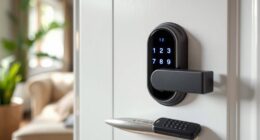
Managing logs and audit trails in your smart home is crucial for security, troubleshooting, and accountability. By recording device activities, voice commands, and system events, you create a clear trail that helps identify unauthorized access or system issues quickly. Synchronizing logs across devices offers an extensive overview, making troubleshooting easier. Proper log management also supports compliance and early threat detection. Keep exploring to find out how to implement these practices effectively for a safer, more reliable smart home.
Key Takeaways
- Maintain detailed records of device activities and user interactions for security and troubleshooting.
- Use synchronized logs across devices to create comprehensive audit trails for multi-device commands.
- Enable anomaly detection and early threat identification through continuous log monitoring.
- Support compliance and security standards by preserving secure, accessible logs for investigation.
- Facilitate quick troubleshooting and accountability with clear, unified logs of system events.
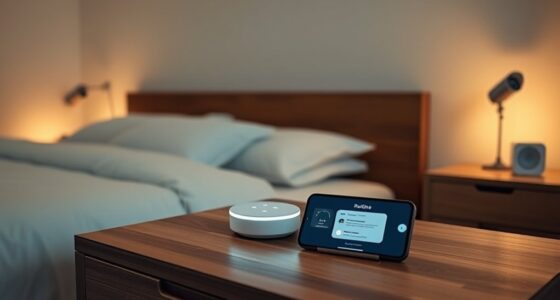
In today’s smart homes, managing logs and maintaining audit trails are essential for guaranteeing security and troubleshooting issues. These logs serve as a record of all device activities, user interactions, and system events, providing clarity and accountability. When you rely on voice control to operate your smart devices, every command is logged, creating a detailed trail that helps you track how and when commands are executed. This becomes especially useful if something doesn’t work as expected or if there’s a security concern. For instance, if your smart lock unlocks unexpectedly, the logs can reveal whether a voice command was issued or if there was an unauthorized attempt. By keeping detailed records, you can quickly pinpoint issues and take appropriate action. Proper log management is vital for ensuring the integrity and usefulness of your audit trails.
Device synchronization plays a fundamental role in maintaining thorough logs. When multiple devices are synchronized, their activities are interconnected and recorded cohesively. This synchronization guarantees that actions across your smart home ecosystem are logged in a unified manner, making it easier to trace events that involve different devices. Imagine you ask your voice assistant to turn on the lights, lock the door, and adjust the thermostat. Thanks to device synchronization, all these actions are logged together, creating an integrated audit trail. This not only simplifies troubleshooting but also enhances security by providing a clear picture of device interactions. It helps you verify that commands are executed correctly and confirms whether devices respond as intended.
Maintaining proper logs and audit trails also supports compliance with security standards, especially if your smart home systems are connected to broader networks or used in a commercial setting. Regularly reviewing these logs allows you to identify unusual activity early, such as repeated failed login attempts or unauthorized device access. Automation tools can be set up to alert you when anomalies are detected, allowing you to respond swiftly. Additionally, keeping a secure backup of logs ensures that even if a device is compromised or experiences a failure, you still have access to important historical data.
Frequently Asked Questions
How Secure Are Smart-Home Log Files From Hacking?
Smart-home log files can be quite secure if you guarantee strong encryption protocols and user authentication. When logs are encrypted, even if hackers access them, they can’t read the data without the decryption key. Additionally, implementing robust user authentication keeps unauthorized users out. Regularly updating your security measures and using multi-factor authentication further enhances protection, making it considerably harder for hackers to compromise your logs.
Can Users Customize Audit Trail Access Permissions?
Yes, you can customize audit trail access permissions. Many smart-home systems offer user permission settings, allowing you to control who can view or modify log files. Access control customization lets you restrict sensitive data to trusted individuals, enhancing security. By adjusting these settings, you guarantee that only authorized users can access specific logs, giving you peace of mind and greater control over your smart home’s privacy and security.
What Is the Typical Data Retention Period for Logs?
Typically, data retention policies for logs vary but often range from 30 to 90 days, depending on the organization’s needs. You should check your specific log archival practices, as some systems retain logs longer for compliance or security reasons. Regularly reviewing and updating your retention periods guarantees you balance data accessibility with privacy and storage considerations, helping you manage logs efficiently and securely.
How Do I Recover Lost or Deleted Log Data?
If you’ve lost or deleted log data, you can recover it through your cloud backup, which stores copies securely. First, access your cloud storage and restore the relevant logs. Make certain data encryption was active to protect your information during backup and recovery. Regularly updating backups helps prevent data loss, so consider setting automated backups to safeguard your logs and make recovery easier when needed.
Are There Industry Standards for Smart-Home Log Management?
Imagine you’re designing a smart-home system; industry standards guide your approach. You should follow best practices like privacy compliance and data encryption to safeguard user data. For example, many companies adopt standards from ISO/IEC 27001 for information security management. These standards ensure logs are securely stored, access is controlled, and audit trails are maintained, helping you meet legal requirements and build user trust.
Conclusion
As you implement smart-home log management and audit trails, remember you’re building more than just a record—you’re creating a safeguard for what matters most. But with every log, every trail, there’s an unseen layer of complexity waiting to be uncovered. Will your system be ready when the unexpected strikes? Stay vigilant, because in the world of smart homes, the true surprises often lie just beneath the surface, ready to change everything in an instant.