
📊 Full opportunity report: Appointment no-show recovery planner for therapy practices on IdeaNavigator AI — validation score, market gap, and execution plan.
TL;DR
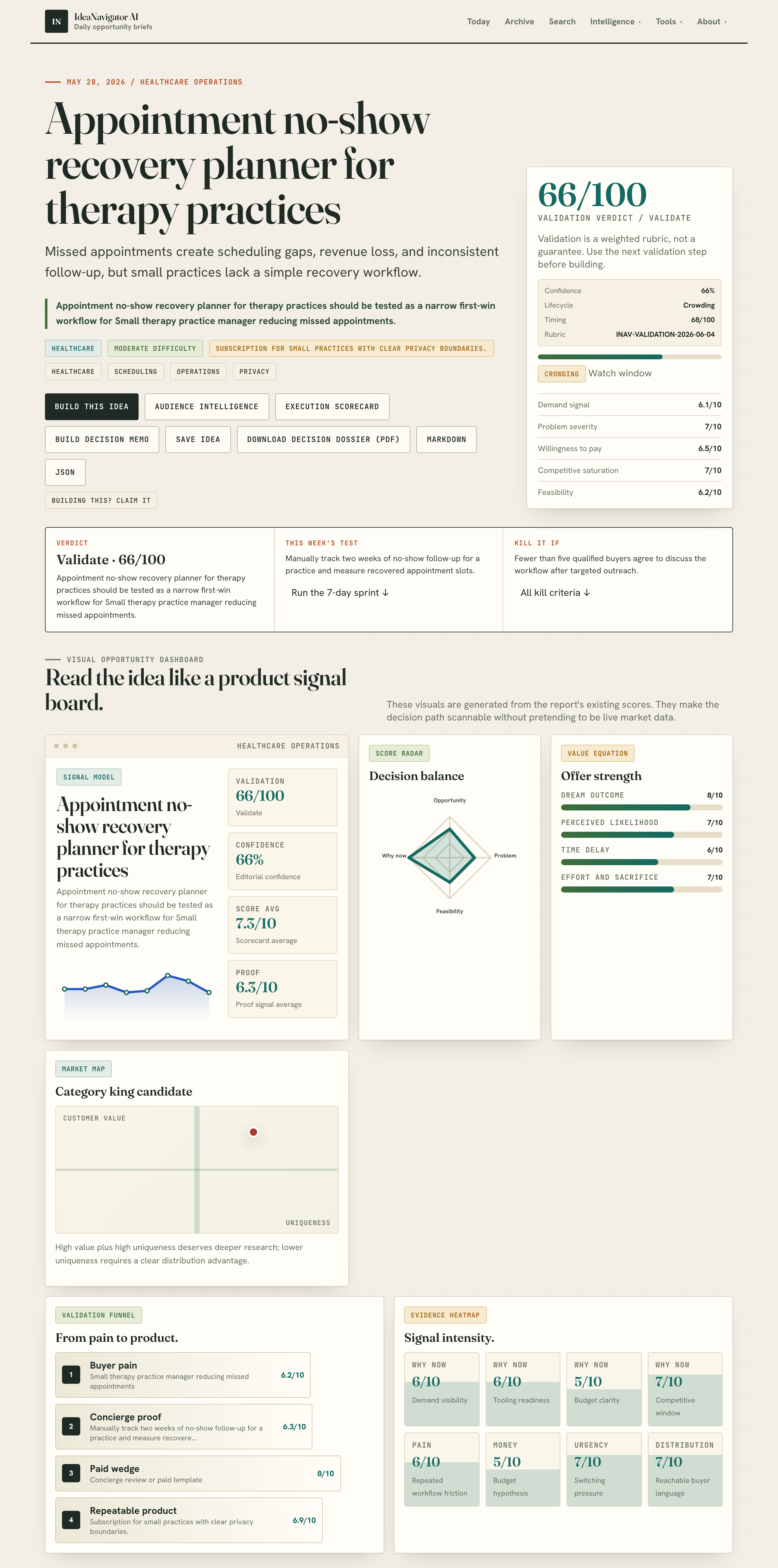
A proposed no-show recovery planner for small therapy practices is entering testing. It aims to log missed appointments, automate reminders, and facilitate rescheduling to recover lost revenue.
A new appointment no-show recovery planner for small therapy practices is being tested as a simple workflow to reduce missed visits and improve follow-up, addressing a common operational challenge.
The proposed tool is a non-clinical workflow designed specifically for small therapy practices. It logs missed appointments, tracks reminder attempts, monitors rescheduling status, and uses outreach templates to reconnect with patients. The goal is to help practices recover appointment slots that are lost due to no-shows, thereby reducing revenue loss and scheduling gaps. This initiative is in the testing phase, where practices will manually track two weeks of follow-up efforts to measure effectiveness. The planner will be offered as a subscription service, with a focus on maintaining patient privacy and operational simplicity. The development is driven by the need for operational tools that enhance reminders and follow-up without making clinical claims, making it suitable for small practice environments.Operational Efficiency and Revenue Recovery for Small Practices
This new workflow tool could significantly improve the efficiency of small therapy practices by reducing missed appointments, which are a major source of revenue loss and scheduling inefficiencies. By automating and streamlining follow-up efforts, practices can recover lost appointment slots and improve patient engagement without adding clinical complexity. This development responds to a clear market need for simple, effective operational tools that do not require extensive technical infrastructure, potentially leading to better financial stability for small practices and enhanced patient care continuity.
Physical Therapy Script Tracker Planner Stickers, Functional Script Planner Stickers, Physical Therapy Reminder, Physical Therapy Appointment, Pick A Color (Mix Colors)
Physical Therapy Script Planner Stickers
As an affiliate, we earn on qualifying purchases.
As an affiliate, we earn on qualifying purchases.
Addressing a Common Challenge in Therapy Practice Management
Missed appointments are a widespread issue in healthcare, particularly for small therapy practices that lack dedicated operational staff. Traditionally, practices rely on manual follow-up, which is time-consuming and often ineffective. Recent efforts in healthcare operations have focused on automation and workflow improvements, but many solutions are tailored for larger organizations. This new no-show recovery planner aims to fill a gap by providing a lightweight, easy-to-implement tool specifically designed for small practices, with validation through manual tracking over a two-week period. The concept builds on existing trends toward operational automation and patient engagement tools in healthcare.“This workflow aims to help small practices recover missed appointment slots without adding clinical complexity.”
— an anonymous researcher
patient rescheduling automation tools
As an affiliate, we earn on qualifying purchases.
As an affiliate, we earn on qualifying purchases.
Effectiveness and Adoption Risks Still Unclear
It is not yet confirmed how effective the no-show recovery planner will be in practice. The validation process involves manual tracking over two weeks, but broader adoption and long-term impact remain untested. Additionally, questions remain about how practices will integrate this workflow into existing systems and whether patients will respond positively to outreach efforts. Further data is needed to assess potential privacy concerns and the scalability of the solution.
The Sanford Guide to Antimicrobial Therapy 2010: Library Edition
Used Book in Good Condition
As an affiliate, we earn on qualifying purchases.
As an affiliate, we earn on qualifying purchases.
Next Steps Include Broader Testing and Validation
Practices participating in the initial testing will manually track no-show follow-up efforts over a two-week period to measure how many appointment slots are recovered. Based on these results, developers plan to refine the workflow and consider wider deployment. Future steps may include integrating the planner into existing scheduling platforms and conducting larger-scale trials to evaluate its impact on practice revenue and patient engagement. The goal is to establish a scalable, easy-to-use tool tailored for small practices’ operational needs.patient engagement follow-up templates
As an affiliate, we earn on qualifying purchases.
As an affiliate, we earn on qualifying purchases.
Key Questions
How does the no-show recovery planner work?
The planner logs missed appointments, automates reminder attempts, tracks rescheduling, and uses outreach templates to reconnect with patients, aiming to recover lost appointment slots.
Is this tool suitable for all therapy practices?
The current focus is on small therapy practices that lack dedicated operational workflows. Its simplicity makes it most suitable for practices with limited administrative resources.
When will the tool be available for wider use?
After successful validation over the initial two-week testing period, developers plan to refine the workflow and consider broader deployment, but an exact release date has not been announced.
Will patient privacy be protected?
Yes, the planner is designed with clear privacy boundaries, focusing on operational tracking without making clinical claims, to ensure compliance with privacy standards.
Can practices customize the outreach templates?
Yes, the workflow includes outreach templates that can be customized to fit each practice’s communication style and patient preferences.
Source: IdeaNavigator AI