
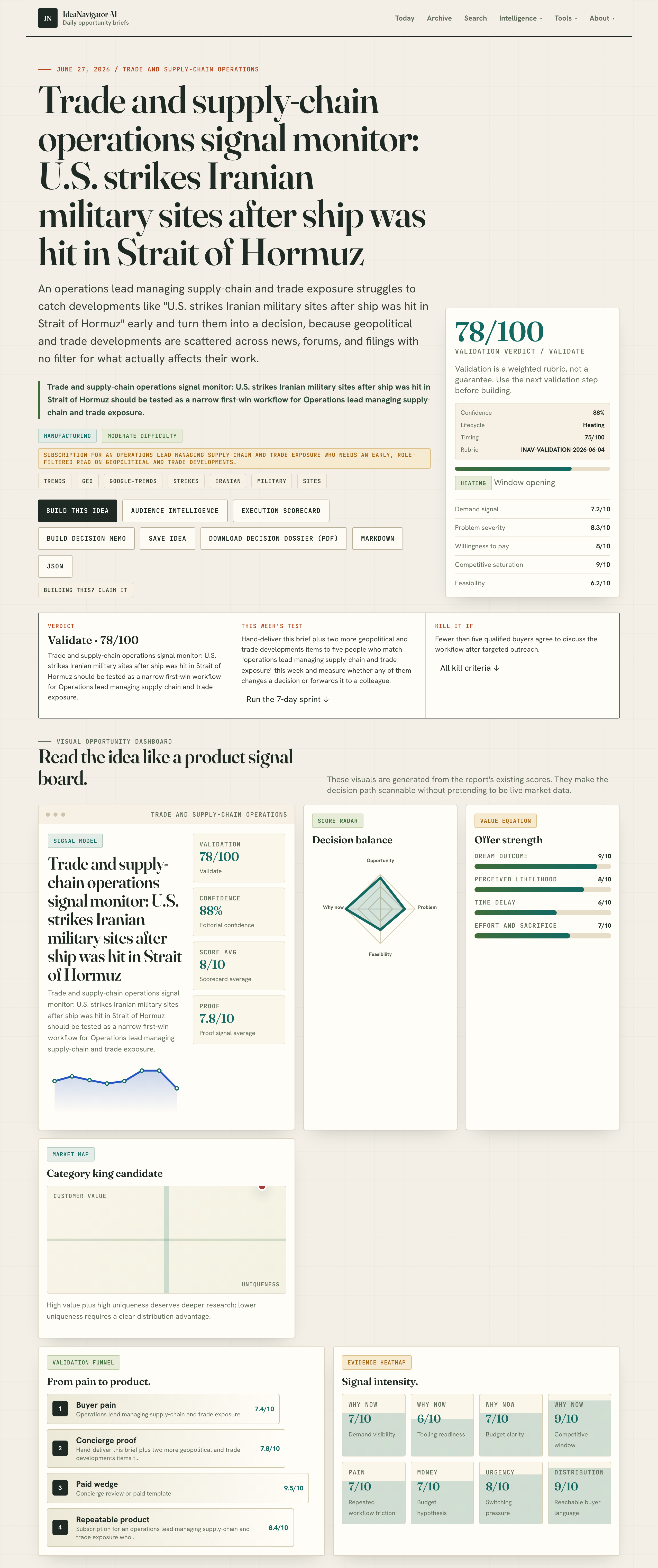
📊 Full opportunity report: Trade and supply-chain operations signal monitor: U.S. strikes Iranian military sites after ship was hit in Strait of Hormuz on IdeaNavigator AI — validation score, market gap, and execution plan.
TL;DR
The U.S. conducted strikes on Iranian military sites after a ship was hit in the Strait of Hormuz. This escalation influences global trade and supply chains, with ongoing developments to monitor.
The United States has launched military strikes against Iranian military sites in response to an attack on a commercial ship in the Strait of Hormuz, according to U.S. officials. This development marks a significant escalation in regional tensions and has immediate implications for global trade and supply chains.
U.S. military sources confirmed that targeted strikes were carried out on Iranian military installations in southern Iran early this morning. The strikes followed an incident yesterday where a commercial vessel was hit in the Strait of Hormuz, an area critical for global oil and trade routes. The incident has prompted the U.S. to respond with military action, aiming to deter further attacks and protect maritime traffic.
Iranian officials have not officially confirmed the strikes but have condemned the attack on the vessel, which they claim was a false flag operation by the U.S. or its allies. The ship involved was reportedly a commercial oil tanker, and the attack caused minor damage but no casualties, according to maritime authorities. The U.S. government has stated that the strikes are a defensive measure and part of efforts to stabilize the region.
Trade and supply chain operations monitoring tools have flagged this escalation as a significant geopolitical event potentially affecting shipping routes, insurance costs, and global oil prices. The incident underscores the vulnerability of the Strait of Hormuz, through which approximately 20% of the world’s oil passes daily.
Impact on Global Trade and Supply Chains
This escalation has immediate implications for global trade, especially oil shipments passing through the Strait of Hormuz. Disruptions or increased tensions could lead to higher insurance premiums, delays, and rerouting of ships, affecting supply chains worldwide. For operations managers, early awareness of such geopolitical events is critical to managing trade exposure and contingency planning.
maritime trade route monitoring tools
As an affiliate, we earn on qualifying purchases.
As an affiliate, we earn on qualifying purchases.
Regional Tensions and Recent Escalations in Iran-U.S. Relations
Over recent months, tensions between Iran and the U.S. have escalated, with incidents involving maritime security and military posturing. The Strait of Hormuz has been a flashpoint for conflict, with previous attacks on vessels and Iranian threats to close the strait if sanctions persist. The attack on the ship yesterday and the subsequent U.S. strikes mark a notable intensification of this ongoing conflict, which has heightened concerns among global trade stakeholders.
“The strikes were targeted at Iranian military facilities in response to recent attacks on maritime traffic. Our actions are aimed at deterring further aggression.”
— U.S. Defense Department spokesperson

Supply Chain Management For Dummies
As an affiliate, we earn on qualifying purchases.
As an affiliate, we earn on qualifying purchases.
Unconfirmed Details and Regional Responses
It is still unclear whether Iran will retaliate further or if the strikes will escalate into broader conflict. The exact targets and scale of the military operations are not fully confirmed, and regional responses remain unpredictable as Iran has issued strong rhetoric but has not yet taken additional military action.

Medical Alert System for Seniors – Advanced Mini Device with Automatic Fall Detection, 24/7 Monitoring, GPS Tracking, Emergency Alert Pendant Necklace, SOS Button, Caregiver App, Waterproof | Black
- Easy Activation and Subscription: Simple setup with $39.99/month plan
- 24/7 Emergency Monitoring: Round-the-clock assistance with rapid response
- Nationwide Cellular Coverage: Operates on Verizon and AT&T networks
As an affiliate, we earn on qualifying purchases.
As an affiliate, we earn on qualifying purchases.
Monitoring Regional Developments and Shipping Impacts
Next steps include close monitoring of Iran’s response, potential escalation in military activity, and updates on the impact on maritime traffic through the Strait of Hormuz. Industry stakeholders and governments are expected to issue travel advisories and adjust shipping routes accordingly. Diplomatic efforts may also increase to de-escalate tensions.

Optimus 3.0 GPS Tracker – Over 1 Month Battery – with Heavy Duty Waterproof Case and Powerful Magnets for Vehicles and Assets
- Real-Time GPS Tracking: Accurate and discreet tracking
- Heavy Duty Magnet Case: Secure attachment to vehicles
- Long Battery Life: Up to 2 months on a single charge
As an affiliate, we earn on qualifying purchases.
As an affiliate, we earn on qualifying purchases.
Key Questions
What prompted the U.S. to launch strikes against Iran?
The strikes were in response to an attack on a commercial ship in the Strait of Hormuz, which the U.S. attributes to Iran or its proxies. The goal is to deter further attacks on maritime traffic.
How might this affect global oil prices?
Disruptions in the Strait of Hormuz could lead to increased oil prices due to supply concerns and higher insurance premiums for shipping through the area.
Are there any signs of Iran retaliating further?
Iran has issued strong rhetoric condemning the strikes but has not yet taken additional military action. The situation remains fluid and unpredictable.
What should supply-chain operators do now?
Operators should monitor geopolitical developments closely, consider rerouting options, and prepare contingency plans for potential delays or disruptions in maritime shipping.
Is this the start of a broader conflict?
It is not yet clear whether this escalation will lead to wider conflict. Regional responses and Iran’s next moves are still uncertain, and diplomatic efforts may influence the outcome.
Source: IdeaNavigator AI